



Community hub
Recent from talks
Knowledge base stats:
Talk channels stats:
Members stats:
Algebraic variety
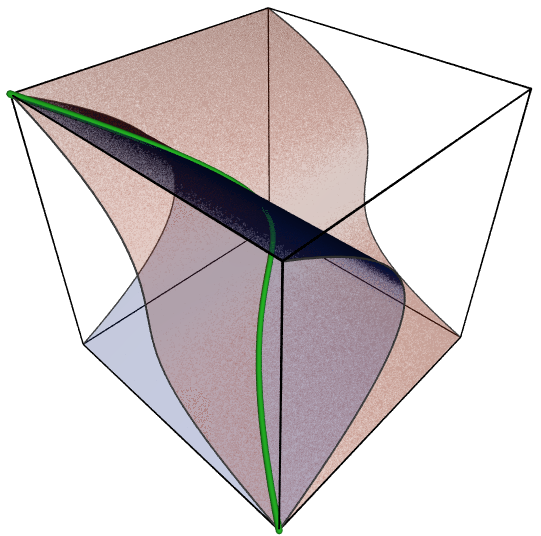
Algebraic varieties are the central objects of study in algebraic geometry, a sub-field of mathematics. Classically, an algebraic variety is defined as the set of solutions of a system of polynomial equations over the real or complex numbers. Modern definitions generalize this concept in several different ways, while attempting to preserve the geometric intuition behind the original definition.
Conventions regarding the definition of an algebraic variety differ slightly. For example, some definitions require an algebraic variety to be irreducible, which means that it is not the union of two smaller sets that are closed in the Zariski topology. Under this definition, non-irreducible algebraic varieties are called algebraic sets. Other conventions do not require irreducibility.
The fundamental theorem of algebra establishes a link between algebra and geometry by showing that a monic polynomial (an algebraic object) in one variable with complex number coefficients is determined by the set of its roots (a geometric object) in the complex plane. Generalizing this result, Hilbert's Nullstellensatz provides a fundamental correspondence between ideals of polynomial rings and algebraic sets. Using the Nullstellensatz and related results, mathematicians have established a strong correspondence between questions on algebraic sets and questions of ring theory. This correspondence is a defining feature of algebraic geometry.
Many algebraic varieties are differentiable manifolds, but an algebraic variety may have singular points while a differentiable manifold cannot. Algebraic varieties can be characterized by their dimension. Algebraic varieties of dimension one are called algebraic curves and algebraic varieties of dimension two are called algebraic surfaces.
In the context of modern scheme theory, an algebraic variety over a field is an integral (irreducible and reduced) scheme over that field whose structure morphism is separated and of finite type.
An affine variety over an algebraically closed field is conceptually the easiest type of variety to define, which will be done in this section. Next, one can define projective and quasi-projective varieties in a similar way. The most general definition of a variety is obtained by patching together smaller quasi-projective varieties. It is not obvious that one can construct genuinely new examples of varieties in this way, but Nagata gave an example of such a new variety in the 1950s.
For an algebraically closed field K and a natural number n, let An be an affine n-space over K, identified to through the choice of an affine coordinate system. The polynomials f in the ring K[x1, ..., xn] can be viewed as K-valued functions on An by evaluating f at the points in An, i.e. by choosing values in K for each xi. For each set S of polynomials in K[x1, ..., xn], define the zero-locus Z(S) to be the set of points in An on which the functions in S simultaneously vanish, that is to say

A subset V of An is called an affine algebraic set if V = Z(S) for some S. A nonempty affine algebraic set V is called irreducible if it cannot be written as the union of two proper algebraic subsets. An irreducible affine algebraic set is also called an affine variety. (Some authors use the phrase affine variety to refer to any affine algebraic set, irreducible or not.)
Hub AI
Algebraic variety AI simulator
(@Algebraic variety_simulator)
Algebraic variety
Algebraic varieties are the central objects of study in algebraic geometry, a sub-field of mathematics. Classically, an algebraic variety is defined as the set of solutions of a system of polynomial equations over the real or complex numbers. Modern definitions generalize this concept in several different ways, while attempting to preserve the geometric intuition behind the original definition.
Conventions regarding the definition of an algebraic variety differ slightly. For example, some definitions require an algebraic variety to be irreducible, which means that it is not the union of two smaller sets that are closed in the Zariski topology. Under this definition, non-irreducible algebraic varieties are called algebraic sets. Other conventions do not require irreducibility.
The fundamental theorem of algebra establishes a link between algebra and geometry by showing that a monic polynomial (an algebraic object) in one variable with complex number coefficients is determined by the set of its roots (a geometric object) in the complex plane. Generalizing this result, Hilbert's Nullstellensatz provides a fundamental correspondence between ideals of polynomial rings and algebraic sets. Using the Nullstellensatz and related results, mathematicians have established a strong correspondence between questions on algebraic sets and questions of ring theory. This correspondence is a defining feature of algebraic geometry.
Many algebraic varieties are differentiable manifolds, but an algebraic variety may have singular points while a differentiable manifold cannot. Algebraic varieties can be characterized by their dimension. Algebraic varieties of dimension one are called algebraic curves and algebraic varieties of dimension two are called algebraic surfaces.
In the context of modern scheme theory, an algebraic variety over a field is an integral (irreducible and reduced) scheme over that field whose structure morphism is separated and of finite type.
An affine variety over an algebraically closed field is conceptually the easiest type of variety to define, which will be done in this section. Next, one can define projective and quasi-projective varieties in a similar way. The most general definition of a variety is obtained by patching together smaller quasi-projective varieties. It is not obvious that one can construct genuinely new examples of varieties in this way, but Nagata gave an example of such a new variety in the 1950s.
For an algebraically closed field K and a natural number n, let An be an affine n-space over K, identified to through the choice of an affine coordinate system. The polynomials f in the ring K[x1, ..., xn] can be viewed as K-valued functions on An by evaluating f at the points in An, i.e. by choosing values in K for each xi. For each set S of polynomials in K[x1, ..., xn], define the zero-locus Z(S) to be the set of points in An on which the functions in S simultaneously vanish, that is to say
A subset V of An is called an affine algebraic set if V = Z(S) for some S. A nonempty affine algebraic set V is called irreducible if it cannot be written as the union of two proper algebraic subsets. An irreducible affine algebraic set is also called an affine variety. (Some authors use the phrase affine variety to refer to any affine algebraic set, irreducible or not.)