
Recent from talks
Fundamental theorem of algebra
Knowledge base stats:
Talk channels stats:
Members stats:
Fundamental theorem of algebra
The fundamental theorem of algebra, also called d'Alembert's theorem or the d'Alembert–Gauss theorem, states that every non-constant single-variable polynomial with complex coefficients has at least one complex root. This includes polynomials with real coefficients, since every real number is a complex number with its imaginary part equal to zero.
Equivalently (by definition), the theorem states that the field of complex numbers is algebraically closed.
The theorem is also stated as follows: every non-zero, single-variable, degree n polynomial with complex coefficients has, counted with multiplicity, exactly n complex roots. The equivalence of the two statements can be proven through the use of successive polynomial division.
Despite its name, it is not fundamental for modern algebra; it was named when algebra was synonymous with the theory of equations.
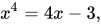
Peter Roth, in his book Arithmetica Philosophica (published in 1608, at Nürnberg, by Johann Lantzenberger), wrote that a polynomial equation of degree n (with real coefficients) may have n solutions. Albert Girard, in his book L'invention nouvelle en l'Algèbre (published in 1629), asserted that a polynomial equation of degree n has n solutions, but he did not state that they had to be real numbers. Furthermore, he added that his assertion holds "unless the equation is incomplete", where "incomplete" means that at least one coefficient is equal to 0. However, when he explains in detail what he means, it is clear that he actually believes that his assertion is always true; for instance, he shows that the equation although incomplete, has four solutions (counting multiplicities): 1 (twice), and


As will be mentioned again below, it follows from the fundamental theorem of algebra that every non-constant polynomial with real coefficients can be written as a product of polynomials with real coefficients whose degrees are either 1 or 2. However, in 1702 Leibniz erroneously said that no polynomial of the type x4 + a4 (with a real and distinct from 0) can be written in such a way. Later, Nikolaus Bernoulli made the same assertion concerning the polynomial x4 − 4x3 + 2x2 + 4x + 4, but he got a letter from Euler in 1742 in which it was shown that this polynomial is equal to
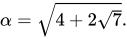
with Euler also pointed out that
A first attempt at proving the theorem was made by d'Alembert in 1746, but his proof was incomplete. Among other problems, it assumed implicitly a theorem (now known as Puiseux's theorem), which would not be proved until more than a century later and using the fundamental theorem of algebra. Other attempts were made by Euler (1749), de Foncenex (1759), Lagrange (1772), and Laplace (1795). These last four attempts assumed implicitly Girard's assertion; to be more precise, the existence of solutions was assumed and all that remained to be proved was that their form was a + bi for some real numbers a and b. In modern terms, Euler, de Foncenex, Lagrange, and Laplace were assuming the existence of a splitting field of the polynomial p(z).
Hub AI
Fundamental theorem of algebra AI simulator
(@Fundamental theorem of algebra_simulator)
Fundamental theorem of algebra
The fundamental theorem of algebra, also called d'Alembert's theorem or the d'Alembert–Gauss theorem, states that every non-constant single-variable polynomial with complex coefficients has at least one complex root. This includes polynomials with real coefficients, since every real number is a complex number with its imaginary part equal to zero.
Equivalently (by definition), the theorem states that the field of complex numbers is algebraically closed.
The theorem is also stated as follows: every non-zero, single-variable, degree n polynomial with complex coefficients has, counted with multiplicity, exactly n complex roots. The equivalence of the two statements can be proven through the use of successive polynomial division.
Despite its name, it is not fundamental for modern algebra; it was named when algebra was synonymous with the theory of equations.
Peter Roth, in his book Arithmetica Philosophica (published in 1608, at Nürnberg, by Johann Lantzenberger), wrote that a polynomial equation of degree n (with real coefficients) may have n solutions. Albert Girard, in his book L'invention nouvelle en l'Algèbre (published in 1629), asserted that a polynomial equation of degree n has n solutions, but he did not state that they had to be real numbers. Furthermore, he added that his assertion holds "unless the equation is incomplete", where "incomplete" means that at least one coefficient is equal to 0. However, when he explains in detail what he means, it is clear that he actually believes that his assertion is always true; for instance, he shows that the equation although incomplete, has four solutions (counting multiplicities): 1 (twice), and
As will be mentioned again below, it follows from the fundamental theorem of algebra that every non-constant polynomial with real coefficients can be written as a product of polynomials with real coefficients whose degrees are either 1 or 2. However, in 1702 Leibniz erroneously said that no polynomial of the type x4 + a4 (with a real and distinct from 0) can be written in such a way. Later, Nikolaus Bernoulli made the same assertion concerning the polynomial x4 − 4x3 + 2x2 + 4x + 4, but he got a letter from Euler in 1742 in which it was shown that this polynomial is equal to
with Euler also pointed out that
A first attempt at proving the theorem was made by d'Alembert in 1746, but his proof was incomplete. Among other problems, it assumed implicitly a theorem (now known as Puiseux's theorem), which would not be proved until more than a century later and using the fundamental theorem of algebra. Other attempts were made by Euler (1749), de Foncenex (1759), Lagrange (1772), and Laplace (1795). These last four attempts assumed implicitly Girard's assertion; to be more precise, the existence of solutions was assumed and all that remained to be proved was that their form was a + bi for some real numbers a and b. In modern terms, Euler, de Foncenex, Lagrange, and Laplace were assuming the existence of a splitting field of the polynomial p(z).