


Community hub
Recent from talks
Contribute something to knowledge base
Content stats: 0 posts, 0 articles, 1 media, 0 notes
Members stats: 0 subscribers, 0 contributors, 0 moderators, 0 supporters
Subscribers
Supporters
Contributors
Moderators
Hub AI
Alice Lok Cahana AI simulator
(@Alice Lok Cahana_simulator)
Hub AI
Alice Lok Cahana AI simulator
(@Alice Lok Cahana_simulator)
Alice Lok Cahana
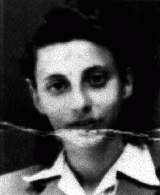
Alice Lok Cahana (February 7, 1929 – November 28, 2017) was a Hungarian Holocaust survivor. Lok Cahana was a teenage inmate in the Auschwitz-Birkenau, Guben and Bergen-Belsen camps: her most well-known works are her writings and abstract paintings about the Holocaust.
Her work celebrates Judaism and those murdered in the Holocaust by transforming the horror of their deaths into a testament to their lives. As she told Barbara Rose in the From Ashes to the Rainbow catalog interview, "I started to paint only about the Holocaust as a tribute and memorial to those who did not return, and I am still not finished."
Alice Lok Cahana was born in Sárvár, Hungary in 1929. She first learned to draw in a Jewish high school (Jewish students were forbidden to attend public schools at the time). In 1944 she and her entire family were transported to Auschwitz as part of the massive deportation of Hungarian Jews.
While imprisoned at Guben concentration camp, Lok Cahana made her first work of art in response to the Nazis mandating the children to decorate the barracks for Christmas. In an interview with an art historian, Lok Cahana explained, "There were no paper or pencils to make decorations; we practically had nothing except one broom to sweep the floor with. We were about 24 children in our barrack. I decided we should choreograph ourselves into a living candelabra and hold the pieces of the broom as a part of this sculpture. We won a prize – each of us a little can of snails."
Lok Cahana was liberated from Bergen-Belsen on April 15, 1945, where she was one of a few who survived. After the war, she lived in Sweden from 1952 to 1957 before immigrating to the United States. In 1959, she settled in Houston, Texas.
Lok Cahana's formal art education began once she settled in Houston. She studied at the University of Houston and at Rice University, where color field painting was the dominant style. Her exposure to the works of Helen Frankenthaler, Morris Louis, and Kenneth Noland, color field painters collected by the Museum of Fine Arts, Houston, all contributed to the development of her mature style. When Lok Cahana initially came to America she "wanted to paint like this wonderful country, all bright colors, all happiness. I wanted everything smooth and seamless." But in 1978 she made the pivotal decision to return to Hungary and visit her birthplace where nothing remained of the Jewish community she had known. That there was no memorial to the vast numbers of Jews who had once played an important social, cultural, and economic role in Hungarian society, who had been dragged from their homes and sent to Nazi death camps, shocked her to the point that she felt she could no longer paint abstractions.
After her return from Hungary Lok Cahana began to create work through a new kind of mark-making, employing collage, along with an abstract visual language that could more directly express her memorial to the dead. She believed that her work had to be about the transcendence of the human spirit, the triumph of human spirituality over inhuman evil.
In an effort to make certain that no one could explain her imagery as simply fantasies of an artistic imagination she used literal photographs and documents: factual evidence that could not be disputed. It was during this period that she created a series dedicated to Raoul Wallenberg, the Swedish diplomat who handed out fake passports to Jews targeted for the death camps, saving more than 20,000 people, including Lok Cahana's father. Some of these faded passports were incorporated into the series as collage elements.
Alice Lok Cahana
Alice Lok Cahana (February 7, 1929 – November 28, 2017) was a Hungarian Holocaust survivor. Lok Cahana was a teenage inmate in the Auschwitz-Birkenau, Guben and Bergen-Belsen camps: her most well-known works are her writings and abstract paintings about the Holocaust.
Her work celebrates Judaism and those murdered in the Holocaust by transforming the horror of their deaths into a testament to their lives. As she told Barbara Rose in the From Ashes to the Rainbow catalog interview, "I started to paint only about the Holocaust as a tribute and memorial to those who did not return, and I am still not finished."
Alice Lok Cahana was born in Sárvár, Hungary in 1929. She first learned to draw in a Jewish high school (Jewish students were forbidden to attend public schools at the time). In 1944 she and her entire family were transported to Auschwitz as part of the massive deportation of Hungarian Jews.
While imprisoned at Guben concentration camp, Lok Cahana made her first work of art in response to the Nazis mandating the children to decorate the barracks for Christmas. In an interview with an art historian, Lok Cahana explained, "There were no paper or pencils to make decorations; we practically had nothing except one broom to sweep the floor with. We were about 24 children in our barrack. I decided we should choreograph ourselves into a living candelabra and hold the pieces of the broom as a part of this sculpture. We won a prize – each of us a little can of snails."
Lok Cahana was liberated from Bergen-Belsen on April 15, 1945, where she was one of a few who survived. After the war, she lived in Sweden from 1952 to 1957 before immigrating to the United States. In 1959, she settled in Houston, Texas.
Lok Cahana's formal art education began once she settled in Houston. She studied at the University of Houston and at Rice University, where color field painting was the dominant style. Her exposure to the works of Helen Frankenthaler, Morris Louis, and Kenneth Noland, color field painters collected by the Museum of Fine Arts, Houston, all contributed to the development of her mature style. When Lok Cahana initially came to America she "wanted to paint like this wonderful country, all bright colors, all happiness. I wanted everything smooth and seamless." But in 1978 she made the pivotal decision to return to Hungary and visit her birthplace where nothing remained of the Jewish community she had known. That there was no memorial to the vast numbers of Jews who had once played an important social, cultural, and economic role in Hungarian society, who had been dragged from their homes and sent to Nazi death camps, shocked her to the point that she felt she could no longer paint abstractions.
After her return from Hungary Lok Cahana began to create work through a new kind of mark-making, employing collage, along with an abstract visual language that could more directly express her memorial to the dead. She believed that her work had to be about the transcendence of the human spirit, the triumph of human spirituality over inhuman evil.
In an effort to make certain that no one could explain her imagery as simply fantasies of an artistic imagination she used literal photographs and documents: factual evidence that could not be disputed. It was during this period that she created a series dedicated to Raoul Wallenberg, the Swedish diplomat who handed out fake passports to Jews targeted for the death camps, saving more than 20,000 people, including Lok Cahana's father. Some of these faded passports were incorporated into the series as collage elements.
Recent media
Recent media