


Community hub
Recent from talks
Contribute something to knowledge base
Content stats: 0 posts, 0 articles, 1 media, 0 notes
Members stats: 0 subscribers, 0 contributors, 0 moderators, 0 supporters
Subscribers
Supporters
Contributors
Moderators
Hub AI
Alidade AI simulator
(@Alidade_simulator)
Hub AI
Alidade AI simulator
(@Alidade_simulator)
Alidade
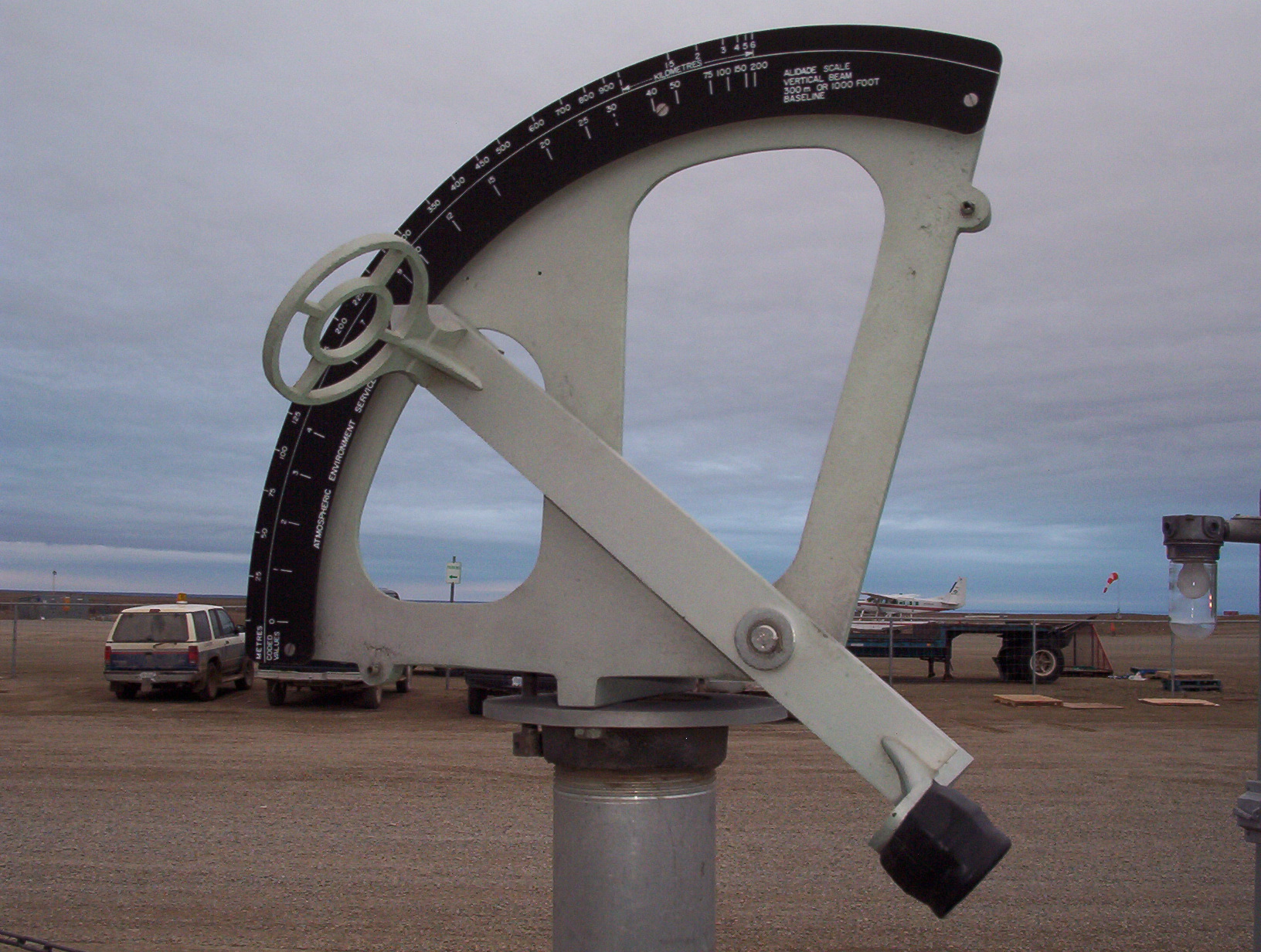
An alidade (/ˈæ.lɪ.deɪd/) (archaic forms include alhidade, alhidad, alidad)[citation needed] or a turning board is a device that allows one to sight a distant object and use the line of sight to perform a task. This task can be, for example, to triangulate a scale map on site using a plane table drawing of intersecting lines in the direction of the object from two or more points or to measure the angle and horizontal distance to the object from some reference point's polar measurement. Angles measured can be horizontal, vertical or in any chosen plane.
The alidade sighting ruler was originally a part of many types of scientific and astronomical instrument. At one time, some alidades, particularly using circular graduations as on astrolabes, were also called diopters. With modern technology, the name is applied to complete instruments such as the 'plane table alidade'.
The word in Arabic (الحلقة العضدية, al-ḥilqa al-ʿaḍudiyya, lit. 'the ruler'), signifies the same device. In Greek and Latin, it is respectively called δίοπτρα, "dioptra", and linea fiduciae, "fiducial line".
The earliest alidades consisted of a bar, rod or similar component with a vane on each end. Each vane (also called a pinnule or pinule) has a hole, slot or other indicator through which one can view a distant object. There may also be a pointer or pointers on the alidade to indicate a position on a scale. Alidades have been made of wood, ivory, brass and other materials.
The figure on the left displays drawings that attempt to show the general forms of various alidades that can be found on many antique instruments. Real alidades of these types could be much more decorative, revealing the maker's artistic talents as well as his technical skills. In the terminology of the time, the edge of an alidade at which one reads a scale or draws a line is called a fiducial edge.
Alidade B in the diagram shows a straight, flat bar with a vane at either end. No pointers are used. The vanes are not centred on the bar but offset so that the sight line coincides with the edge of the bar.
The vanes have a rectangular hole in each with a fine wire held vertically in the opening. To use the alidade, the user sights an object and lines it up with the wires in each vane. This type of alidade could be found on a plane table, graphometer or similar instrument.
Alidades A and C are similar to B but have a slit or circular hole without a wire. In the diagram, the openings are exaggerated in size to show the shape; they would be smaller in a real alidade, perhaps 2 mm or so in width. One can look through the openings and line the openings up with the object of interest in the distance. With a small opening, the error in sighting the object is small. However, if a dim object such as a star is observed through a small hole, the image is difficult to see.
Alidade
An alidade (/ˈæ.lɪ.deɪd/) (archaic forms include alhidade, alhidad, alidad)[citation needed] or a turning board is a device that allows one to sight a distant object and use the line of sight to perform a task. This task can be, for example, to triangulate a scale map on site using a plane table drawing of intersecting lines in the direction of the object from two or more points or to measure the angle and horizontal distance to the object from some reference point's polar measurement. Angles measured can be horizontal, vertical or in any chosen plane.
The alidade sighting ruler was originally a part of many types of scientific and astronomical instrument. At one time, some alidades, particularly using circular graduations as on astrolabes, were also called diopters. With modern technology, the name is applied to complete instruments such as the 'plane table alidade'.
The word in Arabic (الحلقة العضدية, al-ḥilqa al-ʿaḍudiyya, lit. 'the ruler'), signifies the same device. In Greek and Latin, it is respectively called δίοπτρα, "dioptra", and linea fiduciae, "fiducial line".
The earliest alidades consisted of a bar, rod or similar component with a vane on each end. Each vane (also called a pinnule or pinule) has a hole, slot or other indicator through which one can view a distant object. There may also be a pointer or pointers on the alidade to indicate a position on a scale. Alidades have been made of wood, ivory, brass and other materials.
The figure on the left displays drawings that attempt to show the general forms of various alidades that can be found on many antique instruments. Real alidades of these types could be much more decorative, revealing the maker's artistic talents as well as his technical skills. In the terminology of the time, the edge of an alidade at which one reads a scale or draws a line is called a fiducial edge.
Alidade B in the diagram shows a straight, flat bar with a vane at either end. No pointers are used. The vanes are not centred on the bar but offset so that the sight line coincides with the edge of the bar.
The vanes have a rectangular hole in each with a fine wire held vertically in the opening. To use the alidade, the user sights an object and lines it up with the wires in each vane. This type of alidade could be found on a plane table, graphometer or similar instrument.
Alidades A and C are similar to B but have a slit or circular hole without a wire. In the diagram, the openings are exaggerated in size to show the shape; they would be smaller in a real alidade, perhaps 2 mm or so in width. One can look through the openings and line the openings up with the object of interest in the distance. With a small opening, the error in sighting the object is small. However, if a dim object such as a star is observed through a small hole, the image is difficult to see.
Recent media
Recent media