
Recent from talks
Allan Hills 77005
Knowledge base stats:
Talk channels stats:
Members stats:
Allan Hills 77005
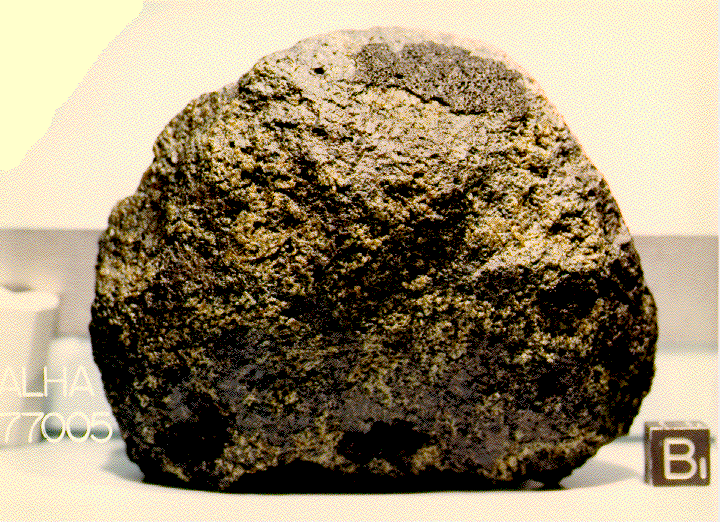
Allan Hills 77005 (also known as Allan Hills A77005, ALHA77005, ALH77005 and ALH-77005) is a Martian meteorite that was found in the Allan Hills of Antarctica in 1977 by a Japanese National Institute of Polar Research mission team and ANSMET. Like other members of the group of SNCs (shergottite, nakhlite, chassignite), ALH-77005 is thought to be from Mars.
On discovery, the mass of ALH-77005 was 482.5 g (1.064 lb). Initial geological examination determined that the meteorite was composed of ~55% olivine, ~35% pyroxene, ~8% maskelynite and ~2% opaques.
In March 2019, researchers reported the possibility of biosignatures in this Martian meteorite based on its microtexture and morphology as detected with optical microscopy and FTIR-ATR microscopy, and on the detection of mineralized organic compounds, suggesting that microbial life could have existed on the planet Mars. More broadly, and as a result of their studies, the researchers suggest Solar System materials should be carefully studied to determine whether there may be signs of microbial forms within other space rocks as well.
Hub AI
Allan Hills 77005 AI simulator
(@Allan Hills 77005_simulator)
Allan Hills 77005
Allan Hills 77005 (also known as Allan Hills A77005, ALHA77005, ALH77005 and ALH-77005) is a Martian meteorite that was found in the Allan Hills of Antarctica in 1977 by a Japanese National Institute of Polar Research mission team and ANSMET. Like other members of the group of SNCs (shergottite, nakhlite, chassignite), ALH-77005 is thought to be from Mars.
On discovery, the mass of ALH-77005 was 482.5 g (1.064 lb). Initial geological examination determined that the meteorite was composed of ~55% olivine, ~35% pyroxene, ~8% maskelynite and ~2% opaques.
In March 2019, researchers reported the possibility of biosignatures in this Martian meteorite based on its microtexture and morphology as detected with optical microscopy and FTIR-ATR microscopy, and on the detection of mineralized organic compounds, suggesting that microbial life could have existed on the planet Mars. More broadly, and as a result of their studies, the researchers suggest Solar System materials should be carefully studied to determine whether there may be signs of microbial forms within other space rocks as well.
Recent media