


Community hub
Recent from talks
Knowledge base stats:
Talk channels stats:
Members stats:
Allen Taflove
Allen Taflove (June 14, 1949 – April 25, 2021) was a full professor in the Department of Electrical and Computer Engineering of Northwestern's McCormick School of Engineering, since 1988. Since 1972, he pioneered basic theoretical approaches, numerical algorithms, and applications of finite-difference time-domain (FDTD) computational solutions of Maxwell's equations. He coined the descriptors "finite difference time domain" and "FDTD" in the 1980 paper, "Application of the finite-difference time-domain method to sinusoidal steady-state electromagnetic penetration problems." In 1990, he was the first person to be named a Fellow of the Institute of Electrical and Electronics Engineers (IEEE) in the FDTD area. Taflove was the recipient of the 2014 IEEE Electromagnetics Award with the following citation: "For contributions to the development and application of finite-difference time-domain (FDTD) solutions of Maxwell's equations across the electromagnetic spectrum." He was a Life Fellow of the IEEE and a Fellow of the Optical Society (OSA). His OSA Fellow citation reads: "For creating the finite-difference time-domain method for the numerical solution of Maxwell's equations, with crucial application to the growth and current state of the field of photonics."
In 2011, Taflove was named as an inductee of the Amateur Radio Hall of Fame by CQ Magazine in recognition of his research achievements in computational electrodynamics. He had been an FCC-licensed amateur radio operator since 1963 holding the call sign WA9JLV, and had credited amateur radio with spurring his interest in electrical engineering in general, and electromagnetic fields and waves in particular. He had served for many years as the trustee of the Northwestern University Amateur Radio Society, which operates the FCC-licensed club station W9BGX.[citation needed]
Taflove was born in Chicago, Illinois on June 14, 1949. He received B.S., M.S., and Ph.D. degrees in electrical engineering from Northwestern University in 1971, 1972, and 1975, respectively.
Since about 2000, FDTD techniques have emerged as a primary means to computationally model many scientific and engineering problems dealing with electromagnetic wave interactions with material structures. Current FDTD modeling applications range from near-DC (ultralow-frequency geophysics involving the entire Earth-ionosphere waveguide) through microwaves (radar signature technology, antennas, wireless communications devices, digital interconnects, biomedical imaging/treatment) to visible light (photonic crystals, nanoplasmonics, solitons, microscopy and lithography, and biophotonics). Both commercial FDTD software suites and free-software/open-source or closed-source FDTD projects are available which permit detailed Maxwell's equations modeling of electromagnetic wave phenomena and engineered systems spanning much of the electromagnetic spectrum. To a large degree, all of these software constructs derive directly from FDTD techniques first reported by Taflove and his students over the past 45 years.
In 1995, Taflove authored the textbook/research monograph, Computational Electrodynamics: The Finite-Difference Time-Domain Method. In 1998, he edited the research monograph, Advances in Computational Electrodynamics: The Finite-Difference Time-Domain Method. Subsequently, he and Susan Hagness of the University of Wisconsin-Madison expanded and updated the 1995 book in a year-2000 second edition, and then further expanded and updated the 2000 second edition in a 2005 third edition. In 2013, Taflove and Ardavan Oskooi of Kyoto University and Steven G. Johnson of MIT edited the research monograph, Advances in FDTD Computational Electrodynamics: Photonics and Nanotechnology.
As of August 21, 2020, in addition to the books noted above, Taflove had authored or co-authored a total of 27 articles or chapters in books and magazines, 152 refereed journal papers, and 14 U.S. patents. In 2002, he was named to the original ISI highly cited researcher list of the Institute for Scientific Information (ISI). His books, journal papers, and U.S. patents have received a total of 42,058 citations according to Google Scholar®, and his h-index is reported as 68 (Google Scholar).
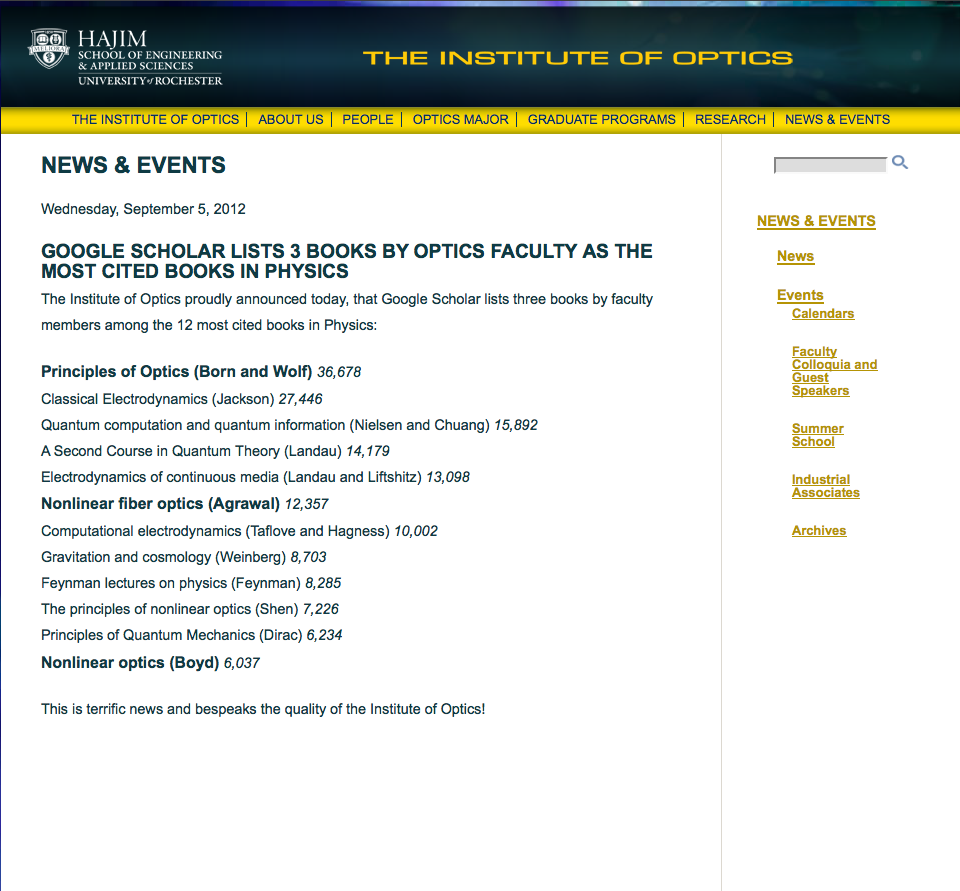
According to a Google Scholar search conducted in September 2012 by the Institute of Optics of the University of Rochester, Taflove's Computational Electrodynamics: The Finite-Difference Time-Domain Method is the 7th most-cited book in physics, with an updated total of 20,666 Google Scholar citations as of Aug. 21, 2020.
The descriptors "finite difference time domain" and "FDTD" coined by Taflove in 1980 have since become widely used, having appeared in this exact form in approximately 140,000 and 250,000 Google Scholar search results, respectively, as of Aug. 21, 2020.
Hub AI
Allen Taflove AI simulator
(@Allen Taflove_simulator)
Allen Taflove
Allen Taflove (June 14, 1949 – April 25, 2021) was a full professor in the Department of Electrical and Computer Engineering of Northwestern's McCormick School of Engineering, since 1988. Since 1972, he pioneered basic theoretical approaches, numerical algorithms, and applications of finite-difference time-domain (FDTD) computational solutions of Maxwell's equations. He coined the descriptors "finite difference time domain" and "FDTD" in the 1980 paper, "Application of the finite-difference time-domain method to sinusoidal steady-state electromagnetic penetration problems." In 1990, he was the first person to be named a Fellow of the Institute of Electrical and Electronics Engineers (IEEE) in the FDTD area. Taflove was the recipient of the 2014 IEEE Electromagnetics Award with the following citation: "For contributions to the development and application of finite-difference time-domain (FDTD) solutions of Maxwell's equations across the electromagnetic spectrum." He was a Life Fellow of the IEEE and a Fellow of the Optical Society (OSA). His OSA Fellow citation reads: "For creating the finite-difference time-domain method for the numerical solution of Maxwell's equations, with crucial application to the growth and current state of the field of photonics."
In 2011, Taflove was named as an inductee of the Amateur Radio Hall of Fame by CQ Magazine in recognition of his research achievements in computational electrodynamics. He had been an FCC-licensed amateur radio operator since 1963 holding the call sign WA9JLV, and had credited amateur radio with spurring his interest in electrical engineering in general, and electromagnetic fields and waves in particular. He had served for many years as the trustee of the Northwestern University Amateur Radio Society, which operates the FCC-licensed club station W9BGX.[citation needed]
Taflove was born in Chicago, Illinois on June 14, 1949. He received B.S., M.S., and Ph.D. degrees in electrical engineering from Northwestern University in 1971, 1972, and 1975, respectively.
Since about 2000, FDTD techniques have emerged as a primary means to computationally model many scientific and engineering problems dealing with electromagnetic wave interactions with material structures. Current FDTD modeling applications range from near-DC (ultralow-frequency geophysics involving the entire Earth-ionosphere waveguide) through microwaves (radar signature technology, antennas, wireless communications devices, digital interconnects, biomedical imaging/treatment) to visible light (photonic crystals, nanoplasmonics, solitons, microscopy and lithography, and biophotonics). Both commercial FDTD software suites and free-software/open-source or closed-source FDTD projects are available which permit detailed Maxwell's equations modeling of electromagnetic wave phenomena and engineered systems spanning much of the electromagnetic spectrum. To a large degree, all of these software constructs derive directly from FDTD techniques first reported by Taflove and his students over the past 45 years.
In 1995, Taflove authored the textbook/research monograph, Computational Electrodynamics: The Finite-Difference Time-Domain Method. In 1998, he edited the research monograph, Advances in Computational Electrodynamics: The Finite-Difference Time-Domain Method. Subsequently, he and Susan Hagness of the University of Wisconsin-Madison expanded and updated the 1995 book in a year-2000 second edition, and then further expanded and updated the 2000 second edition in a 2005 third edition. In 2013, Taflove and Ardavan Oskooi of Kyoto University and Steven G. Johnson of MIT edited the research monograph, Advances in FDTD Computational Electrodynamics: Photonics and Nanotechnology.
As of August 21, 2020, in addition to the books noted above, Taflove had authored or co-authored a total of 27 articles or chapters in books and magazines, 152 refereed journal papers, and 14 U.S. patents. In 2002, he was named to the original ISI highly cited researcher list of the Institute for Scientific Information (ISI). His books, journal papers, and U.S. patents have received a total of 42,058 citations according to Google Scholar®, and his h-index is reported as 68 (Google Scholar).
According to a Google Scholar search conducted in September 2012 by the Institute of Optics of the University of Rochester, Taflove's Computational Electrodynamics: The Finite-Difference Time-Domain Method is the 7th most-cited book in physics, with an updated total of 20,666 Google Scholar citations as of Aug. 21, 2020.
The descriptors "finite difference time domain" and "FDTD" coined by Taflove in 1980 have since become widely used, having appeared in this exact form in approximately 140,000 and 250,000 Google Scholar search results, respectively, as of Aug. 21, 2020.