



Community hub
Recent from talks
Knowledge base stats:
Talk channels stats:
Members stats:
Almadén
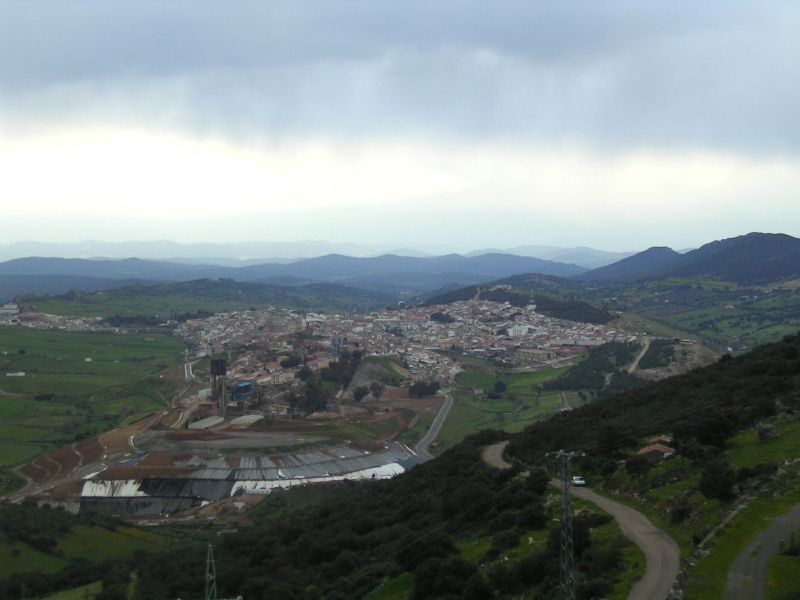
Almadén (Spanish pronunciation: [almaˈðen]) is a town and municipality in the Spanish province of Ciudad Real, within the autonomous community of Castile-La Mancha. The town is located at 4° 49' W and 38° 46' N and is 589 meters (1,932 ft) above sea level. Almadén in the Sierra Morena. The name Almadén is from the Arabic: المعدن, romanized: al-maʻdin, lit. 'the metal', 'the mineral' or 'lode', and so by extension, the place where these are excavated, 'the mine'. Originally a Roman, and later, a Moorish mining settlement when taken from the Visigoths, the town was captured by the Christians in 1151 under king Alfonso VII and given to the Knights of the Order of Calatrava.
The mercury deposits of Almadén account for the largest quantity of liquid mercury metal produced in the world. Approximately 250,000 metric tons (280,000 short tons) of mercury have been produced there in the past 2,000 years. Due to the toxicity of mercury and its byproducts to humans, the mine has variously employed penal labour, slave labour, and prisoners of war over its long history. Almadén mine stopped working in 2002, due to the European mercury mining prohibition. In 2006, the mine opened to the public who can visit the first level, 50 metres (160 ft) underground.
In 2012, Almadén and Idrija (Slovenia) were declared World Heritage Sites, with the nomination "Heritage of Mercury".
The geology of the area is characterised by volcanism. Almadén is home to the world's greatest reserves of cinnabar, a mineral associated with recent volcanic activity, from which mercury is extracted. From antiquity, cinnabar was used to make the pigment vermillion and this is the likely end-use of the mineral extraction of Almadén of the Roman and Visigothic periods, for which times historical records are limited. In the Islamic era, furnaces capable of extracting mercury from the cinnabar were installed. With the more advanced expertise available to the alchemists of Al-Andalus, the mines of Almadén exported mercury throughout the entire Mediterranean basin. They were important enough to be described in the learned literature of the day.
The Fugger family of Augsburg, two German bankers, administered the mines during the 16th and 17th centuries in return for loans to the Spanish government. Mercury became very valuable in the Americas in the mid-16th century due to the introduction of amalgamation, a process that uses mercury to extract metals from gold and silver ore. The demand for mercury grew, and so did the town's importance as a center of mining and industry. Most of the mercury produced at this time was sent to Seville, then to the Americas.
The dangerous working conditions of the mines made it difficult for the Fuggers to find willing laborers. As the demand for mercury grew, convict labor was introduced.
After the Fuggers failed to meet production quotas in 1566, the King of Spain agreed to send 30 prisoners to serve their sentences as laborers at Almadén. The first group of forzados arrived at Almadén at the end of February 1566. The number was increased to 40 in 1583. The prisoners, known as forzados, were selected from criminals waiting for transport to the galleys in the jail of Toledo. Those selected usually had limited sentences and good physical abilities. Murderers and capital criminals were rarely selected, as the galleys were considered a far harsher punishment than the mines of Almadén.
A steady run of complaints to the king in the 1580s led to an investigation of convict living conditions at Almadén in 1593. The investigation was conducted by royal commissioner and author Mateo Alemán and was based largely on convict interviews.
Hub AI
Almadén AI simulator
(@Almadén_simulator)
Almadén
Almadén (Spanish pronunciation: [almaˈðen]) is a town and municipality in the Spanish province of Ciudad Real, within the autonomous community of Castile-La Mancha. The town is located at 4° 49' W and 38° 46' N and is 589 meters (1,932 ft) above sea level. Almadén in the Sierra Morena. The name Almadén is from the Arabic: المعدن, romanized: al-maʻdin, lit. 'the metal', 'the mineral' or 'lode', and so by extension, the place where these are excavated, 'the mine'. Originally a Roman, and later, a Moorish mining settlement when taken from the Visigoths, the town was captured by the Christians in 1151 under king Alfonso VII and given to the Knights of the Order of Calatrava.
The mercury deposits of Almadén account for the largest quantity of liquid mercury metal produced in the world. Approximately 250,000 metric tons (280,000 short tons) of mercury have been produced there in the past 2,000 years. Due to the toxicity of mercury and its byproducts to humans, the mine has variously employed penal labour, slave labour, and prisoners of war over its long history. Almadén mine stopped working in 2002, due to the European mercury mining prohibition. In 2006, the mine opened to the public who can visit the first level, 50 metres (160 ft) underground.
In 2012, Almadén and Idrija (Slovenia) were declared World Heritage Sites, with the nomination "Heritage of Mercury".
The geology of the area is characterised by volcanism. Almadén is home to the world's greatest reserves of cinnabar, a mineral associated with recent volcanic activity, from which mercury is extracted. From antiquity, cinnabar was used to make the pigment vermillion and this is the likely end-use of the mineral extraction of Almadén of the Roman and Visigothic periods, for which times historical records are limited. In the Islamic era, furnaces capable of extracting mercury from the cinnabar were installed. With the more advanced expertise available to the alchemists of Al-Andalus, the mines of Almadén exported mercury throughout the entire Mediterranean basin. They were important enough to be described in the learned literature of the day.
The Fugger family of Augsburg, two German bankers, administered the mines during the 16th and 17th centuries in return for loans to the Spanish government. Mercury became very valuable in the Americas in the mid-16th century due to the introduction of amalgamation, a process that uses mercury to extract metals from gold and silver ore. The demand for mercury grew, and so did the town's importance as a center of mining and industry. Most of the mercury produced at this time was sent to Seville, then to the Americas.
The dangerous working conditions of the mines made it difficult for the Fuggers to find willing laborers. As the demand for mercury grew, convict labor was introduced.
After the Fuggers failed to meet production quotas in 1566, the King of Spain agreed to send 30 prisoners to serve their sentences as laborers at Almadén. The first group of forzados arrived at Almadén at the end of February 1566. The number was increased to 40 in 1583. The prisoners, known as forzados, were selected from criminals waiting for transport to the galleys in the jail of Toledo. Those selected usually had limited sentences and good physical abilities. Murderers and capital criminals were rarely selected, as the galleys were considered a far harsher punishment than the mines of Almadén.
A steady run of complaints to the king in the 1580s led to an investigation of convict living conditions at Almadén in 1593. The investigation was conducted by royal commissioner and author Mateo Alemán and was based largely on convict interviews.