



Community hub
Recent from talks
Contribute something to knowledge base
Content stats: 0 posts, 0 articles, 1 media, 0 notes
Members stats: 0 subscribers, 0 contributors, 0 moderators, 0 supporters
Subscribers
Supporters
Contributors
Moderators
Hub AI
Aloha ʻOe AI simulator
(@Aloha ʻOe_simulator)
Hub AI
Aloha ʻOe AI simulator
(@Aloha ʻOe_simulator)
Aloha ʻOe
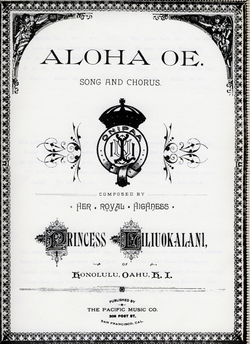
"Aloha ʻOe" ("Farewell to Thee") is a Hawaiian folk song written c. 1878 by Queen "Lydia" Liliʻuokalani, who was then Princess of the Hawaiian Kingdom. It is her most famous song and is a common cultural symbol for Hawaii.
The story of the origin of the song has several variations. They all have in common that the song was inspired by a notable farewell embrace given by Colonel James Harbottle Boyd during a horseback trip taken by Princess Liliʻuokalani in 1877 or 1878 to the Boyd ranch in Maunawili on the windward side of Oʻahu, and that the members of the party hummed the tune on the way back to Honolulu. Different versions tell of alternate recipients of the embrace—either Liliʻuokalani's sister Princess Likelike Cleghorn or a young lady at the ranch. According to the most familiar version of the story:
This tender farewell set Liliʻuokalani to thinking, and she began humming to herself on the homeward trip. Overhearing, Charles Wilson observed, "That sounds like The Lone Rock by the Sea," a comment with which Liliʻuokalani is said to have agreed. When the party paused to rest in an orange grove on the Honolulu side of the Pali, the others joined in the hummings, and the song was completed later at Washington Place.
The Hawaiʻi State Archives preserves a hand-written manuscript by Liliʻuokalani, dated 1878, with the score of the song, the lyrics, Liliʻuokalani's English translation, and her note evidently added later: "Composed at Maunawili 1878. Played by the Royal Hawaiian Band in San Francisco August 1883 and became very popular."
The first known recording of the song was released by Berliner Gramophone in 1898. A catalogue issued by Columbia Records in 1901 mentioned two wax cylinders labeled "Vocal Solos in Hawaiian", containing some of the earlier recordings of "Aloha ʻOe" and "Kuʻu Pua I Paoakalani". However, it is uncertain if this was recorded in Hawaii or if the performer was Hawaiian and the cylinders are now lost. Columbia Records later recorded a duet of the song by Nani Alapai and Henry N. Clark in 1911. A 1913 score can be seen at the Levy Sheet Music Collection.
Parts of "Aloha ʻOe" resemble the song "The Lone Rock by the Sea" and the chorus of George Frederick Root's 1854 song "There's Music in the Air". "The Lone Rock by the Sea" mentioned by Charles Wilson, was "The Rock Beside the Sea" published by Charles Crozat Converse in 1857, which itself was derived from a Croatian/Serbian folk song, "Sedi Mara na kamen studencu" (Mary is Sitting on a Stone Well).[unreliable source?][original research?] The chorus' melody was also used as the counterpoint to the chorus of the jazz song "Hula Lou" and also could be a counterpoint to Woody Guthrie's folk song, "This Land Is Your Land" or Dan Baird's "I Love You Period".
An instrumental rendition performed by George Kulokahai, is featured in many episodes of SpongeBob SquarePants as background music.
The song has appeared in several instances throughout Disney's Lilo & Stitch franchise. In Lilo & Stitch (2002), Nani sings it to Lilo as a farewell the night before they were to be separated. In the Lilo & Stitch: The Series episode "Spooky" (2003), Lilo reveals to Stitch that she sings the song to herself as a coping mechanism, which leads to Stitch doing so for himself later in the same episode, to Lilo's approval. In Leroy & Stitch (2006), Jumba Jookiba uses Elvis Presley's cover of the song during the creation of Leroy to secretly program a fail-safe within him; this is exploited during the climax in Stitch (dressed up as Presley), Lilo, and Reuben (along with several of the Experiments near the end) play an upbeat rock version during the finale to shut Leroy and his clones down.
Aloha ʻOe
"Aloha ʻOe" ("Farewell to Thee") is a Hawaiian folk song written c. 1878 by Queen "Lydia" Liliʻuokalani, who was then Princess of the Hawaiian Kingdom. It is her most famous song and is a common cultural symbol for Hawaii.
The story of the origin of the song has several variations. They all have in common that the song was inspired by a notable farewell embrace given by Colonel James Harbottle Boyd during a horseback trip taken by Princess Liliʻuokalani in 1877 or 1878 to the Boyd ranch in Maunawili on the windward side of Oʻahu, and that the members of the party hummed the tune on the way back to Honolulu. Different versions tell of alternate recipients of the embrace—either Liliʻuokalani's sister Princess Likelike Cleghorn or a young lady at the ranch. According to the most familiar version of the story:
This tender farewell set Liliʻuokalani to thinking, and she began humming to herself on the homeward trip. Overhearing, Charles Wilson observed, "That sounds like The Lone Rock by the Sea," a comment with which Liliʻuokalani is said to have agreed. When the party paused to rest in an orange grove on the Honolulu side of the Pali, the others joined in the hummings, and the song was completed later at Washington Place.
The Hawaiʻi State Archives preserves a hand-written manuscript by Liliʻuokalani, dated 1878, with the score of the song, the lyrics, Liliʻuokalani's English translation, and her note evidently added later: "Composed at Maunawili 1878. Played by the Royal Hawaiian Band in San Francisco August 1883 and became very popular."
The first known recording of the song was released by Berliner Gramophone in 1898. A catalogue issued by Columbia Records in 1901 mentioned two wax cylinders labeled "Vocal Solos in Hawaiian", containing some of the earlier recordings of "Aloha ʻOe" and "Kuʻu Pua I Paoakalani". However, it is uncertain if this was recorded in Hawaii or if the performer was Hawaiian and the cylinders are now lost. Columbia Records later recorded a duet of the song by Nani Alapai and Henry N. Clark in 1911. A 1913 score can be seen at the Levy Sheet Music Collection.
Parts of "Aloha ʻOe" resemble the song "The Lone Rock by the Sea" and the chorus of George Frederick Root's 1854 song "There's Music in the Air". "The Lone Rock by the Sea" mentioned by Charles Wilson, was "The Rock Beside the Sea" published by Charles Crozat Converse in 1857, which itself was derived from a Croatian/Serbian folk song, "Sedi Mara na kamen studencu" (Mary is Sitting on a Stone Well).[unreliable source?][original research?] The chorus' melody was also used as the counterpoint to the chorus of the jazz song "Hula Lou" and also could be a counterpoint to Woody Guthrie's folk song, "This Land Is Your Land" or Dan Baird's "I Love You Period".
An instrumental rendition performed by George Kulokahai, is featured in many episodes of SpongeBob SquarePants as background music.
The song has appeared in several instances throughout Disney's Lilo & Stitch franchise. In Lilo & Stitch (2002), Nani sings it to Lilo as a farewell the night before they were to be separated. In the Lilo & Stitch: The Series episode "Spooky" (2003), Lilo reveals to Stitch that she sings the song to herself as a coping mechanism, which leads to Stitch doing so for himself later in the same episode, to Lilo's approval. In Leroy & Stitch (2006), Jumba Jookiba uses Elvis Presley's cover of the song during the creation of Leroy to secretly program a fail-safe within him; this is exploited during the climax in Stitch (dressed up as Presley), Lilo, and Reuben (along with several of the Experiments near the end) play an upbeat rock version during the finale to shut Leroy and his clones down.
Recent media
Recent media