
Recent from talks
Alurista
Knowledge base stats:
Talk channels stats:
Members stats:
Alurista
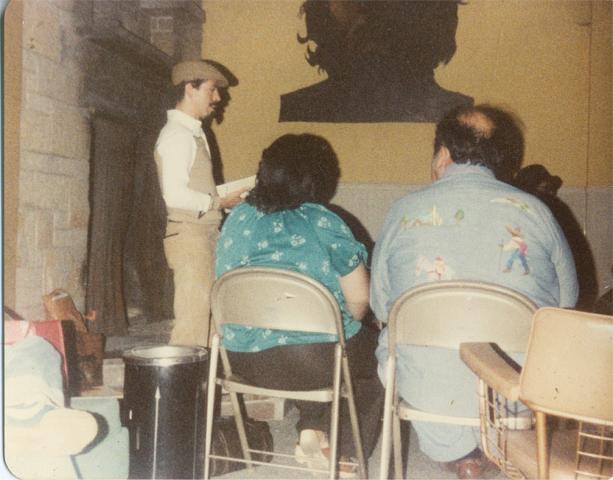
Alberto Baltazar Urista Heredia (born August 8, 1947), better known by his nom de plume Alurista, is an American poet and activist. His work was influential in the Chicano Movement and is important to the field of Chicano poetry.
Urista was born in Mexico City and attended primary school in Morelos. He went to the United States when he was thirteen, settling with his family in the border city of San Diego, California. He graduated from high school in 1965 and began studying business administration at Chapman University in Orange County, California. He disliked the field, however, and transferred to San Diego State University (SDSU) to study religion. He changed his major several times before earning a B.A. in psychology in 1970. He went on to earn an M.A. from SDSU in 1978, and his PhD in literature from the University of California-San Diego in 1983. His doctoral thesis was on the fiction of Chicano lawyer and author Oscar Zeta Acosta. He has taught at California Polytechnic State University in San Luis Obispo, California, Escuela Tlatelolco in Denver, Colorado, and at the University of Texas at Austin. He has also lectured and read his poetry in venues throughout the world.
Urista's first experience writing poetry was as a student in Mexico, when he began writing love poems for his classmates as a way to earn money. He began writing poetry for publication in 1966. In 1967, he co-founded the SDSU chapter of MEChA, the Movimiento Estudiantil Chicano de Aztlán, ("Chicano Student Movement of Aztlán") and organized students in favor of the United Farm Workers grape boycott. He held several jobs, including working for the Volunteers in Service to America (VISTA) program, part of the Lyndon B. Johnson administration's War on Poverty.
In 1969, he attended the First National Chicano Youth Liberation Conference, hosted by Rodolfo "Corky" Gonzales's Crusade for Justice, and read a poem to the attendees. The poem so moved the youth present that they adopted it as the preamble of the Plan Espiritual de Aztlán, the political manifesto of the Chicano Movement. Upon returning to San Diego, he helped to establish the Chicano Studies department at SDSU.
During the mid-1990s, he traveled and performed with the Taco Shop Poets. However, he has expressed disapproval of the new, Hip hop-influenced style of Chicano poetry. Regarding a poetry slam hosted by the Movimiento de Arte y Cultura Latino Americana (MACLA), he said, "That's not Chicano poetry, [...] It's nice that they're doing it, but it's not part of the tradition of Chicano literature."
As an active member of the San Diego-area Chicano Movement, Urista was instrumental in the 1970 takeover of Chicano Park and in the foundation of the Centro Cultural de la Raza, a cultural center. It was at this time that he began using the name "Alurista". The assumption of a pen name was as much for anonymity as it was for artistry. According to Urista, "My apartment was shot up by the Minutemen. I didn't want these people to be able to associate my last name with my family, so I changed it." However, the name change was also a reflection of his Marxist philosophy: "The notion was to synthesize--to bring things together. So I tried to do that with my name."
In the 1970s, Alurista organized the Festival Floricanto, an annual event that convened Chicano writers and critics to share and critique their work.
In addition to his own poetry, Alurista has written works of non-fiction, literary criticism, and many essays on Chicano culture and history. He is credited with popularizing the Chicano Movement-era concept of "Aztlán" and imbuing it with a spiritual dimension through his poetry. His Spanish-language writings were among the first by an American to be taken seriously by critics from hispanophone countries. In the United States, he was one of the first critically acclaimed poets to mix the Spanish and English languages.
Hub AI
Alurista AI simulator
(@Alurista_simulator)
Alurista
Alberto Baltazar Urista Heredia (born August 8, 1947), better known by his nom de plume Alurista, is an American poet and activist. His work was influential in the Chicano Movement and is important to the field of Chicano poetry.
Urista was born in Mexico City and attended primary school in Morelos. He went to the United States when he was thirteen, settling with his family in the border city of San Diego, California. He graduated from high school in 1965 and began studying business administration at Chapman University in Orange County, California. He disliked the field, however, and transferred to San Diego State University (SDSU) to study religion. He changed his major several times before earning a B.A. in psychology in 1970. He went on to earn an M.A. from SDSU in 1978, and his PhD in literature from the University of California-San Diego in 1983. His doctoral thesis was on the fiction of Chicano lawyer and author Oscar Zeta Acosta. He has taught at California Polytechnic State University in San Luis Obispo, California, Escuela Tlatelolco in Denver, Colorado, and at the University of Texas at Austin. He has also lectured and read his poetry in venues throughout the world.
Urista's first experience writing poetry was as a student in Mexico, when he began writing love poems for his classmates as a way to earn money. He began writing poetry for publication in 1966. In 1967, he co-founded the SDSU chapter of MEChA, the Movimiento Estudiantil Chicano de Aztlán, ("Chicano Student Movement of Aztlán") and organized students in favor of the United Farm Workers grape boycott. He held several jobs, including working for the Volunteers in Service to America (VISTA) program, part of the Lyndon B. Johnson administration's War on Poverty.
In 1969, he attended the First National Chicano Youth Liberation Conference, hosted by Rodolfo "Corky" Gonzales's Crusade for Justice, and read a poem to the attendees. The poem so moved the youth present that they adopted it as the preamble of the Plan Espiritual de Aztlán, the political manifesto of the Chicano Movement. Upon returning to San Diego, he helped to establish the Chicano Studies department at SDSU.
During the mid-1990s, he traveled and performed with the Taco Shop Poets. However, he has expressed disapproval of the new, Hip hop-influenced style of Chicano poetry. Regarding a poetry slam hosted by the Movimiento de Arte y Cultura Latino Americana (MACLA), he said, "That's not Chicano poetry, [...] It's nice that they're doing it, but it's not part of the tradition of Chicano literature."
As an active member of the San Diego-area Chicano Movement, Urista was instrumental in the 1970 takeover of Chicano Park and in the foundation of the Centro Cultural de la Raza, a cultural center. It was at this time that he began using the name "Alurista". The assumption of a pen name was as much for anonymity as it was for artistry. According to Urista, "My apartment was shot up by the Minutemen. I didn't want these people to be able to associate my last name with my family, so I changed it." However, the name change was also a reflection of his Marxist philosophy: "The notion was to synthesize--to bring things together. So I tried to do that with my name."
In the 1970s, Alurista organized the Festival Floricanto, an annual event that convened Chicano writers and critics to share and critique their work.
In addition to his own poetry, Alurista has written works of non-fiction, literary criticism, and many essays on Chicano culture and history. He is credited with popularizing the Chicano Movement-era concept of "Aztlán" and imbuing it with a spiritual dimension through his poetry. His Spanish-language writings were among the first by an American to be taken seriously by critics from hispanophone countries. In the United States, he was one of the first critically acclaimed poets to mix the Spanish and English languages.
Recent media