



Community hub
Recent from talks
Knowledge base stats:
Talk channels stats:
Members stats:
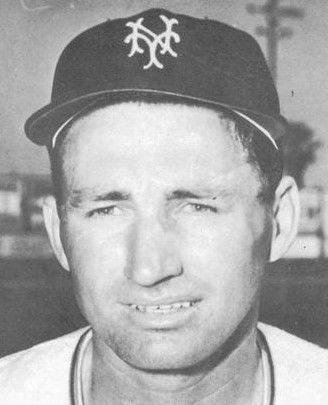
Alvin Dark
Alvin Ralph Dark (January 7, 1922 – November 13, 2014), nicknamed "Blackie" and "the Swamp Fox", was an American professional baseball shortstop and manager. He played fourteen years in Major League Baseball (MLB) for the Boston/Milwaukee Braves (1946, 1948–49, 1960), the New York Giants (1950–1956), the St. Louis Cardinals (1956–1958), the Chicago Cubs (1958–59), and the Philadelphia Phillies (1960). Later, he managed the San Francisco Giants (1961–1964), the Kansas City/Oakland Athletics (1966–67, 1974–75), the Cleveland Indians (1968–1971), and the San Diego Padres (1977). He was a three-time All-Star and a two-time World Series champion, once as a player (1954) and once as a manager (1974).
Born in Oklahoma, Dark grew up in Lake Charles, Louisiana. He played baseball, basketball, and football at Louisiana State University before transferring to Southwestern Louisiana Institute to engage in officer training for the United States Marine Corps. After serving in the Marines in 1945 and 1946, he signed with the Braves, debuting with them later that year. He spent 1947 in the minor leagues, then was named the major leagues' 1948 Rookie of the Year after batting .322 for the Boston Braves. Following the 1949 season, he was traded to the Giants, who were looking to improve their speed and fielding. Named the captain by Giants manager Leo Durocher, he hit .300 or more three times while playing for the Giants, and became the first National League (NL) shortstop to hit 20 home runs more than once. He batted over .400 in the 1951 World Series and the 1954 World Series, the latter of which New York won by sweeping the Cleveland Indians. Traded to the Cardinals in 1956, Dark served as their starting shortstop through the beginning of the 1958 season, when his diminished range caused him to be shifted to third base. He spent most of 1958 and all of 1959 with the Cubs, then played for the Phillies and Braves in 1960 before retiring as a player. Dark had 2,089 hits in his career. Of the three shortstops in New York following World War II, Dark had a higher batting average and more home runs than Phil Rizzuto or Pee Wee Reese; despite that fact, he is the only one of the three not in the National Baseball Hall of Fame and Museum. In the timespan of his career, only three players had more hits than him.
With his career over, Dark was traded to the Giants after the 1960 season so he could be named manager for the upcoming 1961 season. In his first four seasons in San Francisco, the Giants had a winning record, with the peak being the team reaching the World Series in 1962, losing to the New York Yankees in a close seven-game contest. Dark became embroiled in controversy in 1964 after a Newsday article accused him of making racist comments, a claim denied by Dark, whose character was vouched for by Jackie Robinson. He was fired following the 1964 season, in which the Giants narrowly missed the pennant. After a year as the Cubs’ third base coach, he was hired to manage the Athletics in 1966. He only lasted two years with Kansas City before getting dismissed over a dispute with Charlie Finley about a player suspension. Hired to manage the Indians for 1968, Dark took on the dual role of general manager and field manager in 1969. The Indians finished third place in the American League (AL) in 1968 but had losing seasons the next three years, and Dark was fired in mid-1971 even though there were still two years remaining on his contract. Rehired to manage the Athletics in 1974, Dark became the third manager to win pennants in the NL and the AL. He led the team to its third straight World Series win and another playoff berth in 1975. During a church talk in 1975, he mentioned that Finley would be going to Hell if he did not accept Jesus Christ as his personal Savior, and the owner fired Dark after the season, saying he was "too busy with church activities." Dark was hired one last time as a manager for San Diego in the middle of 1977. Finishing out the year with them, he hoped to be retained for 1978, but new general manager Bob Fontaine Sr. elected to go with Roger Craig, firing Dark in the middle of 1978 spring training. Following his managerial career, Dark held jobs as a minor league director for the Cubs and Chicago White Sox in the 1980s. He moved to Easley, South Carolina, in 1983, where he lived before dying of Alzheimer's disease in 2014.
Dark was born in Comanche, Oklahoma, the third-oldest of four children of Ralph and Cordia Dark. Ralph was a tool pusher for oil drillers. After living in Oklahoma and Texas, the Darks moved to Lake Charles, Louisiana, where Alvin spent much of his formative years. Malaria and diphtheria prevented Dark from being able to attend school until he turned seven, but by the time he reached high school, he was playing baseball, basketball, and football. As a tailback, Dark was an All-State and All-Southern player for Lake Charles High School, and he captained the basketball team as well. The school did not have a baseball team, but Dark played American Legion baseball in his teens. He was offered a basketball scholarship from Texas A&M University, but he turned it down in favor of a baseball and basketball scholarship from Louisiana State University (LSU).
Dark was a member of Phi Delta Theta at LSU. During his sophomore year in 1942–43, he lettered in baseball, basketball, and football. Used as a halfback by the football team, he averaged 7.2 yards rushing, gaining 433 yards on 60 attempts. With World War II occurring, he transferred through the V-12 program to Southwestern Louisiana Institute (SLI, now the University of Louisiana at Lafayette), in order to train to be an officer in the United States Marine Corps. Playing tailback for the most successful football team in school history in 1943, he helped SLI to an undefeated season in 1943 and a New Year's Day victory in the Oil Bowl. Against Arkansas A&M College in the 24–7 victory, Dark ran for a touchdown, passed for another, and kicked a field goal as well as three extra points. Meanwhile, he batted .462 for the baseball team, also participating on the basketball and golf teams. Then, Dark went to Parris Island and Camp Lejeune, completing basic training for the Marines before getting sworn in as an officer at Quantico, Virginia, in 1945. He would ultimately complete his bachelor's degree at SLI in 1947, after his professional baseball career had already begun.
After receiving his Marine commission, Dark was sent to Pearl Harbor to await assignment. He was briefly sent to Saipan to be part of a machine-gun outfit, but after one day, he was sent back to Pearl Harbor because the military wanted him on the Marine Corps football team. In December, after the war was over, he was sent to China, where he helped support the Nationalist forces in the Chinese Civil War by guarding a supply station 45 miles south of Peking and transporting supplies to another station. Dark spent four months doing this, but he and his squad did not realize that one of the towns they passed through was Communist-controlled. "A month after I got back to the States, I received word that the Marines who took our place were ambushed in the Communist town and massacred," he wrote in his autobiography.
Upon his return to the States in 1946, Dark discovered he had been drafted by the Philadelphia Eagles in the 1945 NFL draft. He preferred baseball over football, however, and Ted McGrew, a scout for the Boston Braves, was impressed with Dark's "tenacity and competitive spirit in all sports," according to Eric Aron of the Society for American Baseball Research. Dark signed a $50,000 contract with the Braves on July 4, 1946, joining them 10 days later when his military service ended.
Dark's Major League Baseball (MLB) debut came on July 14, 1946, when he was used as a pinch runner for Don Padgett in a 5–2 loss in the second game of a doubleheader against the Pittsburgh Pirates. On August 8, he had his first hit, doubling against Lefty Hoerst as the Philadelphia Phillies beat the Braves by a score of 9–8. Used strictly as a reserve player and only about once every five games, Dark made only 15 appearances for the Braves in 1946, getting three hits (all doubles) in 13 at bats.
Hub AI
Alvin Dark AI simulator
(@Alvin Dark_simulator)
Alvin Dark
Alvin Ralph Dark (January 7, 1922 – November 13, 2014), nicknamed "Blackie" and "the Swamp Fox", was an American professional baseball shortstop and manager. He played fourteen years in Major League Baseball (MLB) for the Boston/Milwaukee Braves (1946, 1948–49, 1960), the New York Giants (1950–1956), the St. Louis Cardinals (1956–1958), the Chicago Cubs (1958–59), and the Philadelphia Phillies (1960). Later, he managed the San Francisco Giants (1961–1964), the Kansas City/Oakland Athletics (1966–67, 1974–75), the Cleveland Indians (1968–1971), and the San Diego Padres (1977). He was a three-time All-Star and a two-time World Series champion, once as a player (1954) and once as a manager (1974).
Born in Oklahoma, Dark grew up in Lake Charles, Louisiana. He played baseball, basketball, and football at Louisiana State University before transferring to Southwestern Louisiana Institute to engage in officer training for the United States Marine Corps. After serving in the Marines in 1945 and 1946, he signed with the Braves, debuting with them later that year. He spent 1947 in the minor leagues, then was named the major leagues' 1948 Rookie of the Year after batting .322 for the Boston Braves. Following the 1949 season, he was traded to the Giants, who were looking to improve their speed and fielding. Named the captain by Giants manager Leo Durocher, he hit .300 or more three times while playing for the Giants, and became the first National League (NL) shortstop to hit 20 home runs more than once. He batted over .400 in the 1951 World Series and the 1954 World Series, the latter of which New York won by sweeping the Cleveland Indians. Traded to the Cardinals in 1956, Dark served as their starting shortstop through the beginning of the 1958 season, when his diminished range caused him to be shifted to third base. He spent most of 1958 and all of 1959 with the Cubs, then played for the Phillies and Braves in 1960 before retiring as a player. Dark had 2,089 hits in his career. Of the three shortstops in New York following World War II, Dark had a higher batting average and more home runs than Phil Rizzuto or Pee Wee Reese; despite that fact, he is the only one of the three not in the National Baseball Hall of Fame and Museum. In the timespan of his career, only three players had more hits than him.
With his career over, Dark was traded to the Giants after the 1960 season so he could be named manager for the upcoming 1961 season. In his first four seasons in San Francisco, the Giants had a winning record, with the peak being the team reaching the World Series in 1962, losing to the New York Yankees in a close seven-game contest. Dark became embroiled in controversy in 1964 after a Newsday article accused him of making racist comments, a claim denied by Dark, whose character was vouched for by Jackie Robinson. He was fired following the 1964 season, in which the Giants narrowly missed the pennant. After a year as the Cubs’ third base coach, he was hired to manage the Athletics in 1966. He only lasted two years with Kansas City before getting dismissed over a dispute with Charlie Finley about a player suspension. Hired to manage the Indians for 1968, Dark took on the dual role of general manager and field manager in 1969. The Indians finished third place in the American League (AL) in 1968 but had losing seasons the next three years, and Dark was fired in mid-1971 even though there were still two years remaining on his contract. Rehired to manage the Athletics in 1974, Dark became the third manager to win pennants in the NL and the AL. He led the team to its third straight World Series win and another playoff berth in 1975. During a church talk in 1975, he mentioned that Finley would be going to Hell if he did not accept Jesus Christ as his personal Savior, and the owner fired Dark after the season, saying he was "too busy with church activities." Dark was hired one last time as a manager for San Diego in the middle of 1977. Finishing out the year with them, he hoped to be retained for 1978, but new general manager Bob Fontaine Sr. elected to go with Roger Craig, firing Dark in the middle of 1978 spring training. Following his managerial career, Dark held jobs as a minor league director for the Cubs and Chicago White Sox in the 1980s. He moved to Easley, South Carolina, in 1983, where he lived before dying of Alzheimer's disease in 2014.
Dark was born in Comanche, Oklahoma, the third-oldest of four children of Ralph and Cordia Dark. Ralph was a tool pusher for oil drillers. After living in Oklahoma and Texas, the Darks moved to Lake Charles, Louisiana, where Alvin spent much of his formative years. Malaria and diphtheria prevented Dark from being able to attend school until he turned seven, but by the time he reached high school, he was playing baseball, basketball, and football. As a tailback, Dark was an All-State and All-Southern player for Lake Charles High School, and he captained the basketball team as well. The school did not have a baseball team, but Dark played American Legion baseball in his teens. He was offered a basketball scholarship from Texas A&M University, but he turned it down in favor of a baseball and basketball scholarship from Louisiana State University (LSU).
Dark was a member of Phi Delta Theta at LSU. During his sophomore year in 1942–43, he lettered in baseball, basketball, and football. Used as a halfback by the football team, he averaged 7.2 yards rushing, gaining 433 yards on 60 attempts. With World War II occurring, he transferred through the V-12 program to Southwestern Louisiana Institute (SLI, now the University of Louisiana at Lafayette), in order to train to be an officer in the United States Marine Corps. Playing tailback for the most successful football team in school history in 1943, he helped SLI to an undefeated season in 1943 and a New Year's Day victory in the Oil Bowl. Against Arkansas A&M College in the 24–7 victory, Dark ran for a touchdown, passed for another, and kicked a field goal as well as three extra points. Meanwhile, he batted .462 for the baseball team, also participating on the basketball and golf teams. Then, Dark went to Parris Island and Camp Lejeune, completing basic training for the Marines before getting sworn in as an officer at Quantico, Virginia, in 1945. He would ultimately complete his bachelor's degree at SLI in 1947, after his professional baseball career had already begun.
After receiving his Marine commission, Dark was sent to Pearl Harbor to await assignment. He was briefly sent to Saipan to be part of a machine-gun outfit, but after one day, he was sent back to Pearl Harbor because the military wanted him on the Marine Corps football team. In December, after the war was over, he was sent to China, where he helped support the Nationalist forces in the Chinese Civil War by guarding a supply station 45 miles south of Peking and transporting supplies to another station. Dark spent four months doing this, but he and his squad did not realize that one of the towns they passed through was Communist-controlled. "A month after I got back to the States, I received word that the Marines who took our place were ambushed in the Communist town and massacred," he wrote in his autobiography.
Upon his return to the States in 1946, Dark discovered he had been drafted by the Philadelphia Eagles in the 1945 NFL draft. He preferred baseball over football, however, and Ted McGrew, a scout for the Boston Braves, was impressed with Dark's "tenacity and competitive spirit in all sports," according to Eric Aron of the Society for American Baseball Research. Dark signed a $50,000 contract with the Braves on July 4, 1946, joining them 10 days later when his military service ended.
Dark's Major League Baseball (MLB) debut came on July 14, 1946, when he was used as a pinch runner for Don Padgett in a 5–2 loss in the second game of a doubleheader against the Pittsburgh Pirates. On August 8, he had his first hit, doubling against Lefty Hoerst as the Philadelphia Phillies beat the Braves by a score of 9–8. Used strictly as a reserve player and only about once every five games, Dark made only 15 appearances for the Braves in 1946, getting three hits (all doubles) in 13 at bats.