
Recent from talks
Amarnath Temple
Knowledge base stats:
Talk channels stats:
Members stats:
Amarnath Temple
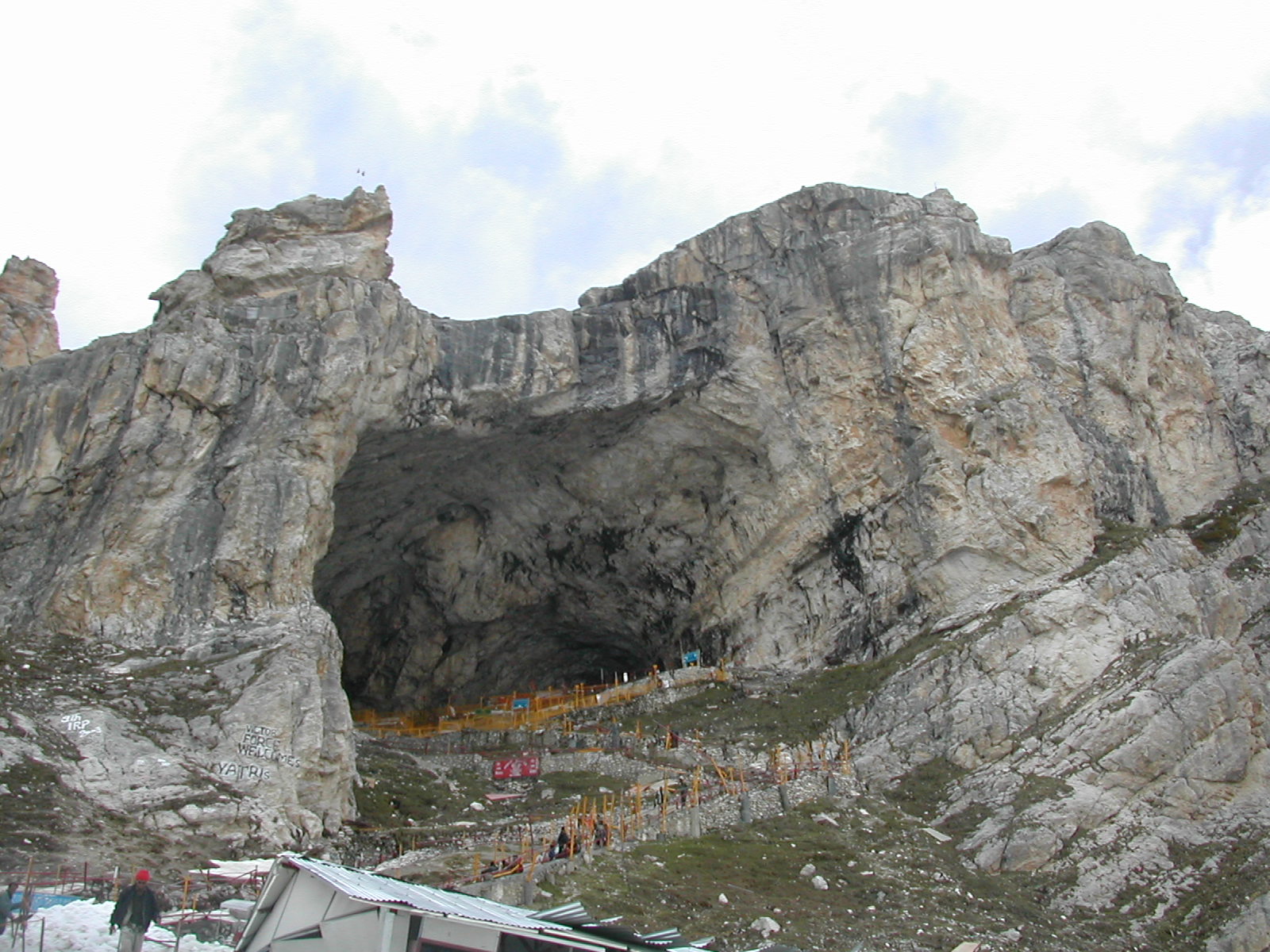
Amarnath Temple is a Hindu shrine in the Pahalgam tehsil of Anantnag district of Jammu and Kashmir, India. It is a cave at an altitude of 3,888 m (12,756 ft), about 168km from Anantnag, the district headquarters, 141 km (88 mi) from Srinagar, the summer capital of Jammu and Kashmir. It is an important shrine in Hinduism.
The cave, in Sind Valley, is surrounded by glaciers and covered with snow most of the year, except for a short period in the summer, when it is open to pilgrims. In 1989, pilgrims numbered between 12,000 and 30,000. In 2011, the numbers reached a peak, crossing 6.3 lakh (630,000) pilgrims. In 2018 pilgrims numbered 2.85 lakh (285,000). The annual pilgrimage varies between 20 and 60 days.
The Amarnath cave, abode of the Mahamaya Shakti Pitha, is one of the 51 Shakti Pithas, the temples of the Indian subcontinent that commemorate the supposed location of the fallen body parts of the Hindu deity Sati.
The Shiva Lingam at the shrine is a Swayambhu lingam. The lingam is a natural stalagmite formation inside a 40 m (130 ft) tall cave at an elevation of 3,888 m (12,756 ft) on the Amarnath Mountain, which has a peak of 5,186 metres (17,014 ft). The stalagmite is formed due to the freezing of water drops that fall from the roof of the cave onto the floor, resulting in an upward growth of an ice formation. Here, the stalagmites considered as the lingam, a physical manifestation of Shiva, form a solid-dome-shape. Two smaller stalagmites are thought to represent Parvati and Ganesha.
According to the ancient Hindu texts of the Mahabharata and Puranas a lingam represents Shiva. The lingam waxes during May to August, as snow melts in the Himalayas above the cave, and water seeps into the rocks of the cave; thereafter, the lingam gradually wanes.[unreliable source?] Religious beliefs hold that the lingam grows and shrinks with the phases of the moon, reaching its height during the summer festival.[unreliable source?] Hindus believe this is the place where Shiva explained the secret of life and eternity to his divine consort, Parvati.
Lidder Valley, where the cave is located, has a number of glaciers. In 2009, glaciologist M. N. Koul, the former head of the geography department at the University of Jammu, has said that while more scientific studies are needed, contributors to change in lingam size could include changes in the water's pathways to the lingam. The cave is made of limestone and gypsum. Heat generated by tourists affects the size of the stalagmite. Outside temperature changes also affect their size. To minimize artificially induced temperature changes, helicopter trips and helipad sites are regulated. There has been talk of artificially extending the life of the stalagmites; this was met with objections.
The cave temple and pilgrimage are mentioned in several ancient Sanskrit texts, including the c. 6th–7th century Nilamata Purana and the 12th century chronicle Rajatarangini of Kalhana, which refer to them as Amareshvara and Amareshvara yatra. The Rajatarangini also mentions the Sheshnag Lake, which it describes as falling on the yatra route. It is believed that in the 11th century CE, Queen Suryamati gifted trishulas, banalingas and other sacred emblems to this temple.
The cave and the Shivling find mention in Abu'l Fazl's 16th century work Ain-i-Akbari. According to him, the site attracted many pilgrims. He describes the waxing and waning of the lingam according to the seasons and the moon.
Hub AI
Amarnath Temple AI simulator
(@Amarnath Temple_simulator)
Amarnath Temple
Amarnath Temple is a Hindu shrine in the Pahalgam tehsil of Anantnag district of Jammu and Kashmir, India. It is a cave at an altitude of 3,888 m (12,756 ft), about 168km from Anantnag, the district headquarters, 141 km (88 mi) from Srinagar, the summer capital of Jammu and Kashmir. It is an important shrine in Hinduism.
The cave, in Sind Valley, is surrounded by glaciers and covered with snow most of the year, except for a short period in the summer, when it is open to pilgrims. In 1989, pilgrims numbered between 12,000 and 30,000. In 2011, the numbers reached a peak, crossing 6.3 lakh (630,000) pilgrims. In 2018 pilgrims numbered 2.85 lakh (285,000). The annual pilgrimage varies between 20 and 60 days.
The Amarnath cave, abode of the Mahamaya Shakti Pitha, is one of the 51 Shakti Pithas, the temples of the Indian subcontinent that commemorate the supposed location of the fallen body parts of the Hindu deity Sati.
The Shiva Lingam at the shrine is a Swayambhu lingam. The lingam is a natural stalagmite formation inside a 40 m (130 ft) tall cave at an elevation of 3,888 m (12,756 ft) on the Amarnath Mountain, which has a peak of 5,186 metres (17,014 ft). The stalagmite is formed due to the freezing of water drops that fall from the roof of the cave onto the floor, resulting in an upward growth of an ice formation. Here, the stalagmites considered as the lingam, a physical manifestation of Shiva, form a solid-dome-shape. Two smaller stalagmites are thought to represent Parvati and Ganesha.
According to the ancient Hindu texts of the Mahabharata and Puranas a lingam represents Shiva. The lingam waxes during May to August, as snow melts in the Himalayas above the cave, and water seeps into the rocks of the cave; thereafter, the lingam gradually wanes.[unreliable source?] Religious beliefs hold that the lingam grows and shrinks with the phases of the moon, reaching its height during the summer festival.[unreliable source?] Hindus believe this is the place where Shiva explained the secret of life and eternity to his divine consort, Parvati.
Lidder Valley, where the cave is located, has a number of glaciers. In 2009, glaciologist M. N. Koul, the former head of the geography department at the University of Jammu, has said that while more scientific studies are needed, contributors to change in lingam size could include changes in the water's pathways to the lingam. The cave is made of limestone and gypsum. Heat generated by tourists affects the size of the stalagmite. Outside temperature changes also affect their size. To minimize artificially induced temperature changes, helicopter trips and helipad sites are regulated. There has been talk of artificially extending the life of the stalagmites; this was met with objections.
The cave temple and pilgrimage are mentioned in several ancient Sanskrit texts, including the c. 6th–7th century Nilamata Purana and the 12th century chronicle Rajatarangini of Kalhana, which refer to them as Amareshvara and Amareshvara yatra. The Rajatarangini also mentions the Sheshnag Lake, which it describes as falling on the yatra route. It is believed that in the 11th century CE, Queen Suryamati gifted trishulas, banalingas and other sacred emblems to this temple.
The cave and the Shivling find mention in Abu'l Fazl's 16th century work Ain-i-Akbari. According to him, the site attracted many pilgrims. He describes the waxing and waning of the lingam according to the seasons and the moon.
Recent media