


Community hub
Recent from talks
Contribute something
Nothing was collected or created yet.
Amarogentin
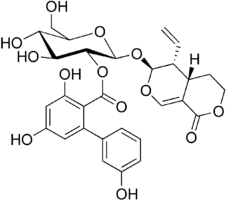
View on Wikipedia Chemical structure of amarogentin
| |
 Chemical structure of amarogentin
| |
| Names | |
|---|---|
| IUPAC name
(4aS,5R,6S)-5-Ethenyl-1-oxo-4,4a,5,6-tetrahydro-1H,3H-pyrano[3,4-c]pyran-6-yl β-D-glucopyranoside 2-(3,3′,5-trihydroxy[1,1′-biphenyl]-2-carboxylate)
| |
| Systematic IUPAC name
(2S,3R,4S,5S,6R)-2-{[(4aS,5R,6S)-5-Ethenyl-1-oxo-4,4a,5,6-tetrahydro-1H,3H-pyrano[3,4-c]pyran-6-yl]oxy}-4,5-dihydroxy-6-(hydroxymethyl)oxan-3-yl 3,3′,5-trihydroxy[1,1′-biphenyl]-2-carboxylate | |
| Identifiers | |
3D model (JSmol)
|
|
| ChEBI | |
| ChEMBL | |
| ChemSpider | |
| ECHA InfoCard | 100.166.688 |
PubChem CID
|
|
| UNII | |
CompTox Dashboard (EPA)
|
|
| |
| |
| Properties | |
| C29H30O13 | |
| Molar mass | 586.546 g·mol−1 |
Except where otherwise noted, data are given for materials in their standard state (at 25 °C [77 °F], 100 kPa).
| |


Amarogentin is a chemical compound found in gentian 7 organisms, including: Swertia chirata (d)[1],[2],[3],[4],[5], Gentiana lutea[6],[7],[8],[9], Gentiana purpurea[10], Gentianella nitida[11],[12], Swertia japonica[13],[14],[15],[16],[17],[18]

Gentian root has a long history of use as a herbal bitter in the treatment of digestive disorders and is an ingredient of many proprietary medicines. The bitter principles of gentian root are secoiridoid glycosides amarogentin and gentiopicrin. The former is one of the most bitter natural compounds known[19] and is used as a scientific basis for measuring bitterness. In humans, it activates the bitter taste receptor TAS2R50.[20] The biphenylcarboxylic acid moiety is biosynthesized by a polyketide-type pathway, with three units of acetyl-CoA and one unit of 3-hydroxybenzoyl-CoA, this being formed from an early shikimate pathway intermediate and not via cinnamic or benzoic acid.[21]
It also shows an antileishmanial activity in animal models[22] being an inhibitor of topoisomerase I.[23]
See also
[edit]References
[edit]- ^ Chang-Zeng Wang, Ulrich H. Maier, Wolfgang Eisenreich, et al.. "Unexpected Biosynthetic Precursors of Amarogentin − A Retrobiosynthetic13C NMR Study". European Journal of Organic Chemistry 2001 (8): pp. 1459-1465. (2002). [[doi:10.1002/1099-0690(200104)2001:8<1459::AID-EJOC1459>3.0.CO;2-0|doi:10.1002/1099-0690(200104)2001:8<1459::AID-EJOC1459>3.0.CO;2-0]].
- ^ Roberto R. Gil. "Amarogentin, a naturally occurring secoiridoid glycoside and a newly recognized inhibitor of topoisomerase I from Leishmania donovani". Journal of Natural Products 59 (1): pp. 27-29. (1996). doi:10.1021/NP960018G. pmid:8984149.
- ^ Prosenjit Saha, Sukta Das. "Regulation of hazardous exposure by protective exposure: modulation of phase II detoxification and lipid peroxidation by Camellia sinensis and Swertia chirata". Birth Defects Research Part B: Developmental and Reproductive Toxicology Suppl 1 (S1): pp. 313-322. (2003). doi:10.1002/TCM.10057. pmid:12616622.
- ^ Hiroyuki Inouye, Yushin Nakamura. "Zwei stark bittere glucoside aus swertia japonica makino: Amarogentin und amaroswerin". Tetrahedron Letters 9 (47): pp. 4919-4924. (1968). doi:10.1016/S0040-4039(00)72792-4.
- ^ Keil M, Härtle B, Guillaume A, et al.. "Production of amarogentin in root cultures of Swertia chirata". Planta Medica 66 (5): pp. 452-457. (2000). doi:10.1055/S-2000-8579. pmid:10909267.
- ^ Hidehiro Ando, Yasuaki Hirai, Mikio Fujii, et al.. "The chemical constituents of fresh Gentian Root". Journal of Natural Medicines 61 (3): pp. 269-279. (2007). doi:10.1007/S11418-007-0143-X.
- ^ Branislav Nastasijevic, Gordana Joksic. "Inhibition of vascular smooth muscle cell proliferation by Gentiana lutea root extracts". PLOS One 8 (4): pp. e61393. (2013). doi:10.1371/JOURNAL.PONE.0061393. pmid:23637826.
- ^ Heymons S, Hölzl J, Weber HC. "Va-Mycorrhiza in Gentiana lutea, the Importance of Cultivation and Influence on Constituents". Planta Medica 52 (6): pp. 510. (1986). doi:10.1055/S-2007-969281. pmid:17345437.
- ^ J. Schultze, Ch. Franz. "SUGARS, BITTER SUBSTANCES AND ESSENTIAL OILS OF GENTIANA LUTEA L. IN DEPENDENCE OF ECOTYPE, PLANT AGE AND STAGE OF DEVELOPMENT". Acta Horticulturae (96): pp. 311-311. (2015). doi:10.17660/ACTAHORTIC.1980.96.30.
- ^ Sz. Nyiredy, C. A. J. Erdelmeier, K. Dallenbach-Toelke, et al.. "Preparative On-Line Overpressure Layer Chromatography (OPLC): a New Separation Technique for Natural Products". Journal of Natural Products 49 (5): pp. 885-891. (2005). doi:10.1021/NP50047A020.
- ^ Kawahara N, Masuda K, Sekita S, et al.. "A new secoiridoid glucoside, amaronitidin, from the Peruvian folk medicine "Hercampuri" (Gentianella nitida).". Chemical & Pharmaceutical Bulletin 49 (6): pp. 771-772. (2001). doi:10.1248/CPB.49.771. pmid:11411536.
- ^ Lacaille-Dubois MA, Galle K, Wagner H. "Secoiridoids and xanthones from Gentianella nitida". Planta Medica 62 (4): pp. 365-368. (1996). doi:10.1055/S-2006-957908. pmid:17252473.
- ^ Kanji Ishimaru, Hiroshi Sudo, Motoyoshi Satake, et al.. "Amarogentin, amaroswerin and four xanthones from hairy root cultures of Swertia japonica". Phytochemistry 29 (5): pp. 1563-1565. (1990). doi:10.1016/0031-9422(90)80122-W.
- ^ Hiroshi KUWAJIMA, Naoki HAYASHI, Kiyokazu TAKAISHI, et al.. "Studies on Monoterpene Glucosides and Related Compounds. LXV. Biosynthesis of the Biphenylcarboxylic Acid Moiety of Amarogentin and Amaroswerin". Journal of the Pharmaceutical Society of Japan 110 (7): pp. 484-489. (2017). doi:10.1248/YAKUSHI1947.110.7_484.
- ^ Kanamori H, Sakamoto I, Mizuta M, et al.. "Studies on the mutagenicity of Swertiae Herba. I. Identification of the mutagenic components". Chemical & Pharmaceutical Bulletin 32 (6): pp. 2290-2295. (1984). doi:10.1248/CPB.32.2290. pmid:6386201.
- ^ Kanamori H, Sakamoto I, Mizuta M, et al.. "Studies on the mutagenicity of swertiae herba. III. Components which become mutagenic on nitrite treatment". Chemical & Pharmaceutical Bulletin 34 (4): pp. 1663-1666. (1986). doi:10.1248/CPB.34.1663. pmid:3719866.
- ^ Ikeshiro Y, Kubota T, Tomita Y. "Two bitter biphenyl glucosides from Swertia japonica". Planta Medica 47 (1): pp. 26-29. (1983). doi:10.1055/S-2007-969942. pmid:17405087.
- ^ Y. Takino, M. Koshioka, M. Kawaguchi, et al.. "Quantitative Determination of Bitter Components in Swertiae Herba". Planta Medica 38 (04): pp. 351-355. (2008). doi:10.1055/S-2008-1074888.
- ^ Heilpflanzen:Gentiana lutea Archived 2009-09-02 at the Wayback Machine (German)
- ^ Behrens, Maik; Brockhoff, Anne; Batram, Claudia; Kuhn, Christina; Appendino, Giovanni; Meyerhof, Wolfgang (2009). "The Human Bitter Taste Receptor hTAS2R50 is Activated by the Two Natural Bitter Terpenoids Andrographolide and Amarogentin". Journal of Agricultural and Food Chemistry. 57 (21): 9860–6. Bibcode:2009JAFC...57.9860B. doi:10.1021/jf9014334. PMID 19817411.
- ^ Wang, Chang-Zeng; Maier, Ulrich H.; Eisenreich, Wolfgang; Adam, Petra; Obersteiner, Ingrid; Keil, Michael; Bacher, Adelbert; Zenk, Meinhart H. (2001). "Unexpected Biosynthetic Precursors of Amarogentin − A Retrobiosynthetic13C NMR Study". European Journal of Organic Chemistry. 2001 (8): 1459. doi:10.1002/1099-0690(200104)2001:8<1459::AID-EJOC1459>3.0.CO;2-0.
- ^ Medda, S.; Mukhopadhyay, S; Basu, MK (1999). "Evaluation of the in-vivo activity and toxicity of amarogentin, an antileishmanial agent, in both liposomal and niosomal forms". Journal of Antimicrobial Chemotherapy. 44 (6): 791–4. doi:10.1093/jac/44.6.791. PMID 10590280.
- ^ Ray, Sutapa; Majumder, Hemanta K.; Chakravarty, Ajit K.; Mukhopadhyay, Sibabrata; Gil, Roberto R.; Cordell, Geoffrey A. (1996). "Amarogentin, a Naturally Occurring Secoiridoid Glycoside and a Newly Recognized Inhibitor of Topoisomerase I fromLeishmania donovani". Journal of Natural Products. 59 (1): 27–29. Bibcode:1996JNAtP..59...27R. doi:10.1021/np960018g. PMID 8984149.