


Community hub
Recent from talks
Contribute something to knowledge base
Content stats: 0 posts, 0 articles, 1 media, 0 notes
Members stats: 0 subscribers, 0 contributors, 0 moderators, 0 supporters
Subscribers
Supporters
Contributors
Moderators
Hub AI
America the Beautiful AI simulator
(@America the Beautiful_simulator)
Hub AI
America the Beautiful AI simulator
(@America the Beautiful_simulator)
America the Beautiful
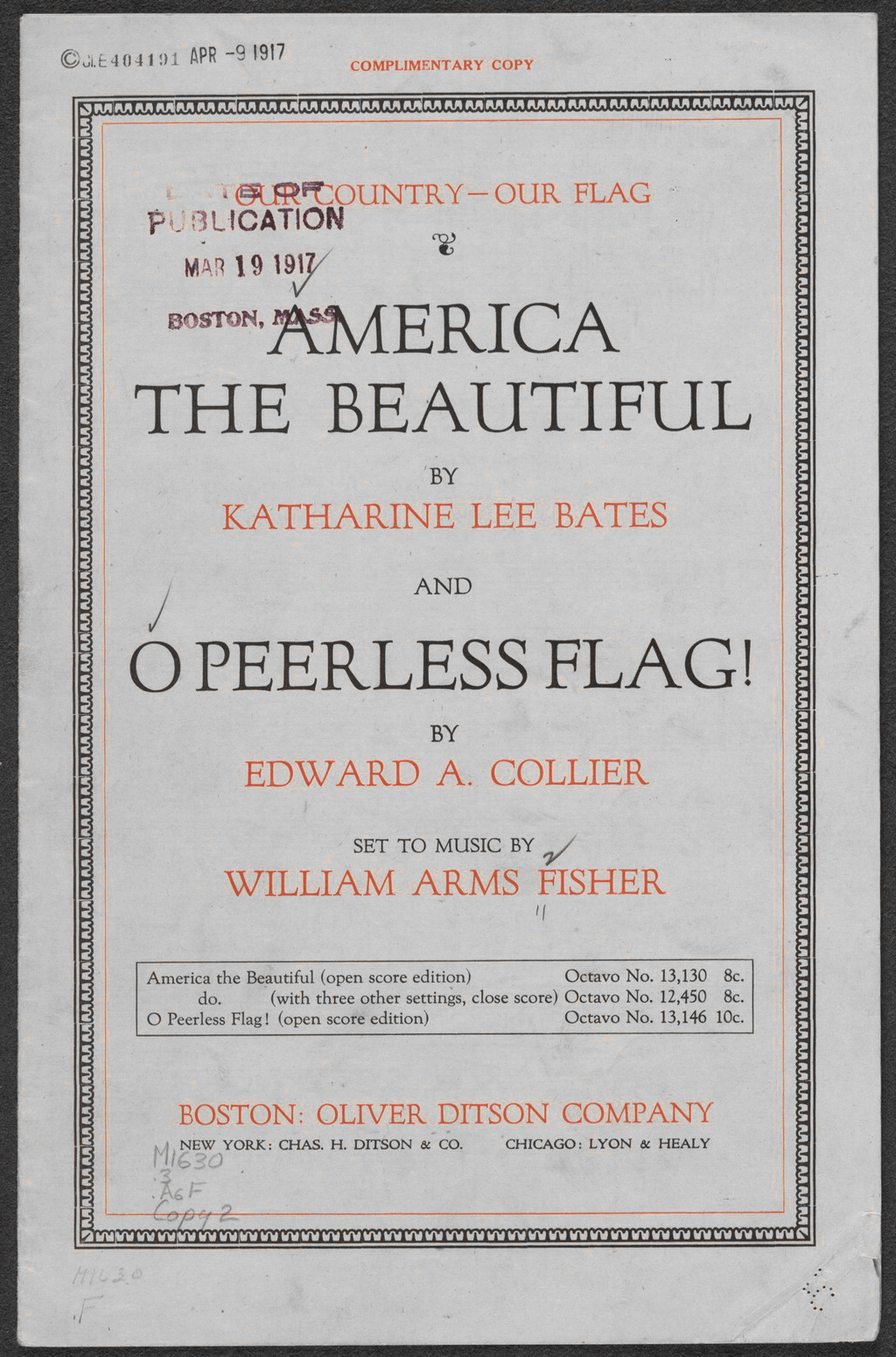
"America the Beautiful" is an American patriotic song. Its lyrics were written by Katharine Lee Bates and its music was composed by church organist and choirmaster Samuel A. Ward at Grace Episcopal Church in Newark, New Jersey, though the two never met.
Bates wrote the words as a poem, originally titled "Pikes Peak". It was first published in the Fourth of July 1895 edition of the church periodical, The Congregationalist. At that time, the poem was titled "America".
Ward had initially composed the song's melody in 1882 to accompany lyrics to "Materna", basis of the hymn, "O Mother dear, Jerusalem", though the hymn was not first published until 1892. The combination of Ward's melody and Bates's poem was first entitled "America the Beautiful" in 1910. The song is one of the most popular of the many American patriotic songs.
In 1893, at the age of 33, Bates, an English professor at Wellesley College, had taken a train trip to Colorado Springs, Colorado, to teach at Colorado College. Several of the sights on her trip inspired her, and they found their way into her poem, including the World's Columbian Exposition in Chicago, the "White City" with its promise of the future contained within its gleaming white buildings; the wheat fields of North America's heartland Kansas, through which her train was riding on July 16; and the majestic view of the Great Plains from high atop Pikes Peak.
On the pinnacle of that mountain, the words of the poem started to come to her, and she wrote them down upon returning to her hotel room at the original Antlers Hotel. The poem was initially published two years later in The Congregationalist to commemorate the Fourth of July. It quickly caught the public's fancy. An amended version was published in 1904.
The first known melody written for the song was sent in by Silas Pratt when the poem was published in The Congregationalist. By 1900, at least 75 different melodies had been written. A hymn tune composed in 1882 by Samuel A. Ward, the organist and choir director at Grace Church, Newark, was generally considered the best music as early as 1910 and is still the popular tune today. Just as Bates had been inspired to write her poem, Ward, too, was inspired. The tune came to him while he was on a ferryboat trip from Coney Island back to his home in New York City after a leisurely summer day and he immediately wrote it down. He composed the tune for the old hymn "O Mother Dear, Jerusalem", retitling the work "Materna". Ward's music combined with Bates's poem were first published together in 1910 and titled "America the Beautiful".
Ward died in 1903, not knowing the national stature his music would attain. The song's popularity was well established by the time of Bates's death in 1929. It is included in songbooks in many religious congregations in the United States.
At various times in the more than one hundred years that have elapsed since the song was written, particularly during the John F. Kennedy administration, there have been efforts to give "America the Beautiful" legal status either as a national hymn or as a national anthem equal to, or in place of, "The Star-Spangled Banner", but so far this has not succeeded. Proponents prefer "America the Beautiful" for various reasons, saying it is easier to sing, more melodic, and more adaptable to new orchestrations while still remaining as easily recognizable as "The Star-Spangled Banner". Some object to the war-oriented imagery of "The Star-Spangled Banner", as well as its implicit support of slavery and racism in the third verse. Some who prefer "The Star-Spangled Banner", however, prefer it specifically for its war themes. While that national dichotomy has stymied any effort at changing the tradition of the national anthem, "America the Beautiful" continues to be held in high esteem by a large number of Americans, and was even being considered before 1931 as a candidate to become the national anthem of the United States.
America the Beautiful
"America the Beautiful" is an American patriotic song. Its lyrics were written by Katharine Lee Bates and its music was composed by church organist and choirmaster Samuel A. Ward at Grace Episcopal Church in Newark, New Jersey, though the two never met.
Bates wrote the words as a poem, originally titled "Pikes Peak". It was first published in the Fourth of July 1895 edition of the church periodical, The Congregationalist. At that time, the poem was titled "America".
Ward had initially composed the song's melody in 1882 to accompany lyrics to "Materna", basis of the hymn, "O Mother dear, Jerusalem", though the hymn was not first published until 1892. The combination of Ward's melody and Bates's poem was first entitled "America the Beautiful" in 1910. The song is one of the most popular of the many American patriotic songs.
In 1893, at the age of 33, Bates, an English professor at Wellesley College, had taken a train trip to Colorado Springs, Colorado, to teach at Colorado College. Several of the sights on her trip inspired her, and they found their way into her poem, including the World's Columbian Exposition in Chicago, the "White City" with its promise of the future contained within its gleaming white buildings; the wheat fields of North America's heartland Kansas, through which her train was riding on July 16; and the majestic view of the Great Plains from high atop Pikes Peak.
On the pinnacle of that mountain, the words of the poem started to come to her, and she wrote them down upon returning to her hotel room at the original Antlers Hotel. The poem was initially published two years later in The Congregationalist to commemorate the Fourth of July. It quickly caught the public's fancy. An amended version was published in 1904.
The first known melody written for the song was sent in by Silas Pratt when the poem was published in The Congregationalist. By 1900, at least 75 different melodies had been written. A hymn tune composed in 1882 by Samuel A. Ward, the organist and choir director at Grace Church, Newark, was generally considered the best music as early as 1910 and is still the popular tune today. Just as Bates had been inspired to write her poem, Ward, too, was inspired. The tune came to him while he was on a ferryboat trip from Coney Island back to his home in New York City after a leisurely summer day and he immediately wrote it down. He composed the tune for the old hymn "O Mother Dear, Jerusalem", retitling the work "Materna". Ward's music combined with Bates's poem were first published together in 1910 and titled "America the Beautiful".
Ward died in 1903, not knowing the national stature his music would attain. The song's popularity was well established by the time of Bates's death in 1929. It is included in songbooks in many religious congregations in the United States.
At various times in the more than one hundred years that have elapsed since the song was written, particularly during the John F. Kennedy administration, there have been efforts to give "America the Beautiful" legal status either as a national hymn or as a national anthem equal to, or in place of, "The Star-Spangled Banner", but so far this has not succeeded. Proponents prefer "America the Beautiful" for various reasons, saying it is easier to sing, more melodic, and more adaptable to new orchestrations while still remaining as easily recognizable as "The Star-Spangled Banner". Some object to the war-oriented imagery of "The Star-Spangled Banner", as well as its implicit support of slavery and racism in the third verse. Some who prefer "The Star-Spangled Banner", however, prefer it specifically for its war themes. While that national dichotomy has stymied any effort at changing the tradition of the national anthem, "America the Beautiful" continues to be held in high esteem by a large number of Americans, and was even being considered before 1931 as a candidate to become the national anthem of the United States.
Recent media
Recent media