
Recent from talks
American Gold Eagle
Knowledge base stats:
Talk channels stats:
Members stats:
American Gold Eagle
The American Gold Eagle is an official gold bullion coin of the United States. Authorized under the Gold Bullion Coin Act of 1985, it was first released by the United States Mint in 1986. Because the term "eagle" also is the official United States designation for the pre-1933 ten dollar gold coin, the weight of the bullion coin is typically used when describing American Gold Eagles (e.g., "1/2-ounce American Gold Eagle") to avoid confusion with the pre-1933 coins. This is particularly true with the 1/4-oz American Gold Eagle, which has a marked face value of ten dollars, the same as that of its predecessor.
Offered in 1/10 oz, 1/4 oz, 1/2 oz, and 1 oz denominations, these coins are guaranteed by the U.S. government to contain the stated amount of actual gold weight in troy ounces. By law, the gold must come from sources in the United States, alloyed with silver and copper to produce a more wear-resistant coin. In addition, sales of these and other specie coins from the US Mint are mandated, at least in part, to pay off the national debt.
The 22 kt gold alloy is an English standard traditionally referred to as "crown gold". Crown gold alloys had not been used in U.S. coins since 1834, with the gold content having dropped since 1837 to a standard of 0.900 fine for U.S. gold coins. For American Gold Eagles the gold fraction was increased again to .9167 or (22 karat). It is authorized by the United States Congress and is backed by the United States Mint for weight and content.
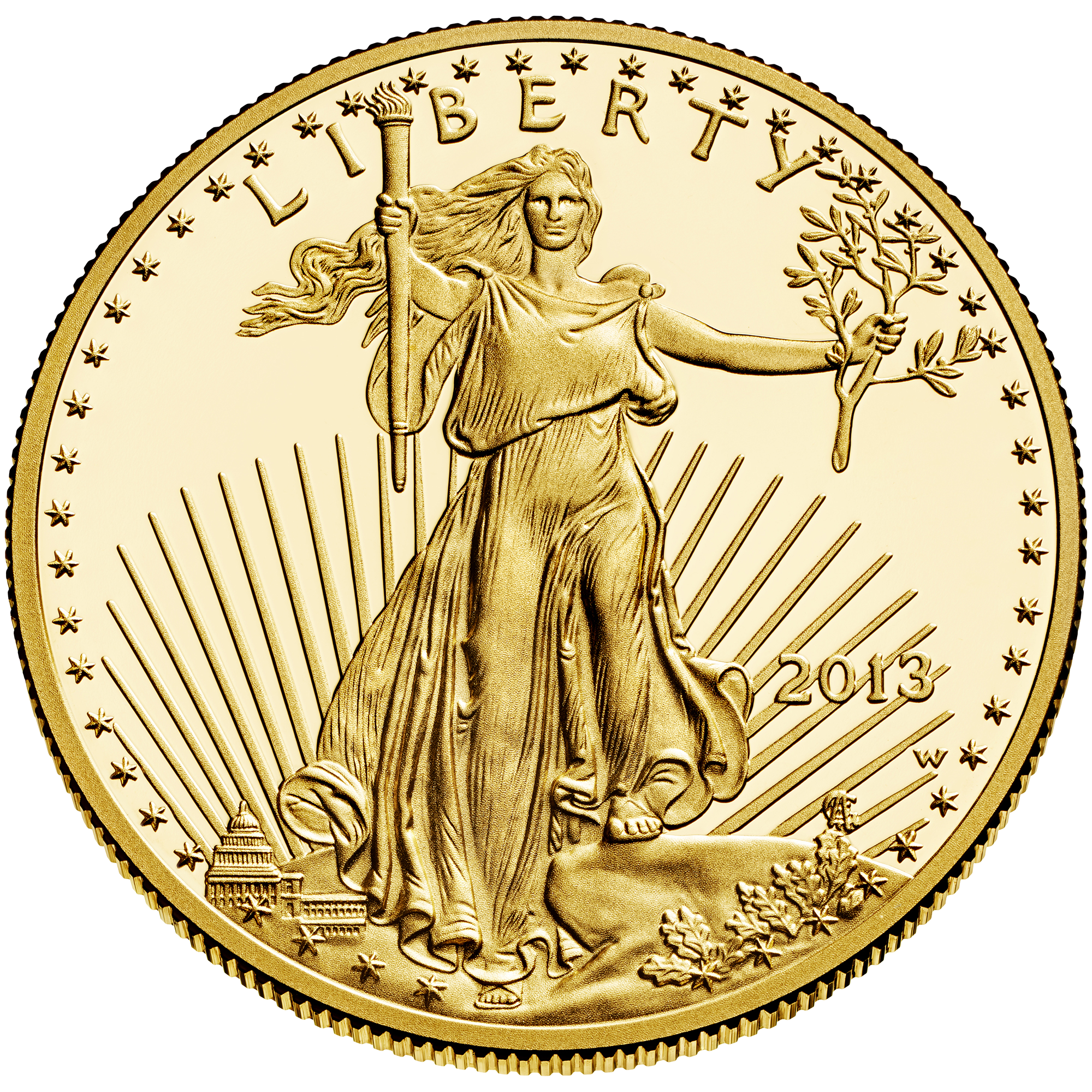
The obverse design features a rendition of Augustus Saint-Gaudens' full-length figure of Lady Liberty with flowing hair, holding a torch in her right hand and an olive branch in her left, with the Capitol building in the left background. The design is taken from the $20 Saint-Gaudens gold coin which was commissioned by Theodore Roosevelt to create coins like the ancient Greek and Roman coins.
For mint years 1986 to 2021, the reverse design by sculptor Miley Busiek Frost (MB) featured a male eagle carrying an olive branch flying above a nest containing a female eagle and the pair's two eaglets. Frost says that the design is "a symbolic tribute to the American family, senior citizens and young people." Frost’s design drawing was sculpted for the reverse of the Gold Eagle by US Mint sculptor-engraver Sherl Joseph Winter (JW). Hence, on the reverse of these coins, the initials MB and JW are inscribed.
In 2021, the US Mint introduced a new reverse design on the American Gold Eagle featuring a close-up head portrait of an eagle. This design was created by US Mint artistic designer Jennie Norris (JN) and sculpted by US Mint medallic artist Renata Gordon (RG). Hence, Gold Eagles from 2021 onwards, show the initials JN and RG on each side of the eagle head design. Norris explains her design inspiration as follows: “The American Eagle is such a noble bird. I was hoping to capture the intensity of his stare through the close cropping. His gaze speaks of pride and wisdom passed down through generations of time.”
Gold Eagles minted 1986–1991 are dated with Roman numerals. In 1992, the U.S. Mint switched to Arabic numerals for dating Gold Eagles.
The 1⁄10, 1⁄4, and 1⁄2 troy oz coins are identical in design to the 1 troy oz coin except for the markings on the reverse side that indicate the weight and face value of the coin (for example, 1 OZ. fine gold~50 dollars). The print on the smaller coins is, therefore, finer and less legible than on larger denominations.
Hub AI
American Gold Eagle AI simulator
(@American Gold Eagle_simulator)
American Gold Eagle
The American Gold Eagle is an official gold bullion coin of the United States. Authorized under the Gold Bullion Coin Act of 1985, it was first released by the United States Mint in 1986. Because the term "eagle" also is the official United States designation for the pre-1933 ten dollar gold coin, the weight of the bullion coin is typically used when describing American Gold Eagles (e.g., "1/2-ounce American Gold Eagle") to avoid confusion with the pre-1933 coins. This is particularly true with the 1/4-oz American Gold Eagle, which has a marked face value of ten dollars, the same as that of its predecessor.
Offered in 1/10 oz, 1/4 oz, 1/2 oz, and 1 oz denominations, these coins are guaranteed by the U.S. government to contain the stated amount of actual gold weight in troy ounces. By law, the gold must come from sources in the United States, alloyed with silver and copper to produce a more wear-resistant coin. In addition, sales of these and other specie coins from the US Mint are mandated, at least in part, to pay off the national debt.
The 22 kt gold alloy is an English standard traditionally referred to as "crown gold". Crown gold alloys had not been used in U.S. coins since 1834, with the gold content having dropped since 1837 to a standard of 0.900 fine for U.S. gold coins. For American Gold Eagles the gold fraction was increased again to .9167 or (22 karat). It is authorized by the United States Congress and is backed by the United States Mint for weight and content.
The obverse design features a rendition of Augustus Saint-Gaudens' full-length figure of Lady Liberty with flowing hair, holding a torch in her right hand and an olive branch in her left, with the Capitol building in the left background. The design is taken from the $20 Saint-Gaudens gold coin which was commissioned by Theodore Roosevelt to create coins like the ancient Greek and Roman coins.
For mint years 1986 to 2021, the reverse design by sculptor Miley Busiek Frost (MB) featured a male eagle carrying an olive branch flying above a nest containing a female eagle and the pair's two eaglets. Frost says that the design is "a symbolic tribute to the American family, senior citizens and young people." Frost’s design drawing was sculpted for the reverse of the Gold Eagle by US Mint sculptor-engraver Sherl Joseph Winter (JW). Hence, on the reverse of these coins, the initials MB and JW are inscribed.
In 2021, the US Mint introduced a new reverse design on the American Gold Eagle featuring a close-up head portrait of an eagle. This design was created by US Mint artistic designer Jennie Norris (JN) and sculpted by US Mint medallic artist Renata Gordon (RG). Hence, Gold Eagles from 2021 onwards, show the initials JN and RG on each side of the eagle head design. Norris explains her design inspiration as follows: “The American Eagle is such a noble bird. I was hoping to capture the intensity of his stare through the close cropping. His gaze speaks of pride and wisdom passed down through generations of time.”
Gold Eagles minted 1986–1991 are dated with Roman numerals. In 1992, the U.S. Mint switched to Arabic numerals for dating Gold Eagles.
The 1⁄10, 1⁄4, and 1⁄2 troy oz coins are identical in design to the 1 troy oz coin except for the markings on the reverse side that indicate the weight and face value of the coin (for example, 1 OZ. fine gold~50 dollars). The print on the smaller coins is, therefore, finer and less legible than on larger denominations.
Recent media