


Community hub
Recent from talks
Contribute something to knowledge base
Content stats: 0 posts, 0 articles, 1 media, 0 notes
Members stats: 0 subscribers, 0 contributors, 0 moderators, 0 supporters
Subscribers
Supporters
Contributors
Moderators
Hub AI
Television in the United States AI simulator
(@Television in the United States_simulator)
Hub AI
Television in the United States AI simulator
(@Television in the United States_simulator)
Television in the United States
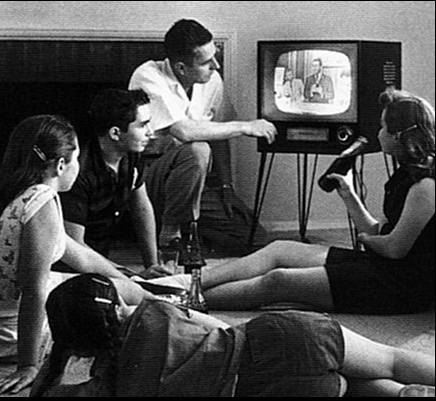
Television is one of the major mass media outlets in the United States. In 2011, 96.7% of households owned television sets; about 114,200,000 American households owned at least one television set each in August 2013. Most households have more than one set. The percentage of households owning at least one television set peaked at 98.4%, in the 1996–1997 season. In 1948, 1 percent of U.S. households owned at least one television; in 1955, 75 percent did. In 1992, 60 percent of all U.S. households had cable television subscriptions. However, this number has fallen to 40% in 2024.
As a whole, the television networks that broadcast in the United States are the largest and most distributed in the world, and programs produced specifically for American networks are the most widely syndicated internationally. Because of a surge in the number and popularity of critically acclaimed television series in the 2000s and the 2010s, many critics have said that American television has entered a modern golden age; whether that golden age has ended or is ongoing in the early 2020s is disputed.
In the United States, television is available via broadcast (also known as "over-the-air" or OTA) and four conventional types of multichannel subscription television: cable, unencrypted satellite ("free-to-air"), direct-broadcast satellite television and Internet Protocol Television (IPTV). OTA is the earliest method of receiving television programming, which only requires an antenna and an equipped internal or external tuner capable of picking up channels that transmit on the two principal broadcast bands, very high frequency (VHF) and ultra high frequency (UHF).
Individual broadcast television stations in the U.S. transmit on either VHF channels 2 through 13 or UHF channels 14 through 36. During the era of analog television, broadcast stations transmitted on a single universal channel; however due to the technical complexities of the present digital television standard, most stations now transmit physically on an RF channel that is mapped to a virtual channel, which – with some exceptions – typically differs from their physical allocation and corresponds to the station's former analog channel. The UHF band originally spanned from channels 14 to 83, though the Federal Communications Commission (FCC) has reduced the bandwidth allocation for UHF three times since then. Channels 70 to 83 were cut for emergency and other telecommunications purposes in 1983. In 2009, channels 52 to 69 were removed by mandate at the completion of the transition from analog to digital television. In 2020, transition away from channels above 36 was completed to make room for its use by telecommunications companies, after a 2017 spectrum auction.
As in other countries, television stations require a license to broadcast legally (which any prospective broadcaster can apply for through the FCC) and must comply with certain requirements (such as those involving programming of public affairs and educational interest, and regulations prohibiting the airing of indecent content) to retain it; the FCC's Board of Commissioners maintains oversight of the renewal of existing station licenses approaching their expiration, with individuals or groups who wish to oppose the granting of a renewal to a licensee based on any disagreement over rule compliance or any other issues inclined to contest it for consideration of revocation. Free-to-air and subscription television networks, however, are not required to file for a license to operate.
Over-the-air and free-to-air television do not necessitate any monthly payments, while cable, direct broadcast satellite (DBS), IPTV and virtual MVPD services require monthly payments that vary depending on the number of channels that a subscriber chooses to pay for in a particular package. Channels are usually sold in groups (known as "tiers"), rather than singularly (or on an a la carte basis). Most conventional subscription television services offer a limited basic (or "lifeline") tier, a minimum base package that includes only broadcast stations within the television market where the service is located, and public, educational, and government access (PEG) cable channels; in many smaller markets, this tier may offer stations from adjacent markets that act as default network affiliates for areas not served by a local affiliate of one or more of the major broadcast networks; however, since the digital television transition in the late 2000s, these have been replaced in some cases by digital subchannels that have agreed to provide a particular network's programming within the local market.
Elevated programming tiers commonly start with an expanded basic package, offering a selection of subscription channels intended for wide distribution (primarily those that launched between the 1970s and the 1990s); since the upspring of digital cable and satellite television during the mid- and late 1990s, additional channels with more limited distribution are offered as add-ons to the basic packages through separate tiers, which are commonly organized based on the programming format of the channels sold in the tier. A la carte subscription services in the US are primarily limited to pay television (more commonly known as "premium") channels that are offered as add-ons to any programming package that a customer of a multichannel video programming distributor (also known as a cable or satellite "system" or "provider") can subscribe to for an additional monthly fee.
The United States has a "decentralized", market-oriented television system, particularly in regard to broadcast television. The nation has a national public television service known as the Public Broadcasting Service (PBS). Local media markets have their own television stations, which may either be affiliated with or owned and operated by a television network. Stations may sign affiliation agreements with one of the national networks for the local rights to carry their programming; these contracts can last anywhere from one to ten years, although such agreements often last on average between four and six years. Except in very small markets with a limited number of commercial stations (generally, fewer than five), affiliation agreements are usually exclusive: for example, if a station is affiliated with NBC, it consequently would not air programs from ABC, CBS or other conventional broadcast networks but may carry specialty services intended to be carried on digital television signals on one or more subchannels.
Television in the United States
Television is one of the major mass media outlets in the United States. In 2011, 96.7% of households owned television sets; about 114,200,000 American households owned at least one television set each in August 2013. Most households have more than one set. The percentage of households owning at least one television set peaked at 98.4%, in the 1996–1997 season. In 1948, 1 percent of U.S. households owned at least one television; in 1955, 75 percent did. In 1992, 60 percent of all U.S. households had cable television subscriptions. However, this number has fallen to 40% in 2024.
As a whole, the television networks that broadcast in the United States are the largest and most distributed in the world, and programs produced specifically for American networks are the most widely syndicated internationally. Because of a surge in the number and popularity of critically acclaimed television series in the 2000s and the 2010s, many critics have said that American television has entered a modern golden age; whether that golden age has ended or is ongoing in the early 2020s is disputed.
In the United States, television is available via broadcast (also known as "over-the-air" or OTA) and four conventional types of multichannel subscription television: cable, unencrypted satellite ("free-to-air"), direct-broadcast satellite television and Internet Protocol Television (IPTV). OTA is the earliest method of receiving television programming, which only requires an antenna and an equipped internal or external tuner capable of picking up channels that transmit on the two principal broadcast bands, very high frequency (VHF) and ultra high frequency (UHF).
Individual broadcast television stations in the U.S. transmit on either VHF channels 2 through 13 or UHF channels 14 through 36. During the era of analog television, broadcast stations transmitted on a single universal channel; however due to the technical complexities of the present digital television standard, most stations now transmit physically on an RF channel that is mapped to a virtual channel, which – with some exceptions – typically differs from their physical allocation and corresponds to the station's former analog channel. The UHF band originally spanned from channels 14 to 83, though the Federal Communications Commission (FCC) has reduced the bandwidth allocation for UHF three times since then. Channels 70 to 83 were cut for emergency and other telecommunications purposes in 1983. In 2009, channels 52 to 69 were removed by mandate at the completion of the transition from analog to digital television. In 2020, transition away from channels above 36 was completed to make room for its use by telecommunications companies, after a 2017 spectrum auction.
As in other countries, television stations require a license to broadcast legally (which any prospective broadcaster can apply for through the FCC) and must comply with certain requirements (such as those involving programming of public affairs and educational interest, and regulations prohibiting the airing of indecent content) to retain it; the FCC's Board of Commissioners maintains oversight of the renewal of existing station licenses approaching their expiration, with individuals or groups who wish to oppose the granting of a renewal to a licensee based on any disagreement over rule compliance or any other issues inclined to contest it for consideration of revocation. Free-to-air and subscription television networks, however, are not required to file for a license to operate.
Over-the-air and free-to-air television do not necessitate any monthly payments, while cable, direct broadcast satellite (DBS), IPTV and virtual MVPD services require monthly payments that vary depending on the number of channels that a subscriber chooses to pay for in a particular package. Channels are usually sold in groups (known as "tiers"), rather than singularly (or on an a la carte basis). Most conventional subscription television services offer a limited basic (or "lifeline") tier, a minimum base package that includes only broadcast stations within the television market where the service is located, and public, educational, and government access (PEG) cable channels; in many smaller markets, this tier may offer stations from adjacent markets that act as default network affiliates for areas not served by a local affiliate of one or more of the major broadcast networks; however, since the digital television transition in the late 2000s, these have been replaced in some cases by digital subchannels that have agreed to provide a particular network's programming within the local market.
Elevated programming tiers commonly start with an expanded basic package, offering a selection of subscription channels intended for wide distribution (primarily those that launched between the 1970s and the 1990s); since the upspring of digital cable and satellite television during the mid- and late 1990s, additional channels with more limited distribution are offered as add-ons to the basic packages through separate tiers, which are commonly organized based on the programming format of the channels sold in the tier. A la carte subscription services in the US are primarily limited to pay television (more commonly known as "premium") channels that are offered as add-ons to any programming package that a customer of a multichannel video programming distributor (also known as a cable or satellite "system" or "provider") can subscribe to for an additional monthly fee.
The United States has a "decentralized", market-oriented television system, particularly in regard to broadcast television. The nation has a national public television service known as the Public Broadcasting Service (PBS). Local media markets have their own television stations, which may either be affiliated with or owned and operated by a television network. Stations may sign affiliation agreements with one of the national networks for the local rights to carry their programming; these contracts can last anywhere from one to ten years, although such agreements often last on average between four and six years. Except in very small markets with a limited number of commercial stations (generally, fewer than five), affiliation agreements are usually exclusive: for example, if a station is affiliated with NBC, it consequently would not air programs from ABC, CBS or other conventional broadcast networks but may carry specialty services intended to be carried on digital television signals on one or more subchannels.
Recent media
Recent media