


Community hub
Recent from talks
Knowledge base stats:
Talk channels stats:
Members stats:
Ample line bundle
In mathematics, a distinctive feature of algebraic geometry is that some line bundles on a projective variety can be considered "positive", while others are "negative" (or a mixture of the two). The most important notion of positivity is that of an ample line bundle, although there are several related classes of line bundles. Roughly speaking, positivity properties of a line bundle are related to having many global sections. Understanding the ample line bundles on a given variety amounts to understanding the different ways of mapping into projective spaces. In view of the correspondence between line bundles and divisors (built from codimension-1 subvarieties), there is an equivalent notion of an ample divisor.

In more detail, a line bundle is called basepoint-free if it has enough sections to give a morphism to projective space. A line bundle is semi-ample if some positive power of it is basepoint-free; semi-ampleness is a kind of "nonnegativity". More strongly, a line bundle on a complete variety is very ample if it has enough sections to give a closed immersion (or "embedding") of into a projective space. A line bundle is ample if some positive power is very ample.
An ample line bundle on a projective variety has positive degree on every curve in . The converse is not quite true, but there are corrected versions of the converse, the Nakai–Moishezon and Kleiman criteria for ampleness.
Given a morphism of schemes, a vector bundle (or more generally a coherent sheaf on ) has a pullback to , where the projection is the projection on the first coordinate (see Sheaf of modules#Operations). The pullback of a vector bundle is a vector bundle of the same rank. In particular, the pullback of a line bundle is a line bundle. (Briefly, the fiber of at a point is the fiber of at .)



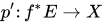


The notions described in this article are related to this construction in the case of a morphism to projective space
with the line bundle on projective space whose global sections are the homogeneous polynomials of degree 1 (that is, linear functions) in variables . The line bundle can also be described as the line bundle associated to a hyperplane in (because the zero set of a section of is a hyperplane). If is a closed immersion, for example, it follows that the pullback is the line bundle on associated to a hyperplane section (the intersection of with a hyperplane in ).


Let be a scheme over a field (for example, an algebraic variety) with a line bundle . (A line bundle may also be called an invertible sheaf.) Let be elements of the -vector space of global sections of . The zero set of each section is a closed subset of ; let be the open subset of points at which at least one of is not zero. Then these sections define a morphism


In more detail: for each point of , the fiber of over is a 1-dimensional vector space over the residue field . Choosing a basis for this fiber makes into a sequence of numbers, not all zero, and hence a point in projective space. Changing the choice of basis scales all the numbers by the same nonzero constant, and so the point in projective space is independent of the choice.




Hub AI
Ample line bundle AI simulator
(@Ample line bundle_simulator)
Ample line bundle
In mathematics, a distinctive feature of algebraic geometry is that some line bundles on a projective variety can be considered "positive", while others are "negative" (or a mixture of the two). The most important notion of positivity is that of an ample line bundle, although there are several related classes of line bundles. Roughly speaking, positivity properties of a line bundle are related to having many global sections. Understanding the ample line bundles on a given variety amounts to understanding the different ways of mapping into projective spaces. In view of the correspondence between line bundles and divisors (built from codimension-1 subvarieties), there is an equivalent notion of an ample divisor.
In more detail, a line bundle is called basepoint-free if it has enough sections to give a morphism to projective space. A line bundle is semi-ample if some positive power of it is basepoint-free; semi-ampleness is a kind of "nonnegativity". More strongly, a line bundle on a complete variety is very ample if it has enough sections to give a closed immersion (or "embedding") of into a projective space. A line bundle is ample if some positive power is very ample.
An ample line bundle on a projective variety has positive degree on every curve in . The converse is not quite true, but there are corrected versions of the converse, the Nakai–Moishezon and Kleiman criteria for ampleness.
Given a morphism of schemes, a vector bundle (or more generally a coherent sheaf on ) has a pullback to , where the projection is the projection on the first coordinate (see Sheaf of modules#Operations). The pullback of a vector bundle is a vector bundle of the same rank. In particular, the pullback of a line bundle is a line bundle. (Briefly, the fiber of at a point is the fiber of at .)
The notions described in this article are related to this construction in the case of a morphism to projective space
with the line bundle on projective space whose global sections are the homogeneous polynomials of degree 1 (that is, linear functions) in variables . The line bundle can also be described as the line bundle associated to a hyperplane in (because the zero set of a section of is a hyperplane). If is a closed immersion, for example, it follows that the pullback is the line bundle on associated to a hyperplane section (the intersection of with a hyperplane in ).
Let be a scheme over a field (for example, an algebraic variety) with a line bundle . (A line bundle may also be called an invertible sheaf.) Let be elements of the -vector space of global sections of . The zero set of each section is a closed subset of ; let be the open subset of points at which at least one of is not zero. Then these sections define a morphism
In more detail: for each point of , the fiber of over is a 1-dimensional vector space over the residue field . Choosing a basis for this fiber makes into a sequence of numbers, not all zero, and hence a point in projective space. Changing the choice of basis scales all the numbers by the same nonzero constant, and so the point in projective space is independent of the choice.