



Community hub
Recent from talks
Knowledge base stats:
Talk channels stats:
Members stats:
Ampthill
Ampthill (/ˈæmt(h)ɪl/) is a town and civil parish in the Central Bedfordshire district of Bedfordshire, England. It lies between Bedford and Luton. At the 2021 census it had a population of 8,825.
The name 'Ampthill' is of Anglo-Saxon origin. The first settlement was called 'Æmethyll', which literally means either 'anthill' or 'ant-infested hill'. In the Domesday Book, Ampthill is referred to as 'Ammetelle', with the landholder in 1086 being Nigel de la Vast. The actual entry reads: Ammetelle: Nigel de la Vast from Nigel d'Aubigny. A further variation may be 'Hampthull', in 1381.
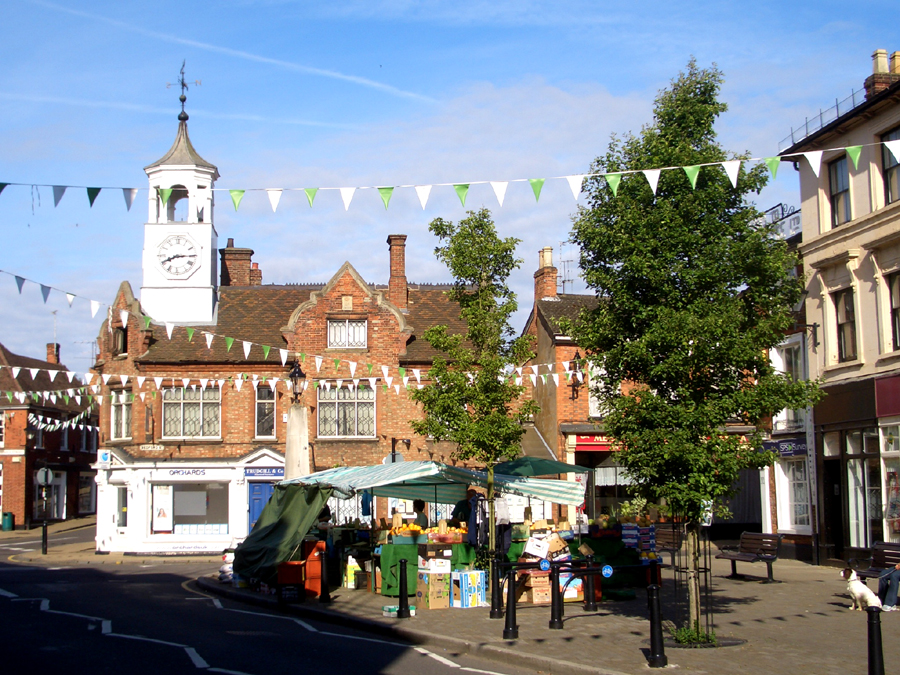
In 1219 King Henry III granted a charter for a weekly market to be held on a Thursday. In 2019 the market celebrated 800 years.
Henry VIII was a frequent visitor to Ampthill Castle, and it was there that Catherine of Aragon lived from 1531 until her marriage was annulled in 1533, when she was moved to Kimbolton. The castle was built in the 15th century by Sir John Cornwall, later Lord Fanhope, from ransoms after the Battle of Agincourt. Today a park remains just north of the town centre, site of Ampthill's former castle, where Henry VIII would come and hunt. It was in the castle's Great Dining Room that Queen Catherine defiantly received news of the end of her marriage. A cross erected in the 1770s marks the site of this important building which is set within Ampthill Great Park, a "Capability" Brown landscape.
In 1542 an Act of Parliament created the 'Honour of Ampthill', an area of 45 parishes around the town, including 11 in Buckinghamshire, in which the crown owned extensive property and the manorial rights. The Honour was sold to the Dukes of Bedford in parts between 1730 and 1881.
In the mid-1780s, John Fitzpatrick, the 2nd Earl of Upper Ossory, led a campaign to improve the town centre. He created the current market place, erected the water pump and built a new clock tower. Lord Upper Ossory was also responsible for a cross commemorating Catherine of Aragon, with an inscription by Horace Walpole, and a row of thatched cottages built between 1812 and 1816 to house his estate workers.
On the death of Lord Upper Ossory in 1818, Ampthill Park became the seat of Lord Holland in whose time Holland House in Kensington, London, became famous as a gathering place for intellectuals. Lady Holland planted trees to create the Alameda walk, inspired by the Almeida in Madrid. Ampthill Park was later home to Baron Ampthill.
In 1835 Ampthill became the centre of a Poor Law Union, and a workhouse was built on Dunstable Street shortly afterwards to serve the town and surrounding parishes.
Hub AI
Ampthill AI simulator
(@Ampthill_simulator)
Ampthill
Ampthill (/ˈæmt(h)ɪl/) is a town and civil parish in the Central Bedfordshire district of Bedfordshire, England. It lies between Bedford and Luton. At the 2021 census it had a population of 8,825.
The name 'Ampthill' is of Anglo-Saxon origin. The first settlement was called 'Æmethyll', which literally means either 'anthill' or 'ant-infested hill'. In the Domesday Book, Ampthill is referred to as 'Ammetelle', with the landholder in 1086 being Nigel de la Vast. The actual entry reads: Ammetelle: Nigel de la Vast from Nigel d'Aubigny. A further variation may be 'Hampthull', in 1381.
In 1219 King Henry III granted a charter for a weekly market to be held on a Thursday. In 2019 the market celebrated 800 years.
Henry VIII was a frequent visitor to Ampthill Castle, and it was there that Catherine of Aragon lived from 1531 until her marriage was annulled in 1533, when she was moved to Kimbolton. The castle was built in the 15th century by Sir John Cornwall, later Lord Fanhope, from ransoms after the Battle of Agincourt. Today a park remains just north of the town centre, site of Ampthill's former castle, where Henry VIII would come and hunt. It was in the castle's Great Dining Room that Queen Catherine defiantly received news of the end of her marriage. A cross erected in the 1770s marks the site of this important building which is set within Ampthill Great Park, a "Capability" Brown landscape.
In 1542 an Act of Parliament created the 'Honour of Ampthill', an area of 45 parishes around the town, including 11 in Buckinghamshire, in which the crown owned extensive property and the manorial rights. The Honour was sold to the Dukes of Bedford in parts between 1730 and 1881.
In the mid-1780s, John Fitzpatrick, the 2nd Earl of Upper Ossory, led a campaign to improve the town centre. He created the current market place, erected the water pump and built a new clock tower. Lord Upper Ossory was also responsible for a cross commemorating Catherine of Aragon, with an inscription by Horace Walpole, and a row of thatched cottages built between 1812 and 1816 to house his estate workers.
On the death of Lord Upper Ossory in 1818, Ampthill Park became the seat of Lord Holland in whose time Holland House in Kensington, London, became famous as a gathering place for intellectuals. Lady Holland planted trees to create the Alameda walk, inspired by the Almeida in Madrid. Ampthill Park was later home to Baron Ampthill.
In 1835 Ampthill became the centre of a Poor Law Union, and a workhouse was built on Dunstable Street shortly afterwards to serve the town and surrounding parishes.