



Community hub
Recent from talks
Knowledge base stats:
Talk channels stats:
Members stats:
An American Family
An American Family is an American television documentary series that followed the life of a California family in the early 1970s. Widely referred to as the first example of an American reality TV show, the series drew millions of weekly viewers, who were drawn to a story that seemed to shatter the rosy façade of upper-middle-class suburbia. It also became a lightning rod for discussion about the precarious state of the American family in the early 1970s. An American Family ranks #32 on TV Guide's 50 Greatest TV Shows of All Time list.
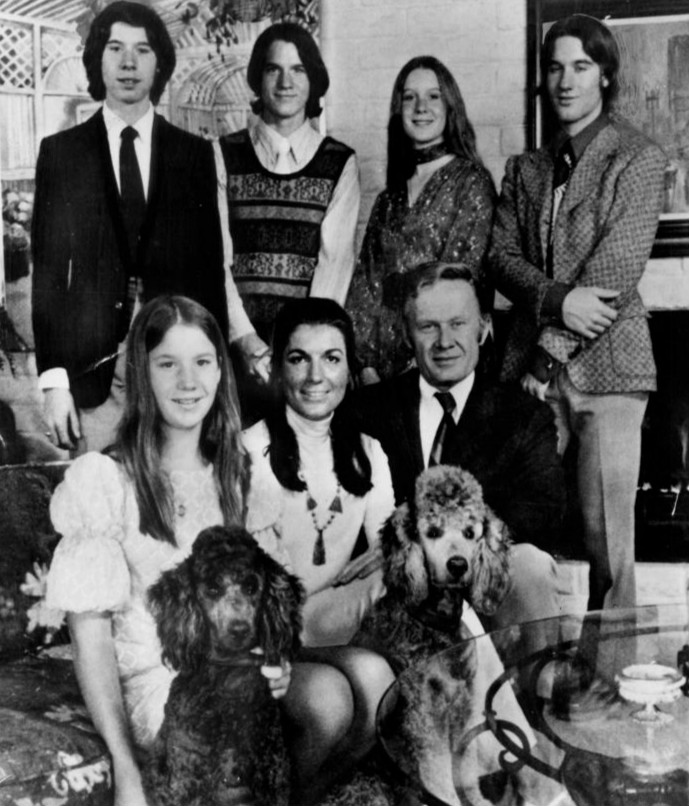
Created by Craig Gilbert, An American Family examined the daily trials and tribulations of the Loud family of Santa Barbara, California. Researching subjects for the series, Gilbert interviewed about 24 families before he settled on the Louds—a mother, father, and five "telegenic" children who owned a large house, multiple cars, and a swimming pool. Shooting began in May 1971, and Gilbert and his film crew, which included the cinematographer Alan Raymond and his wife Susan Raymond who handled sound, spent the next seven months filming the Louds.
The final product, edited down from 300 hours of 16-millimeter footage, was An American Family, which aired in 1973 as 12 weekly one-hour episodes on the Public Broadcasting Service (PBS). The film was presented in fly-on-the-wall style with very limited narration.
The story that unfolded of the Louds, who at the outset of the series seemed to epitomize the American dream, showed a married couple on the verge of divorce and children, ranging from 14 to 20 years old, in high and low moments. The "toothpaste-bright affluence, California-style" family, as described in 1973 in The New York Times, turned out to be "comfortably ordinary, sadly familiar, the kind of family most white middle-class Americans can identify with."
The series was popular, earning more than 10 million viewers a week. It also sparked controversy and drove conversation in national magazines and television talk shows about the state of the American family.
The intense interest in the Louds, wrote Dennis Lim in The New York Times in 2011, "had much to do with their lives seeming to fall apart as America watched."
The popularity of the series, which was viewed by 10 million Americans per week, gave the Louds a form of celebrity. Family members profiled were:
Lance Loud is credited as the first continuing character on television who was openly gay, and he subsequently became an icon within the LGBT community. He later became a columnist for the national LGBT news magazine The Advocate. Lance, who had been a pen pal of Andy Warhol, himself known for his commentary on celebrity, said the series fulfilled “the middle-class dream that you can become famous for being just who you are.”
Hub AI
An American Family AI simulator
(@An American Family_simulator)
An American Family
An American Family is an American television documentary series that followed the life of a California family in the early 1970s. Widely referred to as the first example of an American reality TV show, the series drew millions of weekly viewers, who were drawn to a story that seemed to shatter the rosy façade of upper-middle-class suburbia. It also became a lightning rod for discussion about the precarious state of the American family in the early 1970s. An American Family ranks #32 on TV Guide's 50 Greatest TV Shows of All Time list.
Created by Craig Gilbert, An American Family examined the daily trials and tribulations of the Loud family of Santa Barbara, California. Researching subjects for the series, Gilbert interviewed about 24 families before he settled on the Louds—a mother, father, and five "telegenic" children who owned a large house, multiple cars, and a swimming pool. Shooting began in May 1971, and Gilbert and his film crew, which included the cinematographer Alan Raymond and his wife Susan Raymond who handled sound, spent the next seven months filming the Louds.
The final product, edited down from 300 hours of 16-millimeter footage, was An American Family, which aired in 1973 as 12 weekly one-hour episodes on the Public Broadcasting Service (PBS). The film was presented in fly-on-the-wall style with very limited narration.
The story that unfolded of the Louds, who at the outset of the series seemed to epitomize the American dream, showed a married couple on the verge of divorce and children, ranging from 14 to 20 years old, in high and low moments. The "toothpaste-bright affluence, California-style" family, as described in 1973 in The New York Times, turned out to be "comfortably ordinary, sadly familiar, the kind of family most white middle-class Americans can identify with."
The series was popular, earning more than 10 million viewers a week. It also sparked controversy and drove conversation in national magazines and television talk shows about the state of the American family.
The intense interest in the Louds, wrote Dennis Lim in The New York Times in 2011, "had much to do with their lives seeming to fall apart as America watched."
The popularity of the series, which was viewed by 10 million Americans per week, gave the Louds a form of celebrity. Family members profiled were:
Lance Loud is credited as the first continuing character on television who was openly gay, and he subsequently became an icon within the LGBT community. He later became a columnist for the national LGBT news magazine The Advocate. Lance, who had been a pen pal of Andy Warhol, himself known for his commentary on celebrity, said the series fulfilled “the middle-class dream that you can become famous for being just who you are.”