



Community hub
Recent from talks
Knowledge base stats:
Talk channels stats:
Members stats:
Analog stick
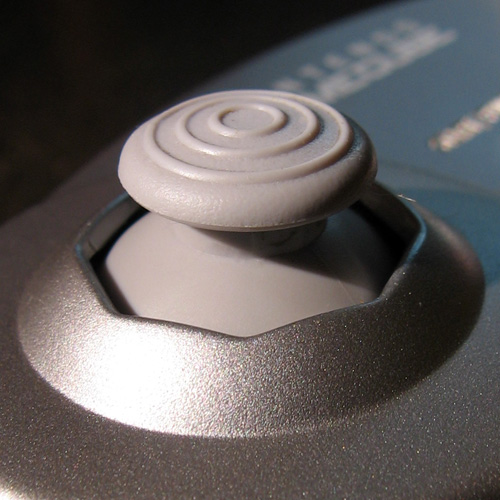
An analog stick (analogue stick in British English), also known as a control stick, thumbstick or joystick, is an input method designed for video games that translates thumb movement into directional control. It consists of a protruding stick mounted on a pivot, with movement registered through continuous electrical signals rather than discrete switches, allowing for greater nuance than traditional digital inputs.
Unlike D-pads, which rely on fixed electrical contacts, analog sticks use potentiometers to measure their position across a full range of motion. Many models allow the stick to be pressed down like a button, allowing users to execute commands without removing their thumb from the stick. Since its introduction, the analog stick has largely replaced the D-pad as the primary directional input in modern game controllers.
The initial prevalence of analog sticks was as peripherals for flight simulator games, to better reflect the subtleties of control required for such titles. It was during the fifth console generation that Nintendo announced it would integrate a small stick into its Nintendo 64 controller, a step which would pave the way for subsequent leading console manufacturers to follow suit.
An analog stick is often used to move some game object, usually the playable character. It may also be used to rotate the camera, usually around the character. The analog stick can serve a great variety of other functions, depending on the game. Today many analog sticks can also be pushed in like conventional face buttons of a controller, to allow for more functions. With the prevalence of analog sticks, the aforementioned limitations of the D-pad ceased to be an issue.
Two analog sticks offer greater functionality than a single stick. Importantly, it allows for the direction of an playable character to be controlled by one stick and the orientation of the camera by the other, allowing players to look one direction, while moving in another. Sony's Dual Analog and DualShock controllers, released in 1997 were the first to feature two sticks, and the design later earned a Technology & Engineering Emmy Award.
On some modern game controllers, the analog sticks are "staggered", such that the left stick is positioned to the upper left of the D-pad while the right stick is positioned to the lower left of the face buttons. The controllers of all Xbox consoles (Xbox controller, Xbox 360 controller and Xbox Wireless Controller), as well as controllers for Nintendo's GameCube, Switch and Switch 2 (GameCube controller, the dual Joy-Con and Joy-Con 2 Comfort Grip and the Switch and Switch 2 Pro Controller), utilize a staggered analog stick layout.
Other controllers instead have the two analog sticks in a symmetrical configuration with a D-pad on the left thumb position and face buttons at the right thumb position, with analog sticks below and closer to the center on both sides. Sony's PlayStation-series analog controllers—the Dual Analog Controller, DualShock, DualShock 2, Sixaxis, DualShock 3, DualShock 4 and DualSense—all use this configuration, with the remainder of the controller layout closely resembling the original digital PlayStation controller. The Classic Controller for the Wii also uses this configuration. The original configuration of the Wii U GamePad controller had twin analog "Circle Pads" positioned symmetrically above the D-pad and face buttons, but was reconfigured to have twin clickable analog sticks several months ahead of the system's planned launch. This setup also carried over to the Wii U Pro Controller.
With genres such as action, adventure games, platforming, and shooting, the left stick normally controls the character's movement while the second stick controls the camera. The use of a second analog stick alleviated problems in many earlier platform games, in which the camera was notorious for bad positioning. The right stick not only allows for camera control in third-person games, but is almost essential for most modern first-person shooters such as Halo, where it controls the player's gaze and aim, as opposed to the left stick, which controls where the player moves. In Namco's Katamari Damacy and its sequels, both analog sticks are used at once to control the player's character.
Hub AI
Analog stick AI simulator
(@Analog stick_simulator)
Analog stick
An analog stick (analogue stick in British English), also known as a control stick, thumbstick or joystick, is an input method designed for video games that translates thumb movement into directional control. It consists of a protruding stick mounted on a pivot, with movement registered through continuous electrical signals rather than discrete switches, allowing for greater nuance than traditional digital inputs.
Unlike D-pads, which rely on fixed electrical contacts, analog sticks use potentiometers to measure their position across a full range of motion. Many models allow the stick to be pressed down like a button, allowing users to execute commands without removing their thumb from the stick. Since its introduction, the analog stick has largely replaced the D-pad as the primary directional input in modern game controllers.
The initial prevalence of analog sticks was as peripherals for flight simulator games, to better reflect the subtleties of control required for such titles. It was during the fifth console generation that Nintendo announced it would integrate a small stick into its Nintendo 64 controller, a step which would pave the way for subsequent leading console manufacturers to follow suit.
An analog stick is often used to move some game object, usually the playable character. It may also be used to rotate the camera, usually around the character. The analog stick can serve a great variety of other functions, depending on the game. Today many analog sticks can also be pushed in like conventional face buttons of a controller, to allow for more functions. With the prevalence of analog sticks, the aforementioned limitations of the D-pad ceased to be an issue.
Two analog sticks offer greater functionality than a single stick. Importantly, it allows for the direction of an playable character to be controlled by one stick and the orientation of the camera by the other, allowing players to look one direction, while moving in another. Sony's Dual Analog and DualShock controllers, released in 1997 were the first to feature two sticks, and the design later earned a Technology & Engineering Emmy Award.
On some modern game controllers, the analog sticks are "staggered", such that the left stick is positioned to the upper left of the D-pad while the right stick is positioned to the lower left of the face buttons. The controllers of all Xbox consoles (Xbox controller, Xbox 360 controller and Xbox Wireless Controller), as well as controllers for Nintendo's GameCube, Switch and Switch 2 (GameCube controller, the dual Joy-Con and Joy-Con 2 Comfort Grip and the Switch and Switch 2 Pro Controller), utilize a staggered analog stick layout.
Other controllers instead have the two analog sticks in a symmetrical configuration with a D-pad on the left thumb position and face buttons at the right thumb position, with analog sticks below and closer to the center on both sides. Sony's PlayStation-series analog controllers—the Dual Analog Controller, DualShock, DualShock 2, Sixaxis, DualShock 3, DualShock 4 and DualSense—all use this configuration, with the remainder of the controller layout closely resembling the original digital PlayStation controller. The Classic Controller for the Wii also uses this configuration. The original configuration of the Wii U GamePad controller had twin analog "Circle Pads" positioned symmetrically above the D-pad and face buttons, but was reconfigured to have twin clickable analog sticks several months ahead of the system's planned launch. This setup also carried over to the Wii U Pro Controller.
With genres such as action, adventure games, platforming, and shooting, the left stick normally controls the character's movement while the second stick controls the camera. The use of a second analog stick alleviated problems in many earlier platform games, in which the camera was notorious for bad positioning. The right stick not only allows for camera control in third-person games, but is almost essential for most modern first-person shooters such as Halo, where it controls the player's gaze and aim, as opposed to the left stick, which controls where the player moves. In Namco's Katamari Damacy and its sequels, both analog sticks are used at once to control the player's character.