



Community hub
Recent from talks
Contribute something to knowledge base
Content stats: 0 posts, 0 articles, 0 media, 0 notes
Members stats: 0 subscribers, 0 contributors, 0 moderators, 0 supporters
Subscribers
Supporters
Contributors
Moderators
Hub AI
Analogical change AI simulator
(@Analogical change_simulator)
Hub AI
Analogical change AI simulator
(@Analogical change_simulator)
Analogical change
In language change, analogical change occurs when one linguistic sign is changed in either form or meaning to reflect another item in the language system on the basis of analogy or perceived similarity. In contrast to regular sound change, analogy is driven by idiosyncratic cognitive factors and applies irregularly across a language system. This leads to what is known as Sturtevant's paradox: sound change is regular, but produces irregularity; analogy is irregular, but produces regularity.
Analogy plays an important role in child language acquisition. The relationship between language acquisition and language change is well established, and while both adult speakers and children can be innovators of morphophonetic and morphosyntactic change, analogy used in child language acquisition likely forms one major source of analogical change.
During the acquisition of grammatical change, children are prone to overregularization, in which the children extends a particular grammatical rule to apply to irregular forms by analogy, such as created forms such as mans and mouses for the plural of man and mouse on the basis of the regular English plural. If this overregularization becomes established in the child's grammar and is adopted by many speakers, it would lead to analogical change in the form of leveling.
Analogical change does not represent a single process, but rather a family of different language change processes which all follow the general principle of irregularly changing one form to 'match' another form or a pattern observed among several other forms.
Proportional analogy or four-part analogy is the simplest form of analogical change, representing the change or introduction of a form on the basis of analogy with a pattern that can be expressed by a single form. This type of analogical change is often diagrammatized with a proportion, in which rows represent paradigms while columns represent dimensions of similarity. Thus, for example, the analogy which generated flammable from inflammable on the basis of the pattern of in- prefixes could summarised as a proportional analogy with the following proportion:
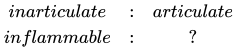
where the <?> represents the new, albeit overregularized form, flammable, with both inflammable and flammable having the same meaning.
Analogical creation refers to cases when analogy creates a new word or form of a word. The example of flammable, having the same meaning as inflammable, is an example of analogical creation, as the word flammable has been created and added to the language system.
Analogical change
In language change, analogical change occurs when one linguistic sign is changed in either form or meaning to reflect another item in the language system on the basis of analogy or perceived similarity. In contrast to regular sound change, analogy is driven by idiosyncratic cognitive factors and applies irregularly across a language system. This leads to what is known as Sturtevant's paradox: sound change is regular, but produces irregularity; analogy is irregular, but produces regularity.
Analogy plays an important role in child language acquisition. The relationship between language acquisition and language change is well established, and while both adult speakers and children can be innovators of morphophonetic and morphosyntactic change, analogy used in child language acquisition likely forms one major source of analogical change.
During the acquisition of grammatical change, children are prone to overregularization, in which the children extends a particular grammatical rule to apply to irregular forms by analogy, such as created forms such as mans and mouses for the plural of man and mouse on the basis of the regular English plural. If this overregularization becomes established in the child's grammar and is adopted by many speakers, it would lead to analogical change in the form of leveling.
Analogical change does not represent a single process, but rather a family of different language change processes which all follow the general principle of irregularly changing one form to 'match' another form or a pattern observed among several other forms.
Proportional analogy or four-part analogy is the simplest form of analogical change, representing the change or introduction of a form on the basis of analogy with a pattern that can be expressed by a single form. This type of analogical change is often diagrammatized with a proportion, in which rows represent paradigms while columns represent dimensions of similarity. Thus, for example, the analogy which generated flammable from inflammable on the basis of the pattern of in- prefixes could summarised as a proportional analogy with the following proportion:
where the <?> represents the new, albeit overregularized form, flammable, with both inflammable and flammable having the same meaning.
Analogical creation refers to cases when analogy creates a new word or form of a word. The example of flammable, having the same meaning as inflammable, is an example of analogical creation, as the word flammable has been created and added to the language system.