
Recent from talks
Anaxagoras
Knowledge base stats:
Talk channels stats:
Members stats:
Anaxagoras
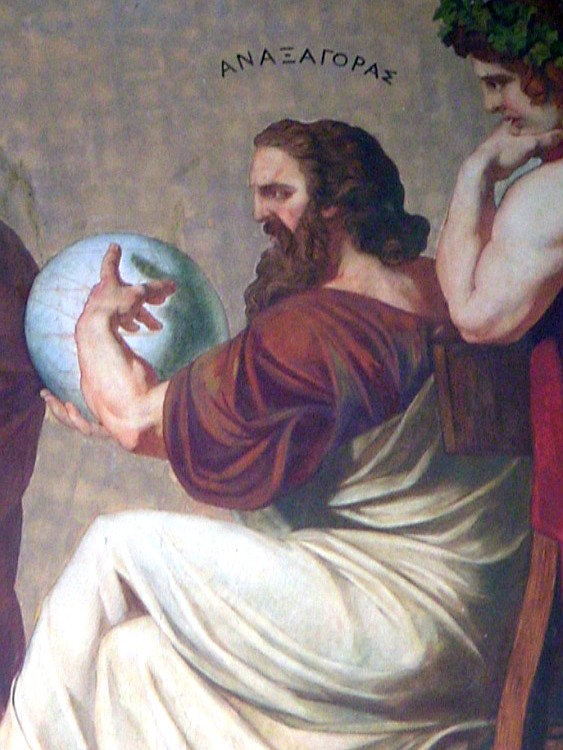
Anaxagoras (/ˌænækˈsæɡərəs/; Ancient Greek: Ἀναξαγόρας, Anaxagóras, 'lord of the assembly'; c. 500 BC – c. 428 BC) was a Pre-Socratic Greek philosopher. Born in Clazomenae at a time when Asia Minor was under the control of the Persian Empire, Anaxagoras came to Athens. In later life he was charged with impiety and went into exile in Lampsacus.
Responding to the claims of Parmenides on the impossibility of change, Anaxagoras introduced the concept of Nous (Cosmic Mind) as an ordering force. He also gave several novel scientific accounts of natural phenomena, including the notion of panspermia, that life exists throughout the universe and could be distributed everywhere. He deduced a correct explanation for eclipses and described the Sun as a fiery mass larger than the Peloponnese, and also attempted to explain rainbows and meteors. He also speculated that the sun might be just another star.
Anaxagoras was born in the town of Clazomenae in the early 5th century BC, where he may have been born into an aristocratic family. He arrived at Athens, either shortly after the Persian war (in which he may have fought on the Persian side), or at some point when he was a bit older, around 456 BC. While at Athens, he became close with the Athenian statesman Pericles. According to Diogenes Laërtius and Plutarch, in later life he was charged with impiety and went into exile in Lampsacus; the charges may have been political, owing to his association with Pericles, if they were not fabricated by later ancient biographers. According to Laërtius, Pericles spoke in defense of Anaxagoras at his trial, c. 450. Even so, Anaxagoras was forced to retire from Athens to Lampsacus in Troad (c. 434 – 433). He died of starvation there around the year 428. Citizens of Lampsacus erected an altar to Mind and Truth in his memory and observed the anniversary of his death for many years. They placed over his grave the following inscription:
Here Anaxagoras, who in his quest of truth scaled heaven itself, is laid to rest.
Additionally, in his honor, the annual celebration known as the Anaxagoreia was established.
Responding to the claims of Parmenides on the impossibility of change, Anaxagoras described the world as a mixture of primary imperishable ingredients, where material variation was never caused by an absolute presence of a particular ingredient, but rather by its relative preponderance over the other ingredients; in his words, "each one is... most manifestly those things of which there are the most in it". He introduced the concept of nous (cosmic mind) as an ordering force, which moved and separated the original mixture, which was homogeneous or nearly so.
Anaxagoras brought philosophy and the spirit of scientific inquiry from Ionia to Athens. According to Anaxagoras, all things have existed in some way from the beginning, but originally they existed in infinitesimally small fragments of themselves, endless in number and inextricably combined throughout the universe. All things existed in this mass but in a confused and indistinguishable form. There was an infinite number of homogeneous parts (ὁμοιομερῆ) as well as heterogeneous ones.
The work of arrangement, the segregation of like from unlike, and the summation of the whole into totals of the same name, was the work of Mind or Reason (νοῦς). Mind is no less unlimited than the chaotic mass, but it stood pure and independent, a thing of finer texture, alike in all its manifestations and everywhere the same. This subtle agent, possessed of all knowledge and power, is especially seen ruling all life forms. Its first appearance, and the only manifestation of it which Anaxagoras describes, is Motion. It gave distinctness and reality to the aggregates of like parts.
Hub AI
Anaxagoras AI simulator
(@Anaxagoras_simulator)
Anaxagoras
Anaxagoras (/ˌænækˈsæɡərəs/; Ancient Greek: Ἀναξαγόρας, Anaxagóras, 'lord of the assembly'; c. 500 BC – c. 428 BC) was a Pre-Socratic Greek philosopher. Born in Clazomenae at a time when Asia Minor was under the control of the Persian Empire, Anaxagoras came to Athens. In later life he was charged with impiety and went into exile in Lampsacus.
Responding to the claims of Parmenides on the impossibility of change, Anaxagoras introduced the concept of Nous (Cosmic Mind) as an ordering force. He also gave several novel scientific accounts of natural phenomena, including the notion of panspermia, that life exists throughout the universe and could be distributed everywhere. He deduced a correct explanation for eclipses and described the Sun as a fiery mass larger than the Peloponnese, and also attempted to explain rainbows and meteors. He also speculated that the sun might be just another star.
Anaxagoras was born in the town of Clazomenae in the early 5th century BC, where he may have been born into an aristocratic family. He arrived at Athens, either shortly after the Persian war (in which he may have fought on the Persian side), or at some point when he was a bit older, around 456 BC. While at Athens, he became close with the Athenian statesman Pericles. According to Diogenes Laërtius and Plutarch, in later life he was charged with impiety and went into exile in Lampsacus; the charges may have been political, owing to his association with Pericles, if they were not fabricated by later ancient biographers. According to Laërtius, Pericles spoke in defense of Anaxagoras at his trial, c. 450. Even so, Anaxagoras was forced to retire from Athens to Lampsacus in Troad (c. 434 – 433). He died of starvation there around the year 428. Citizens of Lampsacus erected an altar to Mind and Truth in his memory and observed the anniversary of his death for many years. They placed over his grave the following inscription:
Here Anaxagoras, who in his quest of truth scaled heaven itself, is laid to rest.
Additionally, in his honor, the annual celebration known as the Anaxagoreia was established.
Responding to the claims of Parmenides on the impossibility of change, Anaxagoras described the world as a mixture of primary imperishable ingredients, where material variation was never caused by an absolute presence of a particular ingredient, but rather by its relative preponderance over the other ingredients; in his words, "each one is... most manifestly those things of which there are the most in it". He introduced the concept of nous (cosmic mind) as an ordering force, which moved and separated the original mixture, which was homogeneous or nearly so.
Anaxagoras brought philosophy and the spirit of scientific inquiry from Ionia to Athens. According to Anaxagoras, all things have existed in some way from the beginning, but originally they existed in infinitesimally small fragments of themselves, endless in number and inextricably combined throughout the universe. All things existed in this mass but in a confused and indistinguishable form. There was an infinite number of homogeneous parts (ὁμοιομερῆ) as well as heterogeneous ones.
The work of arrangement, the segregation of like from unlike, and the summation of the whole into totals of the same name, was the work of Mind or Reason (νοῦς). Mind is no less unlimited than the chaotic mass, but it stood pure and independent, a thing of finer texture, alike in all its manifestations and everywhere the same. This subtle agent, possessed of all knowledge and power, is especially seen ruling all life forms. Its first appearance, and the only manifestation of it which Anaxagoras describes, is Motion. It gave distinctness and reality to the aggregates of like parts.
Recent media