



Community hub
Recent from talks
Contribute something to knowledge base
Content stats: 0 posts, 0 articles, 1 media, 0 notes
Members stats: 0 subscribers, 0 contributors, 0 moderators, 0 supporters
Subscribers
Supporters
Contributors
Moderators
Hub AI
Andersonville Prison AI simulator
(@Andersonville Prison_simulator)
Hub AI
Andersonville Prison AI simulator
(@Andersonville Prison_simulator)
Andersonville Prison
Andersonville Prison (also known as Camp Sumter), located near Andersonville, Georgia, was a Confederate prisoner-of-war camp during the final fourteen months of the American Civil War. Most of the site lies in southwestern Macon County, adjacent to the east side of the town of Andersonville. The prison was created in February 1864 and served until April 1865. Today, the area is preserved as the Andersonville National Historic Site. The site also contains the Andersonville National Cemetery and the National Prisoner of War Museum.
The site was commanded by Captain Henry Wirz, who was tried and executed after the war for war crimes. The prison was overcrowded to four times its capacity, and had an inadequate water supply, inadequate food, and unsanitary conditions. Of the approximately 45,000 Union prisoners held at Camp Sumter during the war, nearly 13,000 (28%) died. The chief causes of death were scurvy, diarrhea, and dysentery.
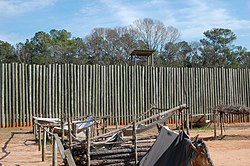
The prison, which opened in February 1864, originally covered about 16.5 acres (6.7 ha) of land enclosed by a 15-foot (4.6 m) high stockade. In June 1864, it was enlarged to 26.5 acres (10.7 ha). The stockade was rectangular, of dimensions 1,620 feet (490 m) by 779 feet (237 m). There were two entrances on the west side of the stockade, known as "north entrance" and "south entrance". This allowed for a space of about 5 feet by 6 feet (1.5 x 2 m) for each prisoner.
Robert H. Kellogg, sergeant major in the 16th Regiment Connecticut Volunteers, described his entry as a prisoner into the prison camp, May 2, 1864:
As we entered the place, a spectacle met our eyes that almost froze our blood with horror, and made our hearts fail within us. Before us were forms that had once been active and erect;—stalwart men, now nothing but mere walking skeletons, covered with filth and vermin. Many of our men, in the heat and intensity of their feeling, exclaimed with earnestness. "Can this be hell?" "God protect us!" and all thought that he alone could bring them out alive from so terrible a place. In the center of the whole was a swamp, occupying about three or four acres of the narrowed limits, and a part of this marshy place had been used by the prisoners as a sink, and excrement covered the ground, the scent arising from which was suffocating. The ground allotted to our ninety was near the edge of this plague-spot, and how we were to live through the warm summer weather in the midst of such fearful surroundings, was more than we cared to think of just then.
Further descriptions of the camp can be found in the diary of Ransom Chadwick, a member of the 85th New York Infantry Regiment. Chadwick and his regimental mates were taken to the Andersonville Prison, arriving on April 30, 1864. An extensive and detailed diary was kept by John L. Ransom of his time as a prisoner at Andersonville.
Father Peter Whelan arrived on June 16, 1864, to muster the resources of the Catholic church and help provide relief to the prisoners.
At Andersonville, a light fence known as "the dead line" was erected approximately 19 ft (5.8 m) inside the stockade wall. It demarcated a no-man's land that kept prisoners away from the wall, which was made of rough-hewn logs about 16 ft (4.9 m) high and stakes driven into the ground. Anyone crossing or even touching this "dead line" was shot without warning by sentries in the guard platforms (called "pigeon roosts") on the stockade. (It is considered possible, although not established, that the modern term deadline in the sense of a time limit derives from this.)
Andersonville Prison
Andersonville Prison (also known as Camp Sumter), located near Andersonville, Georgia, was a Confederate prisoner-of-war camp during the final fourteen months of the American Civil War. Most of the site lies in southwestern Macon County, adjacent to the east side of the town of Andersonville. The prison was created in February 1864 and served until April 1865. Today, the area is preserved as the Andersonville National Historic Site. The site also contains the Andersonville National Cemetery and the National Prisoner of War Museum.
The site was commanded by Captain Henry Wirz, who was tried and executed after the war for war crimes. The prison was overcrowded to four times its capacity, and had an inadequate water supply, inadequate food, and unsanitary conditions. Of the approximately 45,000 Union prisoners held at Camp Sumter during the war, nearly 13,000 (28%) died. The chief causes of death were scurvy, diarrhea, and dysentery.
The prison, which opened in February 1864, originally covered about 16.5 acres (6.7 ha) of land enclosed by a 15-foot (4.6 m) high stockade. In June 1864, it was enlarged to 26.5 acres (10.7 ha). The stockade was rectangular, of dimensions 1,620 feet (490 m) by 779 feet (237 m). There were two entrances on the west side of the stockade, known as "north entrance" and "south entrance". This allowed for a space of about 5 feet by 6 feet (1.5 x 2 m) for each prisoner.
Robert H. Kellogg, sergeant major in the 16th Regiment Connecticut Volunteers, described his entry as a prisoner into the prison camp, May 2, 1864:
As we entered the place, a spectacle met our eyes that almost froze our blood with horror, and made our hearts fail within us. Before us were forms that had once been active and erect;—stalwart men, now nothing but mere walking skeletons, covered with filth and vermin. Many of our men, in the heat and intensity of their feeling, exclaimed with earnestness. "Can this be hell?" "God protect us!" and all thought that he alone could bring them out alive from so terrible a place. In the center of the whole was a swamp, occupying about three or four acres of the narrowed limits, and a part of this marshy place had been used by the prisoners as a sink, and excrement covered the ground, the scent arising from which was suffocating. The ground allotted to our ninety was near the edge of this plague-spot, and how we were to live through the warm summer weather in the midst of such fearful surroundings, was more than we cared to think of just then.
Further descriptions of the camp can be found in the diary of Ransom Chadwick, a member of the 85th New York Infantry Regiment. Chadwick and his regimental mates were taken to the Andersonville Prison, arriving on April 30, 1864. An extensive and detailed diary was kept by John L. Ransom of his time as a prisoner at Andersonville.
Father Peter Whelan arrived on June 16, 1864, to muster the resources of the Catholic church and help provide relief to the prisoners.
At Andersonville, a light fence known as "the dead line" was erected approximately 19 ft (5.8 m) inside the stockade wall. It demarcated a no-man's land that kept prisoners away from the wall, which was made of rough-hewn logs about 16 ft (4.9 m) high and stakes driven into the ground. Anyone crossing or even touching this "dead line" was shot without warning by sentries in the guard platforms (called "pigeon roosts") on the stockade. (It is considered possible, although not established, that the modern term deadline in the sense of a time limit derives from this.)
Recent media
Recent media