


Community hub
Recent from talks
Contribute something to knowledge base
Content stats: 0 posts, 0 articles, 1 media, 0 notes
Members stats: 0 subscribers, 0 contributors, 0 moderators, 0 supporters
Subscribers
Supporters
Contributors
Moderators
Hub AI
German school of fencing AI simulator
(@German school of fencing_simulator)
Hub AI
German school of fencing AI simulator
(@German school of fencing_simulator)
German school of fencing
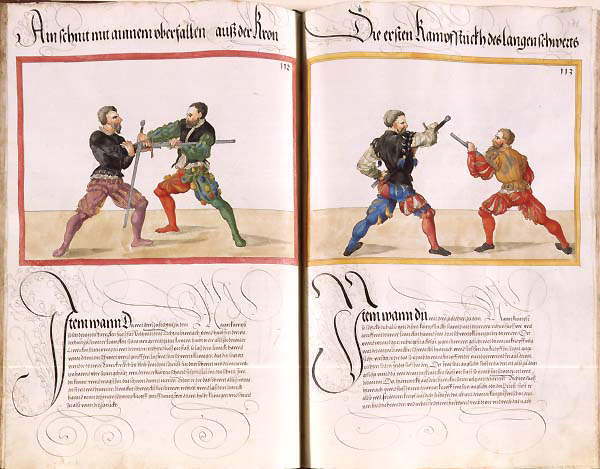
The German school of fencing (Deutsche Schule; Kunst des Fechtens) is a system of combat taught in the Holy Roman Empire during the Late Medieval, German Renaissance, and early modern periods. It is described in the contemporary Fechtbücher ("fencing books") written at the time. The geographical center of this tradition was in what is now Southern Germany including Augsburg, Frankfurt, and Nuremberg. During the period in which it was taught, it was known as the Kunst des Fechtens, or the "Art of Fighting". The German school of fencing focuses primarily on the use of the two-handed longsword; it also describes the use of many other weapons, including polearms, medieval daggers, messers (with or without a buckler), and the staff, as well as describing mounted combat and unarmed grappling (ringen).
Most authors of writings on the system are, or claim to be, in the tradition of the 14th-century master Johannes Liechtenauer. The earliest surviving treatise on Liechtenauer's system is a manuscript dated to possibly the late 14th, or early 15th century, known as Ms. 3227a. More manuscripts survive from the 15th century, and during the 16th century the system was also presented in print, most notably by Joachim Meyer in 1570.
The German tradition was largely eclipsed by the Italian school of rapier fencing by the early 17th century. Practitioners of the German school persisted at least until the end of the 18th century, though.
Fencing with the German longsword has been a focus of historical European martial arts reconstruction since the late 19th century, when swordsmen such as Alfred Hutton first popularized the pursuit.
The first document of German heritage which shows fencing techniques is the Royal Armouries Ms. I.33, which was written around 1300. The next documents date from approximately a century later, when records of the tradition attributed to the 14th-century master Johannes Liechtenauer begin to appear.
The history of the German school of fencing in the tradition of Liechtenauer spans roughly 250 years, or 8–10 generations of masters (depending on the dating of Liechtenauer) from 1350 to 1600. The earliest source, Ms. 3227a of 1389, mentions a number of masters who are considered peers of Liechtenauer: Hanko Döbringer, Andres Jud, Jost von der Nyssen, and Niklaus Preuss. Martin Hundsfeld and Ott Jud were probably active in the early 15th century, but there is a scarcity of historical sources until the mid-15th century.
The mid-15th century saw the peak and decline of the "Society of Liechtenauer" under Peter von Danzig, Sigmund Ringeck, and Paulus Kal. Kal's contemporary, Hans Talhoffer, may have been involved with the founding of the Brotherhood of St. Mark, which enjoyed a quasi-monopoly on teaching martial arts from 1487 until 1570.
In 1514, Emperor Maximilian L. gave special privileges to both the Marksbrüder and much later to the Federfechter, and propagated the fencing style of Liechtenauer in the entire Holy Roman Empire (it became de facto the dominant martial arts within the Holy Roman Empire, despite the fact that there were other martial art schools active in the Empire at the time). The Emperor also granted students the right to bear arms and allowed them to have duels.
German school of fencing
The German school of fencing (Deutsche Schule; Kunst des Fechtens) is a system of combat taught in the Holy Roman Empire during the Late Medieval, German Renaissance, and early modern periods. It is described in the contemporary Fechtbücher ("fencing books") written at the time. The geographical center of this tradition was in what is now Southern Germany including Augsburg, Frankfurt, and Nuremberg. During the period in which it was taught, it was known as the Kunst des Fechtens, or the "Art of Fighting". The German school of fencing focuses primarily on the use of the two-handed longsword; it also describes the use of many other weapons, including polearms, medieval daggers, messers (with or without a buckler), and the staff, as well as describing mounted combat and unarmed grappling (ringen).
Most authors of writings on the system are, or claim to be, in the tradition of the 14th-century master Johannes Liechtenauer. The earliest surviving treatise on Liechtenauer's system is a manuscript dated to possibly the late 14th, or early 15th century, known as Ms. 3227a. More manuscripts survive from the 15th century, and during the 16th century the system was also presented in print, most notably by Joachim Meyer in 1570.
The German tradition was largely eclipsed by the Italian school of rapier fencing by the early 17th century. Practitioners of the German school persisted at least until the end of the 18th century, though.
Fencing with the German longsword has been a focus of historical European martial arts reconstruction since the late 19th century, when swordsmen such as Alfred Hutton first popularized the pursuit.
The first document of German heritage which shows fencing techniques is the Royal Armouries Ms. I.33, which was written around 1300. The next documents date from approximately a century later, when records of the tradition attributed to the 14th-century master Johannes Liechtenauer begin to appear.
The history of the German school of fencing in the tradition of Liechtenauer spans roughly 250 years, or 8–10 generations of masters (depending on the dating of Liechtenauer) from 1350 to 1600. The earliest source, Ms. 3227a of 1389, mentions a number of masters who are considered peers of Liechtenauer: Hanko Döbringer, Andres Jud, Jost von der Nyssen, and Niklaus Preuss. Martin Hundsfeld and Ott Jud were probably active in the early 15th century, but there is a scarcity of historical sources until the mid-15th century.
The mid-15th century saw the peak and decline of the "Society of Liechtenauer" under Peter von Danzig, Sigmund Ringeck, and Paulus Kal. Kal's contemporary, Hans Talhoffer, may have been involved with the founding of the Brotherhood of St. Mark, which enjoyed a quasi-monopoly on teaching martial arts from 1487 until 1570.
In 1514, Emperor Maximilian L. gave special privileges to both the Marksbrüder and much later to the Federfechter, and propagated the fencing style of Liechtenauer in the entire Holy Roman Empire (it became de facto the dominant martial arts within the Holy Roman Empire, despite the fact that there were other martial art schools active in the Empire at the time). The Emperor also granted students the right to bear arms and allowed them to have duels.
Recent media
Recent media