
Recent from talks
Anglo-Saxon law
Knowledge base stats:
Talk channels stats:
Members stats:
Anglo-Saxon law
Anglo-Saxon law (Old English: ǣ, later lagu 'law'; dōm 'decree', 'judgement') was the legal system of Anglo-Saxon England from the 6th century until the Norman Conquest of 1066. It was a form of Germanic law based on unwritten custom known as folk-right and on written laws enacted by kings with the advice of their witan or council. By the later Anglo-Saxon period, a system of courts had developed to administer the law, while enforcement was the responsibility of ealdormen and royal officials such as sheriffs, in addition to self-policing (friborh) by local communities.
Originally, each Anglo-Saxon kingdom had its own laws. As a result of Viking invasions and settlement, the Danelaw followed Scandinavian laws. In the 10th century, a unified Kingdom of England was created with a single Anglo-Saxon government; however, different regions continued to follow their customary legal systems. The last Anglo-Saxon law codes were enacted in the early 11th century during the reign of Cnut the Great.
The native inhabitants of England were Celtic Britons. The unwritten Celtic law was learned and preserved by the Druids, who in addition to their religious role also acted as judges. After the Roman conquest of Britain in the first century, Roman law was operative at least concerning Roman citizens. But the Roman legal system disappeared after the Romans left the island in the 5th century.
In the 5th and 6th centuries, the Anglo-Saxons migrated from continental Europe and established several Anglo-Saxon kingdoms. These had their own legal traditions based in Germanic law that "owed little if anything" to Celtic or Roman influences. Anglo-Saxon law largely derived from unwritten customs termed folk-right (Old English: folcriht, 'right or justice of the people').
The older law of real property, of succession, of contracts, the customary tariffs of fines, were mainly regulated by folk-right. Customary law differed between local cultures. There were different folk-rights of West and East Saxons, of East Angles, of Kentish men, Mercians, Northumbrians, Danes, Welshmen, and these main folk-right divisions remained even when tribal kingdoms disappeared and the people were concentrated in one kingdom.
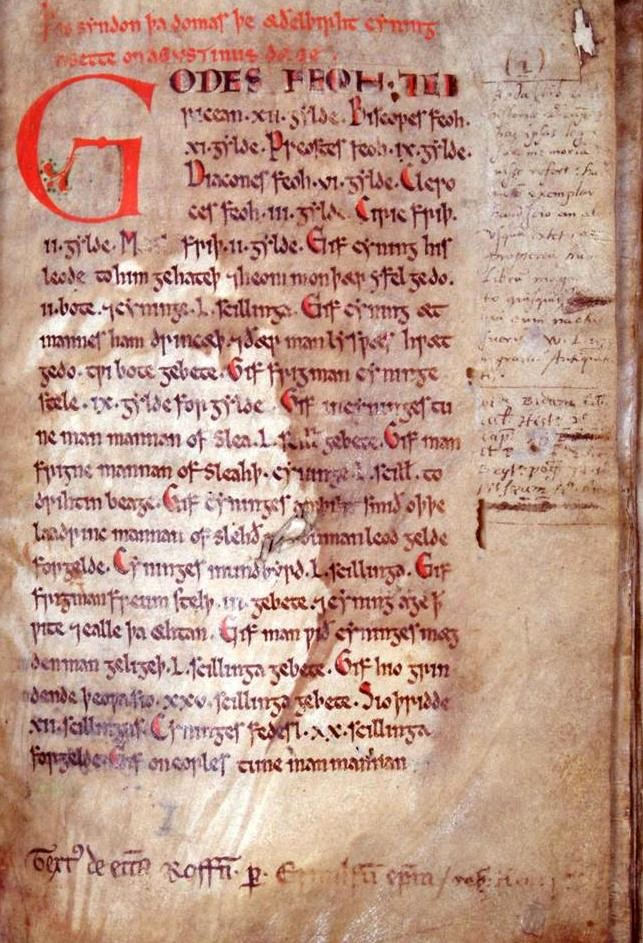
Following the Christianisation of the Anglo-Saxons, written law codes or "dooms" were produced. The Christian clergy brought with them the art of letters, writing, and literacy. The oldest Anglo-Saxon law codes, especially from Kent and Wessex, reveal a close affinity to Germanic law. The first written Anglo-Saxon laws were issued around 600 by Æthelberht of Kent. Writing in the 8th century, the Venerable Bede comments that Æthelberht created his law code "after the examples of the Romans" (Latin: iuxta exempla Romanorum). This likely refers to Romanised peoples such as the Franks, whose Salic law was codified under Clovis I. As a newly Christian king, Æthelberht's creation of his own law code symbolised his belonging to the Roman and Christian traditions. The actual legislation, however, was not influenced by Roman law. Rather, it converted older customs into written legislation, and, reflecting the role of the bishops in drafting it, protected the English church. The first seven clauses deal solely with compensation for the church.
Folk-right could be broken or modified by special law or special grant, and the fountain of such privileges was the royal power. Alterations and exceptions were, as a matter of fact, suggested by the interested parties themselves, and chiefly by the church. Thus a privileged land-tenure was created—bookland; the rules as to the succession of kinsmen were set at nought by concession of testamentary power and confirmations of grants and wills; special exemptions from the jurisdiction of the hundreds and special privileges as to levying fines were conferred. In process of time the rights originating in royal grants of privilege overbalanced, as it were, folk-right in many respects, and became themselves the starting-point of a new legal system—the feudal one.
In the 9th century, the Danelaw was conquered by Danes and governed under Scandinavian law. The word law itself derives from the Old Norse word laga. Starting with Alfred the Great (r. 871–899), the kings of Wessex united the other Anglo-Saxon peoples against their common Danish enemy. In the process, they created a single Kingdom of England. This unification process was completed under Æthelstan (r. 924–939).
Hub AI
Anglo-Saxon law AI simulator
(@Anglo-Saxon law_simulator)
Anglo-Saxon law
Anglo-Saxon law (Old English: ǣ, later lagu 'law'; dōm 'decree', 'judgement') was the legal system of Anglo-Saxon England from the 6th century until the Norman Conquest of 1066. It was a form of Germanic law based on unwritten custom known as folk-right and on written laws enacted by kings with the advice of their witan or council. By the later Anglo-Saxon period, a system of courts had developed to administer the law, while enforcement was the responsibility of ealdormen and royal officials such as sheriffs, in addition to self-policing (friborh) by local communities.
Originally, each Anglo-Saxon kingdom had its own laws. As a result of Viking invasions and settlement, the Danelaw followed Scandinavian laws. In the 10th century, a unified Kingdom of England was created with a single Anglo-Saxon government; however, different regions continued to follow their customary legal systems. The last Anglo-Saxon law codes were enacted in the early 11th century during the reign of Cnut the Great.
The native inhabitants of England were Celtic Britons. The unwritten Celtic law was learned and preserved by the Druids, who in addition to their religious role also acted as judges. After the Roman conquest of Britain in the first century, Roman law was operative at least concerning Roman citizens. But the Roman legal system disappeared after the Romans left the island in the 5th century.
In the 5th and 6th centuries, the Anglo-Saxons migrated from continental Europe and established several Anglo-Saxon kingdoms. These had their own legal traditions based in Germanic law that "owed little if anything" to Celtic or Roman influences. Anglo-Saxon law largely derived from unwritten customs termed folk-right (Old English: folcriht, 'right or justice of the people').
The older law of real property, of succession, of contracts, the customary tariffs of fines, were mainly regulated by folk-right. Customary law differed between local cultures. There were different folk-rights of West and East Saxons, of East Angles, of Kentish men, Mercians, Northumbrians, Danes, Welshmen, and these main folk-right divisions remained even when tribal kingdoms disappeared and the people were concentrated in one kingdom.
Following the Christianisation of the Anglo-Saxons, written law codes or "dooms" were produced. The Christian clergy brought with them the art of letters, writing, and literacy. The oldest Anglo-Saxon law codes, especially from Kent and Wessex, reveal a close affinity to Germanic law. The first written Anglo-Saxon laws were issued around 600 by Æthelberht of Kent. Writing in the 8th century, the Venerable Bede comments that Æthelberht created his law code "after the examples of the Romans" (Latin: iuxta exempla Romanorum). This likely refers to Romanised peoples such as the Franks, whose Salic law was codified under Clovis I. As a newly Christian king, Æthelberht's creation of his own law code symbolised his belonging to the Roman and Christian traditions. The actual legislation, however, was not influenced by Roman law. Rather, it converted older customs into written legislation, and, reflecting the role of the bishops in drafting it, protected the English church. The first seven clauses deal solely with compensation for the church.
Folk-right could be broken or modified by special law or special grant, and the fountain of such privileges was the royal power. Alterations and exceptions were, as a matter of fact, suggested by the interested parties themselves, and chiefly by the church. Thus a privileged land-tenure was created—bookland; the rules as to the succession of kinsmen were set at nought by concession of testamentary power and confirmations of grants and wills; special exemptions from the jurisdiction of the hundreds and special privileges as to levying fines were conferred. In process of time the rights originating in royal grants of privilege overbalanced, as it were, folk-right in many respects, and became themselves the starting-point of a new legal system—the feudal one.
In the 9th century, the Danelaw was conquered by Danes and governed under Scandinavian law. The word law itself derives from the Old Norse word laga. Starting with Alfred the Great (r. 871–899), the kings of Wessex united the other Anglo-Saxon peoples against their common Danish enemy. In the process, they created a single Kingdom of England. This unification process was completed under Æthelstan (r. 924–939).
Recent media