
Recent from talks
Anne Hutchinson
Knowledge base stats:
Talk channels stats:
Members stats:
Anne Hutchinson
Anne Hutchinson (née Marbury; July 1591 – August 1643) was an English-born religious figure who was an important participant in the Antinomian Controversy which shook the nascent Massachusetts Bay Colony from 1636 to 1638. Her strong religious formal declarations were at odds with the established Puritan clergy in the Boston area and her popularity and charisma helped create a theological schism that threatened the Puritan religious community in New England. She was eventually tried and convicted, then banished from the colony with many of her supporters.
Hutchinson was born in Alford, Lincolnshire, the daughter of Francis Marbury, an Anglican cleric and school teacher who gave her a far better education than most other girls received. She lived in London as a young adult, and there married a friend from home, William Hutchinson. The couple moved back to Alford where they began following preacher John Cotton in the nearby port of Boston, Lincolnshire. Cotton was compelled to emigrate in 1633, and the Hutchinsons followed a year later with their 15 children and soon became well established in the growing settlement of Boston in New England. Soon she was hosting women at her house weekly, providing commentary on recent sermons. These meetings became so popular that she began offering meetings for men as well, including the young governor of the colony, Henry Vane.
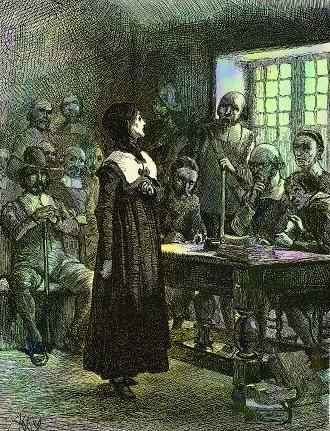
Hutchinson began to accuse the local ministers (except for Cotton and her husband's brother-in-law, John Wheelwright) of preaching a covenant of works rather than a covenant of grace, and many ministers began to complain about her increasingly blatant accusations, as well as certain unorthodox theological teachings. The situation eventually erupted into what is commonly called the Antinomian Controversy, culminating in her 1637 trial, conviction, and banishment from the colony. Hutchinson and many of her supporters established the settlement of Portsmouth, Rhode Island with encouragement from Providence Plantations founder Roger Williams. After her husband's death a few years later, threats of Massachusetts annexing Rhode Island compelled Hutchinson to move totally outside the reach of Boston into the lands of the Dutch. In August 1643, Hutchinson, six of her children, and other household members were killed by Siwanoy people during Kieft's War. The only survivor was her nine-year-old daughter Susanna, who was taken captive.
Hutchinson is a key figure in the history of religious freedom in England's American colonies and the history of women in ministry, challenging the authority of the ministers. She is honored by Massachusetts with a State House monument calling her a "courageous exponent of civil liberty and religious toleration". Historian Michael Winship, author of two books about her, has called her "the most famous—or infamous—English woman in colonial American history".
Anne Hutchinson was born Anne Marbury to parents Francis Marbury and Bridget Dryden in Alford, Lincolnshire, England, and baptised there on 20 July 1591. Her father was an Anglican cleric in London with strong Puritan leanings, who felt strongly that a clergy should be well educated and clashed with his superiors on this issue. Marbury's repeated challenges to the Anglican authorities led to his censure and imprisonment several years before Anne was born. In 1578, he was given a public trial, of which he made a transcript from memory during a period of house arrest.
For his conviction of heresy, Marbury spent two years in Marshalsea Prison on the south side of the River Thames across from London. In 1580, at the age of 25, he was released and was considered sufficiently reformed to preach and teach. He moved to the remote market town of Alford in Lincolnshire, about 140 miles (230 km) north of London. Hutchinson's father was soon appointed curate (assistant priest) of St Wilfrid's Church, Alford, and in 1585 he also became the schoolmaster at the Alford Free Grammar School, one of many such public schools, free to the poor and begun by Queen Elizabeth I. About this time, Marbury married his first wife, Elizabeth Moore, who bore three children, then died. Within a year of his first wife's death, Marbury married Bridget Dryden, about 10 years younger than he and from a prominent Northampton family. Her brother Erasmus was the grandfather of John Dryden, the playwright and Poet Laureate. Anne was the third of 15 children born to this marriage, 12 of whom survived early childhood. The Marburys lived in Alford for the first 15 years of Anne's life, and she received a better education than most girls of her time, with her father's strong commitment to learning, and she also became intimately familiar with scripture and Christian tenets. Education at that time was offered almost exclusively to boys and men. One possible reason why Marbury taught his daughters may have been that six of his first seven children were girls. Another reason may have been that the ruling class in Elizabethan England began realising that girls could be schooled, looking to the example of the queen, who spoke six foreign languages.
In 1605 when Hutchinson was 15, her family moved from Alford to the heart of London, where her father was given the position of vicar of St Martin Vintry. Here his expression of Puritan views was tolerated, though somewhat muffled, because of a shortage of clergy. Marbury took on additional work in 1608, preaching in the parish of St Pancras, Soper Lane, several miles northwest of the city, travelling there by horseback twice a week. In 1610, he replaced that position with one much closer to home and became rector of St Margaret, New Fish Street, a short walk from St Martin Vintry. He was at a high point in his career, but he died suddenly at the age of 55 in February 1611, when Anne was 19 years old.
The year after her father's death, Anne Marbury, aged 21, married William Hutchinson, a familiar acquaintance from Alford who was a fabric merchant then working in London. The couple was married at St Mary Woolnoth Church in London on 9 August 1612, shortly after which they moved back to their hometown of Alford.
Hub AI
Anne Hutchinson AI simulator
(@Anne Hutchinson_simulator)
Anne Hutchinson
Anne Hutchinson (née Marbury; July 1591 – August 1643) was an English-born religious figure who was an important participant in the Antinomian Controversy which shook the nascent Massachusetts Bay Colony from 1636 to 1638. Her strong religious formal declarations were at odds with the established Puritan clergy in the Boston area and her popularity and charisma helped create a theological schism that threatened the Puritan religious community in New England. She was eventually tried and convicted, then banished from the colony with many of her supporters.
Hutchinson was born in Alford, Lincolnshire, the daughter of Francis Marbury, an Anglican cleric and school teacher who gave her a far better education than most other girls received. She lived in London as a young adult, and there married a friend from home, William Hutchinson. The couple moved back to Alford where they began following preacher John Cotton in the nearby port of Boston, Lincolnshire. Cotton was compelled to emigrate in 1633, and the Hutchinsons followed a year later with their 15 children and soon became well established in the growing settlement of Boston in New England. Soon she was hosting women at her house weekly, providing commentary on recent sermons. These meetings became so popular that she began offering meetings for men as well, including the young governor of the colony, Henry Vane.
Hutchinson began to accuse the local ministers (except for Cotton and her husband's brother-in-law, John Wheelwright) of preaching a covenant of works rather than a covenant of grace, and many ministers began to complain about her increasingly blatant accusations, as well as certain unorthodox theological teachings. The situation eventually erupted into what is commonly called the Antinomian Controversy, culminating in her 1637 trial, conviction, and banishment from the colony. Hutchinson and many of her supporters established the settlement of Portsmouth, Rhode Island with encouragement from Providence Plantations founder Roger Williams. After her husband's death a few years later, threats of Massachusetts annexing Rhode Island compelled Hutchinson to move totally outside the reach of Boston into the lands of the Dutch. In August 1643, Hutchinson, six of her children, and other household members were killed by Siwanoy people during Kieft's War. The only survivor was her nine-year-old daughter Susanna, who was taken captive.
Hutchinson is a key figure in the history of religious freedom in England's American colonies and the history of women in ministry, challenging the authority of the ministers. She is honored by Massachusetts with a State House monument calling her a "courageous exponent of civil liberty and religious toleration". Historian Michael Winship, author of two books about her, has called her "the most famous—or infamous—English woman in colonial American history".
Anne Hutchinson was born Anne Marbury to parents Francis Marbury and Bridget Dryden in Alford, Lincolnshire, England, and baptised there on 20 July 1591. Her father was an Anglican cleric in London with strong Puritan leanings, who felt strongly that a clergy should be well educated and clashed with his superiors on this issue. Marbury's repeated challenges to the Anglican authorities led to his censure and imprisonment several years before Anne was born. In 1578, he was given a public trial, of which he made a transcript from memory during a period of house arrest.
For his conviction of heresy, Marbury spent two years in Marshalsea Prison on the south side of the River Thames across from London. In 1580, at the age of 25, he was released and was considered sufficiently reformed to preach and teach. He moved to the remote market town of Alford in Lincolnshire, about 140 miles (230 km) north of London. Hutchinson's father was soon appointed curate (assistant priest) of St Wilfrid's Church, Alford, and in 1585 he also became the schoolmaster at the Alford Free Grammar School, one of many such public schools, free to the poor and begun by Queen Elizabeth I. About this time, Marbury married his first wife, Elizabeth Moore, who bore three children, then died. Within a year of his first wife's death, Marbury married Bridget Dryden, about 10 years younger than he and from a prominent Northampton family. Her brother Erasmus was the grandfather of John Dryden, the playwright and Poet Laureate. Anne was the third of 15 children born to this marriage, 12 of whom survived early childhood. The Marburys lived in Alford for the first 15 years of Anne's life, and she received a better education than most girls of her time, with her father's strong commitment to learning, and she also became intimately familiar with scripture and Christian tenets. Education at that time was offered almost exclusively to boys and men. One possible reason why Marbury taught his daughters may have been that six of his first seven children were girls. Another reason may have been that the ruling class in Elizabethan England began realising that girls could be schooled, looking to the example of the queen, who spoke six foreign languages.
In 1605 when Hutchinson was 15, her family moved from Alford to the heart of London, where her father was given the position of vicar of St Martin Vintry. Here his expression of Puritan views was tolerated, though somewhat muffled, because of a shortage of clergy. Marbury took on additional work in 1608, preaching in the parish of St Pancras, Soper Lane, several miles northwest of the city, travelling there by horseback twice a week. In 1610, he replaced that position with one much closer to home and became rector of St Margaret, New Fish Street, a short walk from St Martin Vintry. He was at a high point in his career, but he died suddenly at the age of 55 in February 1611, when Anne was 19 years old.
The year after her father's death, Anne Marbury, aged 21, married William Hutchinson, a familiar acquaintance from Alford who was a fabric merchant then working in London. The couple was married at St Mary Woolnoth Church in London on 9 August 1612, shortly after which they moved back to their hometown of Alford.
Recent media