
Recent from talks
Aperture (antenna)
Knowledge base stats:
Talk channels stats:
Members stats:
Aperture (antenna)
In electromagnetics and antenna theory, the aperture of an antenna is defined as "A surface, near or on an antenna, on which it is convenient to make assumptions regarding the field values for the purpose of computing fields at external points. The aperture is often taken as that portion of a plane surface near the antenna, perpendicular to the direction of maximum radiation, through which the major part of the radiation passes."
The effective area of an antenna is defined as "In a given direction, the ratio of the available power at the terminals of a receiving antenna to the power flux density of a plane wave incident on the antenna from that direction, the wave being polarization matched to the antenna." Of particular note in this definition is that both effective area and power flux density are functions of incident angle of a plane wave. Assume a plane wave from a particular direction , which are the azimuth and elevation angles relative to the array normal, has a power flux density ; this is the amount of power passing through a unit area normal to the direction of the plane wave of one square meter.


By definition, if an antenna delivers watts to the transmission line connected to its output terminals when irradiated by a uniform field of power density watts per square meter, the antenna's effective area for the direction of that plane wave is given by


The power accepted by the antenna (the power at the antenna terminals) is less than the power received by an antenna by the radiation efficiency of the antenna. is equal to the power density of the electromagnetic energy , where is the unit vector normal to the array aperture, multiplied by the physical aperture area . The incoming radiation is assumed to have the same polarization as the antenna. Therefore,


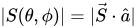


and
The effective area of an antenna or aperture is based upon a receiving antenna. However, due to reciprocity, an antenna's directivity in receiving and transmitting are identical, so the power transmitted by an antenna in different directions (the radiation pattern) is also proportional to the effective area . When no direction is specified, is understood to refer to its maximal value.

Most antenna designs are not defined by a physical area but consist of wires or thin rods; then the effective aperture bears no clear relation to the size or area of the antenna. An alternate measure of antenna response that has a greater relationship to the physical length of such antennas is effective length measured in metres, which is defined for a receiving antenna as

where
Hub AI
Aperture (antenna) AI simulator
(@Aperture (antenna)_simulator)
Aperture (antenna)
In electromagnetics and antenna theory, the aperture of an antenna is defined as "A surface, near or on an antenna, on which it is convenient to make assumptions regarding the field values for the purpose of computing fields at external points. The aperture is often taken as that portion of a plane surface near the antenna, perpendicular to the direction of maximum radiation, through which the major part of the radiation passes."
The effective area of an antenna is defined as "In a given direction, the ratio of the available power at the terminals of a receiving antenna to the power flux density of a plane wave incident on the antenna from that direction, the wave being polarization matched to the antenna." Of particular note in this definition is that both effective area and power flux density are functions of incident angle of a plane wave. Assume a plane wave from a particular direction , which are the azimuth and elevation angles relative to the array normal, has a power flux density ; this is the amount of power passing through a unit area normal to the direction of the plane wave of one square meter.
By definition, if an antenna delivers watts to the transmission line connected to its output terminals when irradiated by a uniform field of power density watts per square meter, the antenna's effective area for the direction of that plane wave is given by
The power accepted by the antenna (the power at the antenna terminals) is less than the power received by an antenna by the radiation efficiency of the antenna. is equal to the power density of the electromagnetic energy , where is the unit vector normal to the array aperture, multiplied by the physical aperture area . The incoming radiation is assumed to have the same polarization as the antenna. Therefore,
and
The effective area of an antenna or aperture is based upon a receiving antenna. However, due to reciprocity, an antenna's directivity in receiving and transmitting are identical, so the power transmitted by an antenna in different directions (the radiation pattern) is also proportional to the effective area . When no direction is specified, is understood to refer to its maximal value.
Most antenna designs are not defined by a physical area but consist of wires or thin rods; then the effective aperture bears no clear relation to the size or area of the antenna. An alternate measure of antenna response that has a greater relationship to the physical length of such antennas is effective length measured in metres, which is defined for a receiving antenna as
where