
Recent from talks
Anterior longitudinal ligament
Knowledge base stats:
Talk channels stats:
Members stats:
Anterior longitudinal ligament
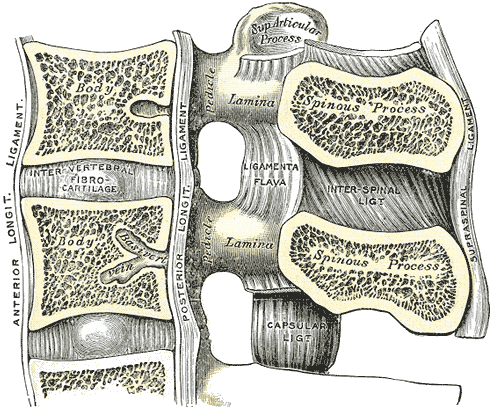
The anterior longitudinal ligament is a ligament that extends across the anterior/ventral aspect of the vertebral bodies and intervertebral discs the spine.
It may be partially cut to treat certain abnormal curvatures in the vertebral column, such as kyphosis.
The anterior longitudinal ligament extends superoinferiorly between the basiocciput of the skull and the anterior tubercle of the atlas (cervical vertebra C1) superiorly, and the superior part of the sacrum inferiorly; inferiorly, it ends at the sacral promontory. It broadens inferiorly. Inferiorly, it becomes continuous with the anterior sacrococcygeal ligament. Superiorly, between the skull and atlas, the ligament is continuous laterally with the anterior atlantooccipital membrane.
The ligament is thick and slightly more narrow over the vertebral bodies and thinner but slightly wider over the intervertebral discs.
It tends to be narrower and thicker around thoracic vertebrae, and wider and thinner around cervical vertebrae and lumbar vertebrae.
The anterior longitudinal ligament adheres strongly to the periosteum of the vertebral bodies, but is less strongly connected with the intervertebral discs.
It has three layers: superficial, intermediate and deep. The superficial layer traverses 3 – 4 vertebrae, the intermediate layer covers 2 – 3 and the deep layer is only between individual vertebrae.[citation needed]
The anterior longitudinal ligament may become calcified, causing back pain.
Hub AI
Anterior longitudinal ligament AI simulator
(@Anterior longitudinal ligament_simulator)
Anterior longitudinal ligament
The anterior longitudinal ligament is a ligament that extends across the anterior/ventral aspect of the vertebral bodies and intervertebral discs the spine.
It may be partially cut to treat certain abnormal curvatures in the vertebral column, such as kyphosis.
The anterior longitudinal ligament extends superoinferiorly between the basiocciput of the skull and the anterior tubercle of the atlas (cervical vertebra C1) superiorly, and the superior part of the sacrum inferiorly; inferiorly, it ends at the sacral promontory. It broadens inferiorly. Inferiorly, it becomes continuous with the anterior sacrococcygeal ligament. Superiorly, between the skull and atlas, the ligament is continuous laterally with the anterior atlantooccipital membrane.
The ligament is thick and slightly more narrow over the vertebral bodies and thinner but slightly wider over the intervertebral discs.
It tends to be narrower and thicker around thoracic vertebrae, and wider and thinner around cervical vertebrae and lumbar vertebrae.
The anterior longitudinal ligament adheres strongly to the periosteum of the vertebral bodies, but is less strongly connected with the intervertebral discs.
It has three layers: superficial, intermediate and deep. The superficial layer traverses 3 – 4 vertebrae, the intermediate layer covers 2 – 3 and the deep layer is only between individual vertebrae.[citation needed]
The anterior longitudinal ligament may become calcified, causing back pain.
Recent media