Hubbry Logo
Anthony McCallAnthony McCallMain
Open search
Anthony McCall
Community hub
Anthony McCall
logo
8 pages, 0 posts
0 subscribers
Be the first to start a discussion here.
Anthony McCall
Anthony McCall
from Wikipedia

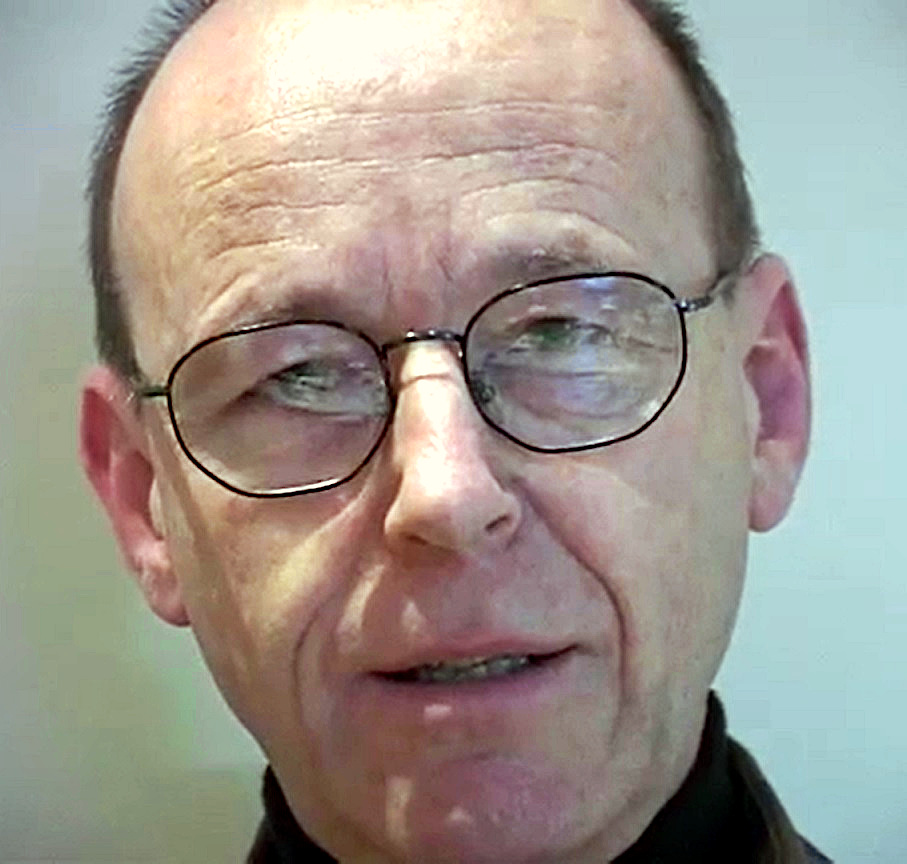
Anthony McCall c.2003

Anthony McCall (born 1946) is a British-born New York based artist known for his ‘solid-light’ installations, a series that he began in 1973 with "Line Describing a Cone," in which a volumetric form composed of projected light slowly evolves in three-dimensional space.[1]

Occupying a space between cinema, sculpture, and drawing, his work's historical importance has been recognised in such exhibitions as "Into the Light: the Projected Image in American Art 1964–77,” Whitney Museum of American Art (2001–02); "The Expanded Screen: Actions and Installations of the Sixties and Seventies,” Museum Moderner Kunst, Vienna (2003–04); "The Expanded Eye," Kunsthaus Zurich (2006); "Beyond Cinema: the Art of Projection,” Hamburger Bahnhof, Berlin (2006–07); "The Cinema Effect: Illusion, Reality and the Projected Image,” Hirshhorn Museum, Washington DC (2008); and "On Line: Drawing Through the Twentieth Century,” Museum of Modern Art (2010–11) and “Solid Light”, Tate Modern, London (2024-25).

Career

[edit]

Early life and 1970s career

[edit]

McCall studied graphic design and photography at Ravensbourne College of Art and Design, Bromley, Kent, England from 1964 to 1968. He became widely recognized for his groundbreaking “solid light” works, beginning with Line Describing a Cone (1973), a film installation that uses projected light to form a three-dimensional shape in space.[2]

McCall was a key figure in the avant-garde London Film-makers Co-operative in the 1970s. His earliest films are documents of outdoor performances that were notable for their minimal use of the elements, most notably fire. McCall's first piece was called Landscape for Fire.[3][4]

After moving to New York in 1973, McCall continued his fire performances and developed his 'solid light' film series, beginning with Line Describing a Cone, in 1973. Based on simple, animated line-drawings, these projections strikingly emphasise the sculptural qualities of a beam of light. In darkened, haze-filled rooms, the projections create an illusion of three-dimensional shapes, ellipses, waves and flat planes that gradually expand, contract or sweep through space. In these works, the artist sought to deconstruct cinema by reducing film to its principle components of time and light and removing the screen entirely as the prescribed surface for projection. The works also shift the relationship of the audience to film, as viewers become participants, their bodies intersecting and modifying the transitory forms.

At the end of the 1970s, McCall withdrew from making art. When he took his Line Describing a Cone installation to Konsthallen [sv] in Lund, Sweden, the artwork was rendered invisible. Very much unlike the New York lofts where dust and cigarette smoke created a haze, Swedish clean air shocked him severely, casting him into a "wilderness" that would last two decades.[3] His showing at documenta 6 in 1977 would be his last for over 25 years.[5]

Resurgence in the 2000s

[edit]

Some twenty years later, McCall's works started to appear at such institutions as Centre Pompidou, Whitney Museum and Tate Modern.[5] This brought his attention and he acquired a new dynamic and re-opened his 'solid light' series, this time using digital animation and digital projection rather than 16mm film.[1] The first of the new works, "Doubling Back" (2003) was exhibited at the 2004 Whitney Biennial. McCall developed the use of a slow-moving cinematic ‘wipe’ to combine and separate two opposing forms within one volumetric object; the new works also explored the extended cyclical ‘installation’ structure that he had first developed in the film-based work of the seventies. New installations included "You and I, Horizontal" (2006), "Leaving, with Two-Minute Silence" (2009), and "Face to Face" (2013). McCall also developed a parallel series of vertically oriented works, starting with "Breath" (2004) in which a projector mounted on the ceiling projects directly downwards onto the floor, creating a ten-metre-tall, tent-like, almost architectural enclosure with a 4-metre wide base. Other vertical works included "Between You and I" (2006), "Meeting You Halfway" (2009), and "Coupling" (2009).

The first survey exhibition of McCall's work in an international institution took place at the Serpentine Gallery London, in 2007-8. This included early performance films, horizontal solid light works, and works on paper. The vertical works were first exhibited as a solo show ("Breath: The Vertical Works”) at Hangar Bicocca, Milan in 2009. The horizontal and vertical works were combined in a solo show at Hamburger Bahnhof, Berlin ("Five Minutes of Pure Sculpture") in 2012.

McCall has recently embarked on a new series, which use slanting beams, projected from ceiling-to-floor at a 45-degree angle. Originating from two widely separated projectors mounted on the ceiling, the beams converge at the floor, creating a single, superimposed ‘footprint’. Works include "Coming About" (2016) and the four-projector installation, "Crossing" (2016).

Personal life

[edit]

McCall had a relationship with performance artist Carolee Schneemann in the 1970s. They met in London and McCall followed her when she moved back to New York.[3]

Exhibitions and screenings

[edit]

Solo exhibitions and screenings

[edit]
  • Artists Space, New York, 1974, 1976
  • The Clocktower, New York, 1974.
  • Collective for Living Cinema, New York, 1974, 1975
  • London Film-Makers’ Cooperative, London, 1974, 1975
  • Millennium Film Workshop, New York, 1974, 1976
  • Museum of Modern Art, Oxford, England, 1974.
  • Museum of Art, Carnegie Institute, Pittsburgh, 1975.
  • Serpentine Gallery, London, 1975.
  • Musée Nationale d’Art Moderne, Paris, 1976.
  • The Museum of Modern Art, New York, 1976
  • Centre Pompidou / Fondation Antoine de Galbert, Paris, 2004.
  • Tate Britain, London, 2004.
  • Museu d’Art Contemporani de Barcelona, 2005.
  • Museum für Moderne Kunst, Frankfurt, 2005.
  • Musée Départemental d’Art Contemporain, Rochechouart, France, 2007.
  • Serpentine Gallery, London, 2007–2008.
  • Hangar Bicocca, Milan, 2009.
  • Moderna Museet, Stockholm, 2009.
  • Hamburger Bahnhof, Berlin, 2012.
  • Tate Tanks, London, 2012.
  • Kunstmuseum St. Gallen, Die Lokremise, Switzerland, 2013.
  • Les Abattoirs, Toulouse, 2013.
  • Eye Film Museum, Amsterdam, 2014.
  • LAC Lugano Arte e Cultura, Lugano, Switzerland, 2015.
  • Milwaukee Art Museum, Wisconsin, 2015.
  • Fundació Gaspar, Barcelona, Spain, 2016.
  • Pioneer Works, Brooklyn, New York, 2018.
  • The Hepworth Wakefield, Wakefield, UK, 2018.
  • Albright Knox Art Gallery, Buffalo, NY, 2019.

Group exhibitions

[edit]
  • Gallery House, London, 1972. A Survey of the Avant-Garde in Britain.
  • Institute of Contemporary Arts, London, 1976. The Festival of Expanded Cinema.
  • Documenta 6, Kassel, Germany, 1977.
  • Whitney Museum of American Art, New York, 2001–2002. Into the Light: The Projected Image in American Art 1964–1977.
  • Tate Modern, London, 2002. Shoot Shoot Shoot: The First Decade of the London Film-Makers’ Cooperative & British Avant-Garde Film 1966–76.
  • Museum Moderner Kunst (MUMOK), Vienna, 2003–2004. X-Screen: The Expanded Screen: Actions and Installations of the Sixties and Seventies.
  • Hartware MedienKunstVerein (HMKV), Dortmund, Germany, 2004. Expanded Cinema: Film as Spectacle, Event and Performance.
  • Whitney Museum of American Art, New York, 2004. Whitney Biennial.
  • ZKM | Museum für Neue Kunst, Karlsruhe, Germany, 2005–2006. Lichtkunst aus Kunstlicht.
  • Hamburger Bahnhof, Berlin, 2006–2007. Projections: Beyond Cinematic Space.
  • Kunsthaus Zürich, 2006. The Expanded Eye.
  • Museum für Moderne Kunst (MMK), Frankfurt, 2007. Das Kapital: Blue Chips & Masterpieces.
  • San Francisco Museum of Modern Art (SFMoMA), 2007. Project, Transform, Erase: Anthony McCall and Imi Knoebel.
  • Akademie der Künste, Berlin, 2008. Notation: Calculation and Form in the Arts.
  • Hirshhorn Museum, Smithsonian Institution, Washington, D.C., 2008. The Cinema Effect: Illusion, Reality, and the Moving Image.
  • Orchard, New York. 2008. Spring Wound.
  • The Museum of Modern Art, New York, 2010–11. On Line: Drawing Through the Twentieth Century.
  • Fundação Serralves, Porto, Portugal, 2011. Off the Wall. Curated by Chrissie Iles.
  • Geffen Contemporary at MOCA, Los Angeles, 2012. Ends of the Earth: Land Art to 1974.
  • Haus der Kunst, Munich, 2012–13. Ends of the Earth: Land Art to 1974.
  • Hayward Gallery, London, 2013. Light Show.
  • SFMoMA, San Francisco, 2016. About Time: Photography in a Moment of Change. Curated by Corey Keller.
  • Whitney Museum of American Art, New York, 2016-17. Dreamlands: Immersive Cinema and Art, 1905-2016.
  • LAM, Lille, France, 2018. Danser Brut.
  • Denver Art Museum, Denver, CO, 2019. Eyes On: Anthony McCall.
  • ZKM Center for Art and Media, Karlsruhe, Germany, 2019. NegaOve Space: Trajectories of Sculpture.

Publications

[edit]

Monographs and catalogues

[edit]
  • Anthony McCall and David Grubbs: Simultaneous Soloists. Texts by Anthony McCall, David Grubbs, Branden W. Joseph, and Swagato Chakravorty. Brooklyn, New York: Pioneer Works Press, 2019.
  • Anthony McCall: Solid Light Works (exh. cat.). Texts by Antonio Somaini, Bettina Della Casa, Jarrett Earnest, and Luke Skrebowski. Lugano, Switzerland: LAC Lugano Arte e Cultura, 2015. (English/Italian)
  • Anthony McCall: Notebooks and Conversations. Texts by Graham Ellard and Stephen Johnstone. Lund Humphries, in association with Kunstmuseum St Gallen, 2015.
  • Anthony McCall: Face to Face (exh. cat.). Texts by Maxa Zoller, Luke Smythe and Anthony McCall. Amsterdam: EYE Filmmuseum, 2014.
  • Anthony McCall: 1970s Works on Paper. Text by Anne Wagner. Köln: Walther König, 2013.
  • Anthony McCall: Five Minutes of Pure Sculpture (exh. cat.). Text by Noam Elcott. Berlin: Nationalgalerie im Hamburger Bahnhof – Museum für Gegenwart – Berlin, 2012. (English/German)
  • Anthony McCall: Breath [The Vertical Works] (exh. cat.). Text by Hal Foster. Milan: Hangar Bicocca, 2009. (English/Italian)
  • Anthony McCall: Elements for a Retrospective 1972–1979 / 2003– . Text by Olivier Michelon. London: Serpentine Gallery; Rochechouart, France: Musée Départemental d’Art Contemporain; and Paris: Monografik, 2007. (English/French)
  • Anthony McCall: The Solid Light Films and Related Works. Texts by Branden W. Joseph and Jonathan Walley. Edited by Christopher Eamon. Evanston, Illinois: Northwestern University Press; San Francisco: New Art Trust; and Göttingen, Germany: Steidl, 2005.
  • Anthony McCall: Film Installations (exh. cat.). Texts by George Baker, Lisa Le Feuvre, Anthony McCall. Edited by Helen Legg. Coventry, England: Mead Gallery, University of Warwick, 2004.

Critical texts

[edit]
  • Baker, George. “Film Beyond Its Limits.” Grey Room 25 (Fall 2006), pp. 92–125.
  • Bobka, Vivian. “Eye, Gaze, Screen: Anthony McCall.” Texte zur Kunst, no. 68 (December 2007).
  • Elcott, Noam. “Smoke Screen.” Aperture Magazine, issue 231 (Summer 2018), pp. 73-77.
  • Ellard, Graham and Johnstone, Stephen. “Anthony McCall” (Interview). Bomb, issue 97 (Fall 2006), pp. 92–125.
  • Foster, Hal. “Film Stripped Bare.” In The Art-Architecture Complex, London: Verso, 2011. Chapter 9.
  • McCall, Anthony. “Line Describing a Cone and Related Films”, October 103 (Winter 2003), pp 42–62.
  • Michaud, Philippe-Alain. “The Geometric Cinema of Anthony McCall.” October 137 (Summer 2011).
  • Richard, Laura. “Anthony McCall: The Long Shadow of Ambient Light.” Oxford Art Journal, Oxford University Press, 2012.
  • Sitney, P. Adams, ed. The Avant-Garde Film: A Reader of Theory and Criticism. New York: New York University Press, 1978, pp. 250–254.
  • Walley, Jonathan. “The Material of Film and the Idea of Cinema.” October 103 (Winter 2003), pp. 15–30.

References

[edit]
[edit]
Revisions and contributorsEdit on WikipediaRead on Wikipedia
from Grokipedia
''Anthony McCall'' is a British artist known for his pioneering solid-light installations that materialize projected light into three-dimensional sculptural forms within darkened spaces. Born in 1946 in St. Paul's Cray, England, he relocated to New York City, where he continues to live and work. McCall first gained international recognition in the 1970s for his groundbreaking work in expanded cinema and light-based art, particularly through the seminal piece Line Describing a Cone (1973), which uses a projected line to generate a volumetric cone made visible by environmental haze. Following a period of limited artistic production during the 1980s and 1990s, McCall returned to active practice in the early 2000s, incorporating digital projection technologies to create increasingly complex and interactive solid-light works. These later installations, such as Doubling Back (2003), You and I (II) (2010), and Split Second (Mirror) (2018), explore themes of duration, spectator participation, and the intersection of sculpture, film, and drawing. McCall's contributions have positioned him as a key figure in contemporary installation art, with his works featured in solo and group exhibitions at leading institutions worldwide, including Tate Modern, Guggenheim Bilbao, Denver Art Museum, and Albright-Knox Art Gallery. His practice continues to influence discussions on perception, materiality, and the experiential dimensions of light in art.

Early life and education

Birth and background

Anthony McCall was born in 1946 in St Paul's Cray, a suburban area in southeast London, England. He is a British-born artist who spent his early life in the United Kingdom. Limited public information exists on his family background or specific childhood experiences, with available sources focusing primarily on his place and year of birth rather than personal or environmental details from that period. He later relocated to New York, where he has been based for much of his professional career.

Education

Anthony McCall studied graphic design, photography, art history, and philosophy at Ravensbourne College of Art and Design in Bromley, Kent (now part of London), from 1964 to 1968. This formal training provided him with a foundation in visual communication and artistic theory before he moved to New York in the early 1970s.

Move to New York and early career

Relocation to New York

Anthony McCall relocated from London to New York in 1973, immersing himself in the city's vibrant avant-garde art scene. He moved together with the American performance artist Carolee Schneemann, his partner at the time, whose established presence in experimental art circles facilitated his integration into the New York milieu. The 1970s New York art world served as a major hub for radical experimentation, where boundaries between film, sculpture, performance, and other media were actively challenged by communities centered around venues like Anthology Film Archives and The Kitchen, as well as influences from Fluxus artists, Andy Warhol's structural films, and Yoko Ono's durational performances. This dynamic environment, building on but distinct from London's Filmmakers' Co-op scene where McCall had been active, drew international artists seeking to push interdisciplinary boundaries, providing fertile ground for McCall's shift toward exploring light as a tangible medium. Shortly after his arrival, McCall began developing the ideas that would define his early New York work, connecting with the city's experimental film and performance networks.

Early projects and performances

After relocating to New York in 1973, Anthony McCall immersed himself in the city's experimental art scene, where he began creating installation works that explored projected light and temporal structures. These early projects often took place in alternative spaces such as lofts and galleries in SoHo, emphasizing the interaction between light, space, and viewer perception. He used elements like mist or smoke to make projected beams visible, creating volumetric forms that engaged audiences directly and challenged conventional notions of sculpture and cinema. A key example is Line Describing a Cone (1973), in which a projected line draws a volumetric cone over 30 minutes, visible through environmental haze. These activities marked a transitional phase in his practice, bridging his prior work in film and performance from the UK with the conceptual innovations that would define his subsequent career.

Solid light installations

Development of solid light

Anthony McCall developed the concept of solid light in the early 1970s amid his involvement in London's independent film community and expanded cinema scene. Following his 1972 performance work Landscape for Fire, documented on 16mm film, McCall became dissatisfied with conventional filmmaking, where the projected image functioned as a secondary record of a past event viewed separately from the original action. He began exploring whether a film could exist only in the continuous present tense of projection, shared physically and temporally with the audience. This line of inquiry produced the theoretical basis for solid light: projected light beams treated as primary volumetric forms rather than mere carriers of coded information decoded on a flat screen. McCall termed these "solid light films" and emphasized their direct engagement with one of film's irreducible conditions—projected light—independent of narrative or representational concerns. The works draw conceptually from structuralist materialist film practices, influences including John Cage, Michael Snow, and Andy Warhol, as well as intersections with sculpture and performance, positioning light as a sculptural medium that occupies real three-dimensional space. Technically, the early solid light works relied on 16mm film projection in pitch-dark environments, with no traditional screen required. Visibility of the volumetric light forms depended on the beam intersecting with airborne particles such as dust, humidity, or haze, making the light tangible and sculptural within the shared space. The projector was placed inside the viewing area as an integral element, and viewers faced toward it, experiencing the evolving light structures directly in real time. This approach established solid light as a hybrid practice that fused film, sculpture, drawing, and performance, with the projected form existing only momentarily during projection.

Line Describing a Cone

Line Describing a Cone is a seminal projected film installation created by Anthony McCall in 1973. Executed as a 16mm film, the work has a duration of 30 minutes and functions as the first in the artist's series of solid light films. The piece begins with a single white dot projected onto a wall, which slowly traces the circumference of a circle over the full duration, leaving a visible trail that gradually materializes a complete hollow cone of light within the darkened exhibition space. The projector, positioned at one end of the room, emits a continuous pencil of light that becomes the sculptural form itself, rendered visible through atmospheric haze or dust that fills the environment. McCall has explained that the work opens with a narrow beam connecting the projector to the wall, where the initial dot expands into a curving line that completes the circle very slowly, culminating in the full conical volume. Spectators are immersed directly inside this evolving three-dimensional light structure and are encouraged to move freely around and through it, often turning their backs to the wall image to observe the beam from different perspectives. This interaction introduces a performative dimension, as viewers' bodies intersect and alter the transitory form, contrasting sharply with the fixed seating of conventional cinema. The work premiered on August 30, 1973, at Fylkingen in Stockholm, Sweden. Early showings took place in New York, including at Artists Space in 1974. Line Describing a Cone is regarded as a landmark in expanded cinema and installation art for its radical redefinition of projected light as a volumetric, sculptural presence that occupies real space and engages viewers physically, thereby testing the boundaries between film, sculpture, and drawing.

Other early solid light works

Following Line Describing a Cone, Anthony McCall produced a series of related solid light films in 1974 and 1975 that continued to investigate projected light as a volumetric, sculptural presence in darkened spaces, often using haze to render the beams tangible and encourage viewer movement around the forms. Conical Solid (1974) projects a flat, triangular blade of light that rotates from a fixed central axis at eight progressively changing speeds, creating a perceptual threshold where flashing planes become recognizable as temporally describing a solid conical form. Partial Cone (1974) generates a half-cone of light whose surface is systematically modulated by varying frequencies of light and dark frames, transitioning through states from solid to tremoring, glimmering, blinking, and flashing to probe the illusory solidity of the projected membrane. Cone of Variable Volume (1974) presents a full cone of light that repeatedly expands and contracts at four different speeds, extending the exploration of dynamic volumetric change. Long Film for Four Projectors (1974) marks a shift toward greater duration and spatial complexity, using four 16mm projectors to create intersecting planes of light that form dynamic walls within the room, producing an active field of interpenetrating volumes over approximately five and a half hours and emphasizing ideas of architecture, duration, and relational viewer involvement. Four Projected Movements (1975) involves a single fifteen-minute reel of triangular light blades presented live by a projectionist in four orientations—forwards, backwards, forwards back-to-front, and backwards back-to-front—generating distinct spatial movements from a corner-placed projector that uses the adjacent walls and floor to bound the work's three-dimensional path.

Career in the 1980s and 1990s

Shift in practice

In the late 1970s, Anthony McCall shifted away from his pioneering solid-light projections and returned to his training in graphic design, establishing a successful New York studio where he specialized in designing art books, including publications for sculptor Richard Serra. He experienced increasing frustration when art historians or others wanted to discuss his earlier light works, feeling that such conversations betrayed his current direction and amounted to wasted time. Eventually, this discomfort became so acute that he could no longer bear to design another book. A decisive event that deepened his withdrawal from solid-light practice occurred during an invitation to exhibit Line Describing a Cone at Lunds Konsthall in Sweden. In the gallery's excessively hygienic environment, the projected beam appeared completely flat and invisible as a volumetric form, lacking the ambient dust and cigarette smoke that had made the light tangible in New York industrial lofts. Attempts to recreate the necessary particulates—such as smoking multiple cigarettes, using dry ice, or burning frankincense—failed, resulting in his ejection by a guard. This encounter cast McCall into a prolonged period of disengagement from solid-light works, spanning a 20-year hiatus through the 1980s and 1990s. During these decades, McCall concentrated on his graphic design practice while producing few, if any, new works in the solid-light series. His interest in projection-based art revived in the late 1990s, spurred by technological developments including haze machines, new screen and projection practices, custom animation software, and high-luminosity, long-throw digital projectors. McCall returned to solid-light installations in the 2000s.

Revival and contemporary work

Return to solid light

In the early 2000s, Anthony McCall returned to his solid light practice after a period of relative dormancy in the medium, marking a significant revival beginning in 2003. This re-engagement was made possible by key technological advancements, particularly the widespread availability of digital projectors and the development of haze machines capable of producing a thin, non-toxic mist that safely rendered light beams visible in modern, smoke-free exhibition spaces. These innovations allowed McCall to revisit and re-present his foundational solid light works from the 1970s using contemporary equipment, improving clarity and accessibility while preserving the original conceptual intent. For instance, re-presentations of early pieces took place in 2003, including updated installations of works such as Long Film for Four Projectors (1974). The shift to digital technology also introduced computer control, enabling more precise animation of forms and greater flexibility in projection compared to the analog film-based methods of his initial explorations. This transition facilitated renewed presentations of his early solid light concepts in institutional settings during this period, including examples around the Whitney Museum in the early 2000s.

Recent installations

In the early 2000s, Anthony McCall resumed his solid-light practice after a two-decade hiatus, creating new installations that translated the vocabulary of his 1970s works into digital formats while emphasizing viewer interaction and spatial presence. Notable among these is You and I, Horizontal (2007), a horizontal solid-light film consisting of slowly rising and falling planes that viewers can pass through, with variants such as You and I, Horizontal (III) featuring paired three-dimensional forms projected side by side across a thirty-five-foot span in a silent thirty-minute cycle. These horizontal pieces marked a key development in his revival, allowing audiences to physically intersect and experience the volumetric light forms. McCall concurrently explored vertical solid-light works that introduced breathing-like motions and interpersonal dynamics. The Breath series, including Breath I (2004), Breath II (2004), and Breath III (2005), presents slowly expanding and contracting conical volumes that evoke respiration, engaging viewers through gradual transformation. Other vertical installations, such as Between You and I (2006) with two large opposing cones facing each other and Coupling (2009), further emphasize relational interaction by having forms approach, touch, or pass through one another. These works, often shown together in exhibitions like the 2009 presentation at Pirelli HangarBicocca, Milan, highlighted McCall's interest in duration and bodily engagement. Subsequent installations built on these themes with increased complexity. Meeting You Halfway (2009) features two vertical forms that slowly converge and intersect before separating, while Face to Face (2013) and its variants depict opposing forms that approach and withdraw. Later pieces include Swell (2016), a vertical form, and Split Second (Mirror) (2018), which incorporates reflective elements. McCall's contemporary practice has evolved to include digital projection and haze machines for precise control, with recent works introducing composed soundtracks to enhance immersion. Raised Voices (2020), a horizontal installation, transitions from a unified beam to translucent forms accompanied by David Grubbs's score incorporating voices and ambient urban sounds. Other sound-infused works include Skylight (2020) with thunderstorm elements and Rooms (2021), synchronized to lap steel guitar. In 2024, Split Second Mirror IV debuted as a new two-projector mirror-based piece. These installations continue to be presented in major venues, including Tate Modern and Guggenheim Bilbao in 2024.

Artistic techniques and philosophy

Solid light concept

Anthony McCall's solid light practice conceptualizes projected light as a primary sculptural material, capable of forming tangible, three-dimensional volumes that occupy real space rather than merely representing it. He describes his works as existing "in the space where cinema, sculpture and drawing overlap," with beams of light creating immersive, inhabitable structures that blur conventional medium boundaries. McCall has articulated this approach by noting that a solid light piece functions as "a large sculpture made of light, which, therefore, can be walked around, and walked into, and walked through," while simultaneously evolving over time in a manner akin to film. Central to his philosophy is a rejection of traditional screen-based cinema, which treats the light beam as a carrier of coded information decoded on a flat surface to produce illusionistic images. Instead, McCall directs attention to the beam itself as the essential phenomenon, independent of representational content. His works emphasize duration, unfolding gradually in real time over extended cycles, and demand active viewer movement to explore the spatial dimensions from multiple perspectives and bodily positions. McCall's objective is to deliver a primary, direct experience rather than a secondary or referential one, where space and time are actual and present rather than illusory or allusive. He has stated that such works contain "no illusion" and constitute "a primary experience, not secondary: i.e. the space is real, not referential; the time is real, not referential." To make the volumetric forms perceptible in gallery settings, the installations incorporate a controlled haze that renders the projected beams visible without relying on ambient dust or smoke.

Technical evolution and viewer interaction

Anthony McCall's solid light installations have undergone a significant technical evolution from analog to digital methods, reflecting broader shifts in projection technology and environmental control. In his early works of the 1970s, McCall used 16mm film projectors to present hand-animated, black-and-white drawings that slowly traced simple geometric forms, with a single projector typically employed to generate the evolving light volumes. The beams became visible as three-dimensional structures through ambient conditions such as dust, cigarette smoke, or existing haze in the darkened, often loft-like venues where the pieces were shown. Upon reviving the series in 2003, McCall adopted digital projectors, which provided higher luminosity, greater precision, and the ability to run custom animation software from computers, enabling more intricate curvilinear geometries and extended cycles. Reliable haze machines producing a thin, non-toxic mist replaced dependence on ambient particles, ensuring consistent visibility of the light forms in contemporary gallery environments. Later installations have incorporated multiple projectors or additional sources to create intersecting or layered volumes, further expanding the spatial complexity controlled through digital means. Viewer interaction has remained essential throughout both analog and digital eras, as the works' sculptural presence depends on active participation. Spectators are invited to move through, around, and between the volumetric light forms, with changes in position and perspective revealing different aspects of the evolving structures. This bodily navigation heightens corporeal awareness and encourages subtle synchronization between the viewer's movements and the slow drifts of the projections, making the audience an integral component of the experience rather than passive observers. The shift to digital tools has thus preserved and intensified the participatory dimension while allowing greater technical flexibility in realizing the solid light concept.

Exhibitions and collections

Major solo exhibitions

Anthony McCall's major solo exhibitions have showcased his influential solid light installations and related works at prominent institutions and galleries worldwide, often emphasizing immersive viewer experiences and the evolution of his practice. In 2024, Tate Modern in London presented a dedicated solo exhibition of McCall's immersive solid light works, running from June 2024 to April 2025, where visitors' movements activated and interacted with the projected forms in darkened galleries. Concurrently, a major solo show at the Guggenheim Bilbao in Spain featured his solid light installations until October 13, 2024. The artist's first solo museum exhibition in North America was "Dark Rooms, Solid Light" at the Buffalo AKG Art Museum (formerly Albright-Knox Art Gallery) in Buffalo, New York, held from August 16 to November 3, 2019, which occupied the entire 1905 building with large-scale light projections and explored the spatial and temporal dimensions of his work. In 2018, "Solid Light Works" was exhibited as a solo presentation at Pioneer Works in Brooklyn, New York, highlighting historical and new solid light pieces. McCall has also held significant gallery-based solo shows, including "Split Second" at Sean Kelly Gallery in New York in 2018, featuring new solid-light installations and earlier works such as Doubling Back (2003). More recent international solo exhibitions include "Meeting You Halfway" at Fubon Art Museum in Taipei, marking his first major solo in Taiwan and spanning five decades of practice, as well as a retrospective-like solo at Luciana Brito Galeria in São Paulo, Brazil, his first in that country. Additional notable solo presentations feature "Face to Face" at Trish Clark Gallery in Auckland, New Zealand, and ongoing or upcoming shows such as "Solid Light" at Shenzhen Bay Cultural Park in Shenzhen, China (November 2025–March 2026).

Group exhibitions and collections

Anthony McCall has participated in numerous significant group exhibitions at leading international institutions throughout his career. His groundbreaking early work, including Line Describing a Cone, appeared in the landmark group show Into the Light: the Projected Image in American Art, 1964–1977 at the Whitney Museum of American Art in 2001. He was also selected for the Whitney Biennial in 2004, where his solid light installations were presented alongside contemporary works exploring projection and space. Further group presentations include Projections: Beyond Cinematic Space at Hamburger Bahnhof in Berlin in 2006, The Expanded Eye at Kunsthaus Zürich in 2006, and exhibitions at the Hayward Gallery in London in 2004 and the Museum of Modern Art in New York in 2008. McCall's works are held in the permanent collections of several major museums. These include the Museum of Modern Art in New York, which owns pieces such as Miniature in Black and White (1972) and Water Table (c. 1972). The Whitney Museum of American Art in New York holds works including Line Describing a Cone (1973) and Circulation Figures (1972/2011). Tate in London includes Line Describing a Cone (1973) in its collection. The Centre Pompidou in Paris holds installations such as Long Film for Four Projectors (1974) and Line Describing a Cone (1973). Moderna Museet in Stockholm has acquired Doubling Back.

Personal life and legacy

Personal life

Anthony McCall has resided in New York City since 1973, where he lives and works in Manhattan. Public information about his personal life beyond this residence is limited, with no documented details on family or personal milestones shared in available sources.

Influence and recognition

Anthony McCall's pioneering "solid light" installations have profoundly influenced subsequent generations of artists working at the intersection of film, installation, and immersive art. His practice has inspired a generation of practitioners exploring light, projection, and spatial interactions, establishing him as a foundational figure in experimental film and installation art. McCall is widely regarded as a visionary in contemporary visual culture whose innovative approach has helped redefine boundaries across media and encouraged active viewer participation in spatial experiences. His contributions have earned significant institutional recognition, including the Arts and Letters Award in Art from the American Academy of Arts and Letters in 2018, a fellowship from the American Academy in Berlin in 2014, and a John Simon Guggenheim Memorial Foundation Fellowship in 2008. McCall's works are held in prominent public collections such as the Museum of Modern Art in New York, Tate in London, the Whitney Museum of American Art in New York, and the Centre Georges Pompidou in Paris, underscoring his enduring impact. Ongoing critical regard is reflected in major solo exhibitions at leading institutions, including Tate Modern in London (2024–2025), the Guggenheim Museum Bilbao (2024), and the Buffalo AKG Art Museum (2019), among others. Over the years, McCall has steadily garnered acclaim through presentations at prominent museums worldwide.

References

Add your contribution
Related Hubs
User Avatar
No comments yet.