
Recent from talks
Antifreeze protein
Knowledge base stats:
Talk channels stats:
Members stats:
Antifreeze protein
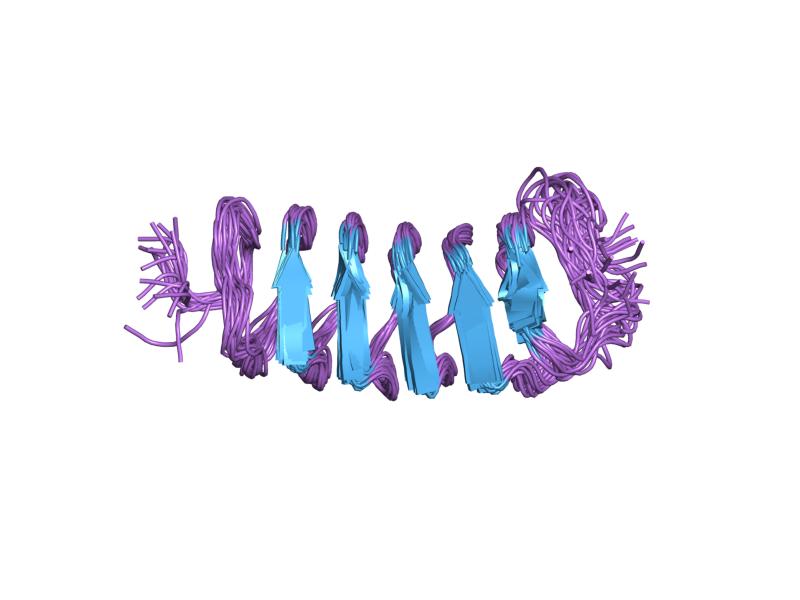
Antifreeze proteins (AFPs) or ice structuring proteins refer to a class of polypeptides produced by certain animals, plants, fungi and bacteria that permit their survival in temperatures below the freezing point of water. AFPs bind to small ice crystals to inhibit the growth and recrystallization of ice that would otherwise be fatal. There is also increasing evidence that AFPs interact with mammalian cell membranes to protect them from cold damage. This work suggests the involvement of AFPs in cold acclimatization.
Unlike the widely used automotive antifreeze, ethylene glycol, AFPs do not lower freezing point in proportion to concentration.[citation needed] Rather, they work in a noncolligative manner. This phenomenon allows them to act as an antifreeze at concentrations 1/300th to 1/500th of those of other dissolved solutes. Their low concentration minimizes their effect on osmotic pressure. The unusual properties of AFPs are attributed to their selective affinity for specific crystalline ice forms and the resulting blockade of the ice-nucleation process.
AFPs create a difference between the melting point and freezing point (busting temperature of AFP bound ice crystal) known as thermal hysteresis. The addition of AFPs at the interface between solid ice and liquid water inhibits the thermodynamically favored growth of the ice crystal. Ice growth is kinetically inhibited by the AFPs covering the water-accessible surfaces of ice.
Thermal hysteresis is easily measured in the lab with a nanolitre osmometer. Organisms differ in their values of thermal hysteresis. The maximum level of thermal hysteresis shown by fish AFP is approximately −3.5 °C (Sheikh Mahatabuddin et al., SciRep)(29.3 °F). In contrast, aquatic organisms are exposed only to −1 to −2 °C below freezing. During the extreme winter months, the spruce budworm resists freezing at temperatures approaching −30 °C.
The rate of cooling can influence the thermal hysteresis value of AFPs. Rapid cooling can substantially decrease the nonequilibrium freezing point, and hence the thermal hysteresis value. Consequently, organisms cannot necessarily adapt to their subzero environment if the temperature drops abruptly.
Species containing AFPs may be classified as
Freeze avoidant: These species are able to prevent their body fluids from freezing altogether. Generally, the AFP function may be overcome at extremely cold temperatures, leading to rapid ice growth and death.
Freeze tolerant: These species are able to survive body fluid freezing. Some freeze tolerant species are thought to use AFPs as cryoprotectants to prevent the damage of freezing, but not freezing altogether. The exact mechanism is still unknown. However, it is thought AFPs may inhibit recrystallization and stabilize cell membranes to prevent damage by ice. They may work in conjunction with ice nucleating proteins (INPs) to control the rate of ice propagation following freezing.
Hub AI
Antifreeze protein AI simulator
(@Antifreeze protein_simulator)
Antifreeze protein
Antifreeze proteins (AFPs) or ice structuring proteins refer to a class of polypeptides produced by certain animals, plants, fungi and bacteria that permit their survival in temperatures below the freezing point of water. AFPs bind to small ice crystals to inhibit the growth and recrystallization of ice that would otherwise be fatal. There is also increasing evidence that AFPs interact with mammalian cell membranes to protect them from cold damage. This work suggests the involvement of AFPs in cold acclimatization.
Unlike the widely used automotive antifreeze, ethylene glycol, AFPs do not lower freezing point in proportion to concentration.[citation needed] Rather, they work in a noncolligative manner. This phenomenon allows them to act as an antifreeze at concentrations 1/300th to 1/500th of those of other dissolved solutes. Their low concentration minimizes their effect on osmotic pressure. The unusual properties of AFPs are attributed to their selective affinity for specific crystalline ice forms and the resulting blockade of the ice-nucleation process.
AFPs create a difference between the melting point and freezing point (busting temperature of AFP bound ice crystal) known as thermal hysteresis. The addition of AFPs at the interface between solid ice and liquid water inhibits the thermodynamically favored growth of the ice crystal. Ice growth is kinetically inhibited by the AFPs covering the water-accessible surfaces of ice.
Thermal hysteresis is easily measured in the lab with a nanolitre osmometer. Organisms differ in their values of thermal hysteresis. The maximum level of thermal hysteresis shown by fish AFP is approximately −3.5 °C (Sheikh Mahatabuddin et al., SciRep)(29.3 °F). In contrast, aquatic organisms are exposed only to −1 to −2 °C below freezing. During the extreme winter months, the spruce budworm resists freezing at temperatures approaching −30 °C.
The rate of cooling can influence the thermal hysteresis value of AFPs. Rapid cooling can substantially decrease the nonequilibrium freezing point, and hence the thermal hysteresis value. Consequently, organisms cannot necessarily adapt to their subzero environment if the temperature drops abruptly.
Species containing AFPs may be classified as
Freeze avoidant: These species are able to prevent their body fluids from freezing altogether. Generally, the AFP function may be overcome at extremely cold temperatures, leading to rapid ice growth and death.
Freeze tolerant: These species are able to survive body fluid freezing. Some freeze tolerant species are thought to use AFPs as cryoprotectants to prevent the damage of freezing, but not freezing altogether. The exact mechanism is still unknown. However, it is thought AFPs may inhibit recrystallization and stabilize cell membranes to prevent damage by ice. They may work in conjunction with ice nucleating proteins (INPs) to control the rate of ice propagation following freezing.
Recent media