



Community hub
Recent from talks
Knowledge base stats:
Talk channels stats:
Members stats:
Antigen-presenting cell
An antigen-presenting cell (APC) or accessory cell is a cell that displays an antigen bound by major histocompatibility complex (MHC) proteins on its surface; this process is known as antigen presentation. T cells may recognize these complexes using their T cell receptors (TCRs). APCs process antigens and present them to T cells.
Almost all cell types can present antigens in some way. They are found in a variety of tissue types. Dedicated antigen-presenting cells, including macrophages, B cells and dendritic cells, present foreign antigens to helper T cells, while virus-infected cells (or cancer cells) can present antigens originating inside the cell to cytotoxic T cells. In addition to the MHC family of proteins, antigen presentation relies on other specialized signaling molecules on the surfaces of both APCs and T cells.
Antigen-presenting cells are vital for effective adaptive immune response, as the functioning of both cytotoxic and helper T cells is dependent on APCs. Antigen presentation allows for specificity of adaptive immunity and can contribute to immune responses against both intracellular and extracellular pathogens. It is also involved in defense against tumors. Some cancer therapies involve the creation of artificial APCs to prime the adaptive immune system to target malignant cells.
Antigen-presenting cells fall into two categories: professional and non-professional. Those that express MHC class II molecules along with co-stimulatory molecules and pattern recognition receptors are often called professional antigen-presenting cells. The non-professional APCs express MHC class I molecules.
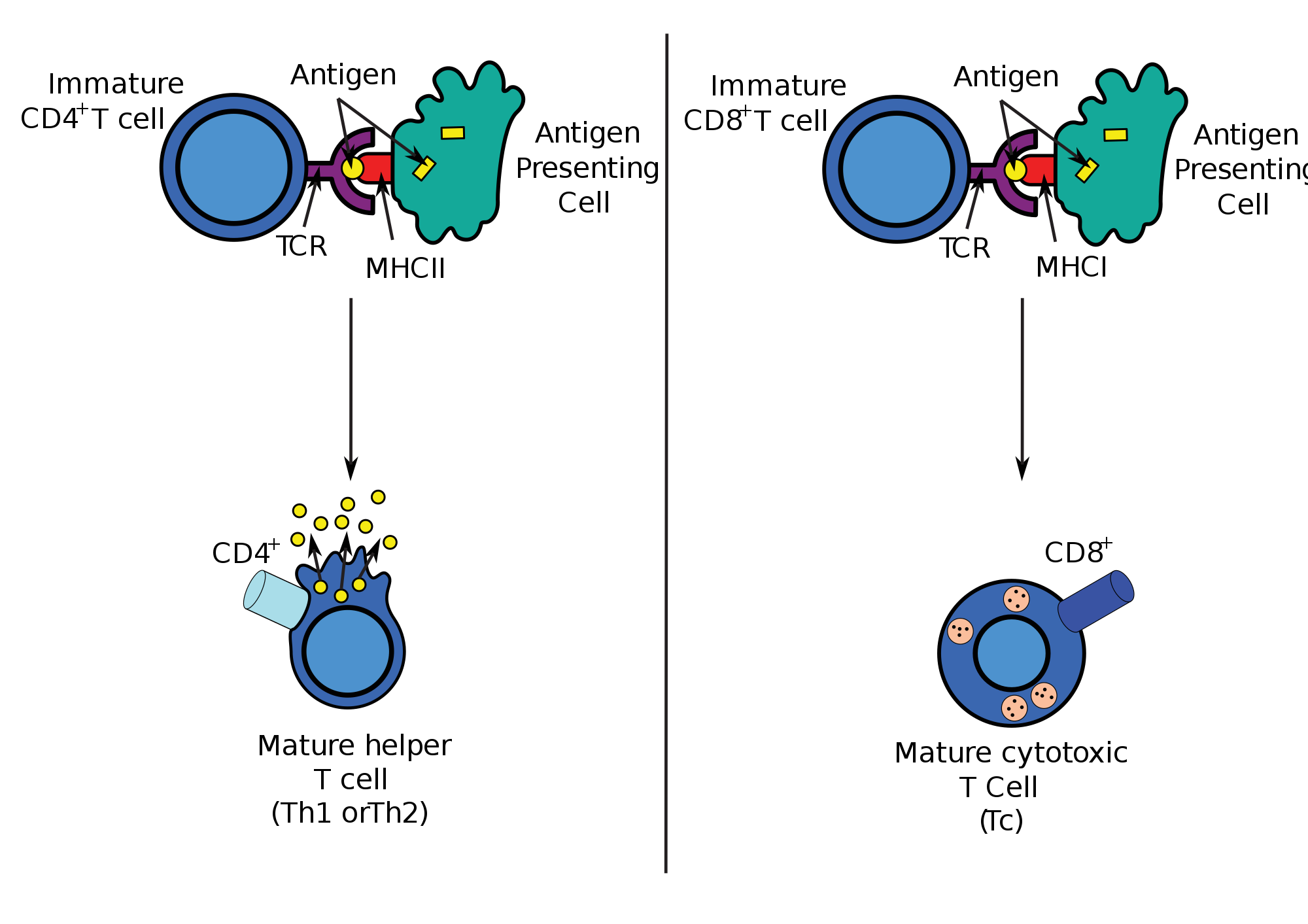
T cells must be activated before they can divide and perform their function. This is achieved by interacting with a professional APC which presents an antigen recognized by their T cell receptor. The APC involved in activating T cells is usually a dendritic cell. T cells cannot recognize (and therefore cannot respond to) "free" or soluble antigens. They can only recognize and respond to antigen that has been processed and presented by cells via carrier molecules like MHC molecules. Helper T cells can recognize exogenous antigen presented on MHC class II; cytotoxic T cells can recognize endogenous antigen presented on MHC class I. Most cells in the body can present antigen to CD8+ cytotoxic T cells via MHC class I; however, the term "antigen-presenting cell" is often used specifically to describe professional APCs. Such cells express MHC class I and MHC class II molecules and can stimulate CD4+ helper T cells as well as cytotoxic T cells.
APCs can also present foreign and self lipids to T cells and natural killer cells by using the CD1 family of proteins, which are structurally similar to the MHC class I family.
Professional APCs describe those APCs which are capable of delivering all 3 signals needed to activate a naive T cell (signal 1- the antigen itself, the peptide-MHC complex; signal 2 - costimulatory ligand; signal 3- cytokines to guide polarization of the T cell). Canonically, the 3 pAPC types are dendritic cells, macrophages, and B cells. They are very efficient at internalizing antigens, either by phagocytosis (e.g. macrophages), or by receptor-mediated endocytosis (B cells), processing the antigen into peptide fragments and then displaying those peptides (bound to a class II MHC molecule) on their membrane. The T cell recognizes and interacts with the antigen-class II MHC molecule complex on the membrane of the antigen-presenting cell. An additional co-stimulatory signal is then produced by the antigen-presenting cell, leading to activation of the T cell. The expression of co-stimulatory molecules and MHC class II are defining features of professional APCs. All professional APCs also express MHC class I molecules as well.
The main types of professional antigen-presenting cells are dendritic cells, macrophages and B cells.
Hub AI
Antigen-presenting cell AI simulator
(@Antigen-presenting cell_simulator)
Antigen-presenting cell
An antigen-presenting cell (APC) or accessory cell is a cell that displays an antigen bound by major histocompatibility complex (MHC) proteins on its surface; this process is known as antigen presentation. T cells may recognize these complexes using their T cell receptors (TCRs). APCs process antigens and present them to T cells.
Almost all cell types can present antigens in some way. They are found in a variety of tissue types. Dedicated antigen-presenting cells, including macrophages, B cells and dendritic cells, present foreign antigens to helper T cells, while virus-infected cells (or cancer cells) can present antigens originating inside the cell to cytotoxic T cells. In addition to the MHC family of proteins, antigen presentation relies on other specialized signaling molecules on the surfaces of both APCs and T cells.
Antigen-presenting cells are vital for effective adaptive immune response, as the functioning of both cytotoxic and helper T cells is dependent on APCs. Antigen presentation allows for specificity of adaptive immunity and can contribute to immune responses against both intracellular and extracellular pathogens. It is also involved in defense against tumors. Some cancer therapies involve the creation of artificial APCs to prime the adaptive immune system to target malignant cells.
Antigen-presenting cells fall into two categories: professional and non-professional. Those that express MHC class II molecules along with co-stimulatory molecules and pattern recognition receptors are often called professional antigen-presenting cells. The non-professional APCs express MHC class I molecules.
T cells must be activated before they can divide and perform their function. This is achieved by interacting with a professional APC which presents an antigen recognized by their T cell receptor. The APC involved in activating T cells is usually a dendritic cell. T cells cannot recognize (and therefore cannot respond to) "free" or soluble antigens. They can only recognize and respond to antigen that has been processed and presented by cells via carrier molecules like MHC molecules. Helper T cells can recognize exogenous antigen presented on MHC class II; cytotoxic T cells can recognize endogenous antigen presented on MHC class I. Most cells in the body can present antigen to CD8+ cytotoxic T cells via MHC class I; however, the term "antigen-presenting cell" is often used specifically to describe professional APCs. Such cells express MHC class I and MHC class II molecules and can stimulate CD4+ helper T cells as well as cytotoxic T cells.
APCs can also present foreign and self lipids to T cells and natural killer cells by using the CD1 family of proteins, which are structurally similar to the MHC class I family.
Professional APCs describe those APCs which are capable of delivering all 3 signals needed to activate a naive T cell (signal 1- the antigen itself, the peptide-MHC complex; signal 2 - costimulatory ligand; signal 3- cytokines to guide polarization of the T cell). Canonically, the 3 pAPC types are dendritic cells, macrophages, and B cells. They are very efficient at internalizing antigens, either by phagocytosis (e.g. macrophages), or by receptor-mediated endocytosis (B cells), processing the antigen into peptide fragments and then displaying those peptides (bound to a class II MHC molecule) on their membrane. The T cell recognizes and interacts with the antigen-class II MHC molecule complex on the membrane of the antigen-presenting cell. An additional co-stimulatory signal is then produced by the antigen-presenting cell, leading to activation of the T cell. The expression of co-stimulatory molecules and MHC class II are defining features of professional APCs. All professional APCs also express MHC class I molecules as well.
The main types of professional antigen-presenting cells are dendritic cells, macrophages and B cells.