



Community hub
Recent from talks
Contribute something
Nothing was collected or created yet.
Antithetic variates
View on WikipediaIn statistics, the antithetic variates method is a variance reduction technique used in Monte Carlo methods. Considering that the error in the simulated signal (using Monte Carlo methods) has a one-over square root convergence, a very large number of sample paths is required to obtain an accurate result. The antithetic variates method reduces the variance of the simulation results.[1][2]
Underlying principle
[edit]The antithetic variates technique consists, for every sample path obtained, in taking its antithetic path — that is given a path to also take . The advantage of this technique is twofold: it reduces the number of normal samples to be taken to generate N paths, and it reduces the variance of the sample paths, improving the precision.
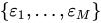

Suppose that we would like to estimate

For that we have generated two samples

An unbiased estimate of is given by

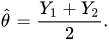
And

so variance is reduced if is negative.

Example 1
[edit]If the law of the variable X follows a uniform distribution along [0, 1], the first sample will be , where, for any given i, is obtained from U(0, 1). The second sample is built from , where, for any given i: . If the set is uniform along [0, 1], so are . Furthermore, covariance is negative, allowing for initial variance reduction.


Example 2: integral calculation
[edit]We would like to estimate
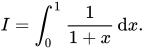
The exact result is . This integral can be seen as the expected value of , where


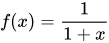
and U follows a uniform distribution [0, 1].
The following table compares the classical Monte Carlo estimate (sample size: 2n, where n = 1500) to the antithetic variates estimate (sample size: n, completed with the transformed sample 1 − ui):
Estimate standard error Classical Estimate 0.69365 0.00255 Antithetic Variates 0.69399 0.00063
The use of the antithetic variates method to estimate the result shows an important variance reduction.
See also
[edit]References
[edit]- ^ Botev, Z.; Ridder, A. (2017). "Variance Reduction". Wiley StatsRef: Statistics Reference Online. pp. 1–6. doi:10.1002/9781118445112.stat07975. hdl:1959.4/unsworks_50616. ISBN 9781118445112.
- ^ Kroese, D. P.; Taimre, T.; Botev, Z. I. (2011). Handbook of Monte Carlo methods. John Wiley & Sons.(Chapter 9.3)
Antithetic variates
View on GrokipediaFundamentals
Definition and Motivation
Monte Carlo methods provide a fundamental approach for estimating expectations or integrals in stochastic systems by generating independent random samples and applying the law of large numbers, which ensures that the sample average converges to the true expectation as the number of samples increases.[3] However, standard Monte Carlo estimators often suffer from high variance, leading to imprecise approximations that require prohibitively large sample sizes to achieve desired accuracy levels, particularly in computationally intensive simulations.[5] Antithetic variates constitute a variance reduction technique within Monte Carlo simulation that enhances estimation efficiency by generating pairs of random variables with identical marginal distributions but negative correlation, thereby reducing the overall variance of the paired estimator compared to independent sampling.[1] This method leverages the induced negative dependence to offset variations in the function evaluations, allowing for more reliable estimates of expectations without proportionally increasing the computational effort.[6] The motivation for antithetic variates arises from the need to mitigate the inefficiency of naive Monte Carlo in applications demanding high precision, such as physical modeling and financial risk assessment, where reducing variance directly translates to faster convergence and lower costs.[4] Historically, the technique emerged in the 1950s amid early developments in Monte Carlo methods for neutron transport problems, with pioneering variance reduction ideas explored by H. Kahn in his work on random sampling techniques.[7] It was formally introduced by J. M. Hammersley and K. W. Morton in 1956 as a novel correlation-based approach, and subsequently popularized through the comprehensive treatment in Hammersley and D. C. Handscomb's 1964 monograph on Monte Carlo methods.[1][8]Underlying Principle
The underlying principle of antithetic variates relies on generating pairs of random variables that exhibit negative correlation, thereby reducing the variance of Monte Carlo estimators by offsetting errors in opposite directions. In this method, a pair is constructed such that for a decreasing function , which induces and lowers the variance of the paired average relative to independent samples. This technique exploits the symmetry in random sampling to achieve more stable estimates without increasing computational effort.[1] The intuition behind this variance reduction is that deviations above and below the expected value in one variable of the pair are likely to be counterbalanced by opposite deviations in its antithetic counterpart, smoothing out fluctuations in the overall estimator. For instance, when one sample yields a high value, its paired counterpart tends to yield a low value, causing their average to remain closer to the true mean. This offsetting effect enhances the efficiency of simulations, particularly for monotone functions where the negative correlation is most pronounced.[1][9] Implementation typically begins with generating a uniform random variable , then forming the antithetic pair by using alongside , and applying the simulation function to both to compute their average. This pairing leverages the uniform distribution's symmetry to ensure the negative dependence, making it a straightforward extension of standard Monte Carlo procedures. A simple analogy is akin to averaging opposite extremes to smooth fluctuations, much like balancing pulls in opposing directions to stabilize a path in a random process.[1][9]Mathematical Formulation
Variance Reduction Mechanism
The antithetic variates method estimates the expectation , where is a random variable and is a function, using the paired estimator , with an antithetic variate to that shares the same marginal distribution but exhibits negative dependence.[1] This estimator remains unbiased, as , since .[3] The variance of this estimator is given by Since and have identical variances, , the expression simplifies to .[10] Variance reduction compared to independent pairing occurs when , as the negative covariance term offsets the positive variance contributions.[3] For independent pairs , the Monte Carlo estimator is , yielding where is the correlation coefficient between and .[11] In standard Monte Carlo with independent samples, the variance is . Thus, the antithetic approach strictly reduces variance if , with the reduction factor being ; maximal efficiency arises as .[3] To derive this, note that independence implies , so negative directly lowers the effective variance relative to the baseline.[10] The effectiveness of this mechanism hinges on achieving negative correlation, which for natural antithetics—such as generating from —requires to be monotonically decreasing (or increasing, with appropriate adjustment), ensuring that high values of pair with low values of and vice versa.[3] This negative association aligns with the underlying principle of inducing dependence to counteract random fluctuations in Monte Carlo estimation.[1]Correlation Requirements
For the antithetic variates technique to achieve variance reduction, the paired random variables must exhibit negative correlation, ensuring that their average has lower variance than independent samples. In the foundational case using a uniform random variable , the antithetic counterpart is , which yields . This covariance reflects a perfect negative Pearson correlation coefficient of between and , as is a linear decreasing transformation of .[6] When applying antithetic variates to estimate for a general function , negative correlation between and requires to be monotone (either increasing or decreasing). Under strict monotonicity, the ranks of and are perfectly reversed due to the reversal in and , resulting in a Spearman's rank correlation of . This property guarantees that the Pearson correlation is also negative, though its magnitude may be less than 1 depending on the nonlinearity of .[12] If is non-monotonic, the antithetic pairing may fail to induce negative correlation, potentially yielding and thus no variance reduction or even an increase in variance relative to crude Monte Carlo. In such cases, the method's effectiveness diminishes because high values of may align with high values of in regions of non-monotonicity.[12] To address scenarios where natural antithetic pairs do not produce sufficient negative correlation—such as in higher dimensions or with non-monotone integrands—artificial antithetic variates can be constructed using techniques like Latin hypercube sampling. This approach stratifies the input space and pairs points to enforce desired negative dependence structures, thereby approximating the ideal negative correlation even when direct transformations like are inadequate.[13] The success of antithetic variates is measured by the correlation coefficient between the paired estimates, which determines the variance reduction factor . When , this factor is less than 1, quantifying the efficiency gain over independent sampling; the more negative is (approaching ), the greater the reduction.[12]Applications
Monte Carlo Integration
Antithetic variates provide a variance reduction technique for Monte Carlo integration, particularly useful for estimating expectations of the form , where is an integrable function over the unit interval. The method exploits the negative correlation between function evaluations at a uniform random variable and its complement , which share the same marginal distribution but tend to produce oppositely directed deviations when is monotone. Introduced as a core Monte Carlo tool by Hammersley and Morton in 1956, this approach enhances efficiency by pairing samples to cancel out variability without altering the unbiasedness of the estimator.[1] The standard procedure generates independent uniform random variables on , computes the paired averages for , and forms the estimator as the sample mean . This requires evaluations of , matching the computational cost of crude Monte Carlo with samples, but leverages the induced negative dependence to lower the estimator's variance. The overall estimator remains unbiased for , as each is an unbiased estimate of .[2] The variance of is , where and is typically negative for monotone , yielding a reduction by a factor of relative to the crude Monte Carlo variance . For linear , , resulting in zero variance and perfect estimation; in practice, for smooth monotone integrands, the method achieves substantial reduction, for example halving the variance when . This is particularly effective for smooth, monotonic integrands, such as those encountered in option pricing integrals where the payoff functions exhibit such properties.[3][4] Compared to crude Monte Carlo, antithetic variates reduce the computational effort required to attain a given precision level, as the lower variance translates to narrower confidence intervals for the same number of samples. Empirical studies confirm efficiency gains, with error reductions exceeding factors of two in suitable cases while maintaining comparable runtime.[3]Financial Modeling
In financial modeling, antithetic variates serve as a key variance reduction technique in Monte Carlo simulations for derivative pricing under the Black-Scholes model. The method generates paired lognormal asset price paths by simulating increments from standard normal random variables and their antithetic counterparts , which induces negative correlation between the paths. This correlation lowers the variance of the estimator for the average discounted payoff of European options, such as calls with payoff , particularly when the payoff function exhibits monotonicity in the underlying asset price.[14][4] Antithetic variates are similarly employed in risk management to enhance Value-at-Risk (VaR) estimation through paired simulation scenarios that stabilize tail estimates of portfolio losses. By negatively correlating simulated returns or factor shocks, the approach mitigates the high sampling variability inherent in quantile-based risk metrics, leading to more precise assessments of potential losses at specified confidence levels.[14] The technique has seen widespread adoption in quantitative finance software, with MATLAB's Financial Toolbox incorporating support for antithetic variates in Monte Carlo routines for option pricing and risk simulation since the 1990s, reflecting its integration into standard computational practices following early theoretical developments.[15] In multidimensional settings, such as multi-asset derivative pricing or portfolio simulations with correlated factors, antithetic variates face challenges in achieving consistent negative correlations across paths, often necessitating combination with stratified sampling to maintain effectiveness and further reduce variance.[14][12]Examples
Basic Uniform Distribution Example
A simple example of antithetic variates involves estimating the expected value , where . The true value is , obtained by direct integration .[16] In the crude Monte Carlo approach, generate independent samples and compute the estimator . The variance of each is . Thus, the variance of is , yielding a standard error of about 0.0094.[17] For the antithetic variates method, generate 500 independent , pair each with its antithetic counterpart , and compute the paired estimator for each pair, where . The overall estimator is the average over these 500 pairs, using a total of 1000 uniform samples equivalent to the crude case. The negative correlation between and —specifically, —reduces the variance of each paired average to . The variance of the overall estimator is then , resulting in a standard error of about 0.0033. This demonstrates a variance reduction factor of 8.[17][3] Numerical simulations with often yield estimates close to ; for instance, a crude Monte Carlo run might produce with standard error 0.009, while the antithetic approach gives with standard error 0.003, highlighting the improved precision.[16]Integral Approximation Example
A classic application of antithetic variates in Monte Carlo integration involves approximating the definite integral , which equals .[14] This integral represents the expected value , where . In the crude Monte Carlo approach, independent samples are drawn from the uniform distribution, and the estimator is the sample average , with variance .[14] For the antithetic variates method, samples are generated in pairs: for each , compute the antithetic counterpart , and form the paired estimator , where now denotes the number of pairs (using total uniform samples). The negative correlation between and —arising from the monotone decreasing nature of —reduces the variance of to approximately , achieving a variance reduction factor of over 30 compared to crude Monte Carlo with the same number of samples.[14] This variance reduction translates to faster convergence: for pairs (200 uniform samples), the standard error of the antithetic estimator is approximately 0.0022, typically yielding an absolute error under 0.005, whereas the crude Monte Carlo standard error with 200 samples is about 0.0128, often resulting in errors around 0.01 or larger.[14] The following pseudocode illustrates the implementations: Crude Monte Carlo:Generate n uniform U_i ~ Unif(0,1)
Compute sum = Σ e^{-U_i}
Return sum / n
Generate n uniform U_i ~ Unif(0,1)
Compute sum = Σ e^{-U_i}
Return sum / n
Generate n uniform U_i ~ Unif(0,1)
Compute sum = Σ (e^{-U_i} + e^{-(1 - U_i)}) / 2
Return sum / n
Generate n uniform U_i ~ Unif(0,1)
Compute sum = Σ (e^{-U_i} + e^{-(1 - U_i)}) / 2
Return sum / n
| Method | Samples | Standard Error (approx.) | Typical Absolute Error |
|---|---|---|---|
| Crude Monte Carlo | 200 | 0.0128 | ~0.01 |
| Antithetic Variates | 200 (100 pairs) | 0.0022 | <0.005 |