Hubbry Logo
search
logo
1776502

Apollo 15 postal covers incident

logo
Community Hub0 Subscribers
Write something...
Be the first to start a discussion here.
See all
Apollo 15 postal covers incident

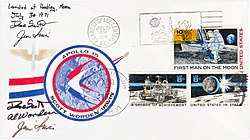
In June 1972, a scandal involving the crew of NASA's Apollo 15 became publicly known. The crew—David Scott, Alfred Worden, and James Irwin—had carried about 400 unauthorized postal covers (stamped and postmarked envelopes) into space and to the Moon's surface on the Lunar Module Falcon. Some of the envelopes were sold at high prices by West German stamp dealer Hermann Sieger, and are known as "Sieger covers". Scott, Worden, and Irwin all agreed to take payments for carrying the covers. Although they returned the money, they were reprimanded by NASA. Amid much press coverage of the incident, the astronauts were called before a closed session of a Senate committee and never flew in space again.

The three astronauts and an acquaintance, Horst Eiermann, had agreed to have the covers made and taken into space. Each astronaut was to receive about US$7,000 (equivalent to $52,620 in 2024). Scott arranged to have the covers postmarked on the morning of the Apollo 15 launch on July 26, 1971. They were packaged for space and brought to him as he prepared for liftoff; he brought them aboard in a pocket of his space suit. They were not included on the list of the personal items he was taking into space. The covers spent July 30 to August 2 on the Moon inside Falcon. On August 7, the date of splashdown, the covers were postmarked again on the recovery carrier USS Okinawa. One hundred were sent to Eiermann (and passed on to Sieger); the remaining covers were divided among the astronauts.

Worden had agreed to carry 144 additional covers, largely for an acquaintance, F. Herrick Herrick; these had been approved for travel to space. Apollo 15 carried a total of about 641 covers. In late 1971, when NASA learned that the Herrick covers were being sold, the astronauts' supervisor, Deke Slayton, warned Worden to avoid further commercialization of what he had been allowed to take into space. After Slayton heard of the Sieger arrangement, he removed the three as backup crew members for Apollo 17, though the astronauts had by then returned compensation from Sieger. The Sieger matter became generally known in the newspapers in June 1972. There was widespread coverage, with the astronauts portrayed negatively for their actions.

By 1977, all three former astronauts had left NASA. In February 1983, Worden sued, alleging the government's 1972 seizure of 298 of the envelopes without a hearing had violated the Constitution. The Department of Justice concluded it had no grounds for fighting the suit, and the government returned all the covers in an out-of-court settlement that July. In 2014, one of the postal covers given to Sieger sold for over $50,000 (equivalent to $66,000 in 2024).

After the start of the Space Age with the launch of Sputnik I on October 4, 1957, astrophilately (space-related stamp collecting) began. Nations such as the United States and USSR issued commemorative postage stamps depicting spacecraft and satellites. Astrophilately was most popular during the years of the Apollo program's Moon landings from 1969 to 1972. Collectors and dealers sought philatelic souvenirs related to the American space flight program, often through specially designed envelopes (known as covers). Cancelling covers submitted by the public became a major duty of the employees of the Kennedy Space Center (KSC) post office on space mission launch days.

The American astronauts participated in creating collectables. Beginning in the late 1960s, Harold G. Collins, head of the Mission Support Office at KSC, arranged for specially designed envelopes to be printed for the different missions, and to be canceled on the launch dates. Such unflown philatelic covers were often gifts for the astronauts' friends, or for employees of NASA and its contractors. Although it was not publicly known until September 1972, 15 of the men who entered space as Apollo program astronauts before Apollo 15 had agreed with a West German named Horst Eiermann to autograph 500 philatelic items (postcards and blocks of stamps) in exchange for $2,500 (equivalent to $19,000 in 2024). This included a member of each mission between Apollo 7 (1968) and Apollo 13 (1970). These items were not taken into space.

The astronauts were allowed to take Personal Preference Kits (PPKs) into space with them. These small bags, with their contents limited in size and weight, contained personal items the astronauts wanted to be flown as souvenirs of the mission. As the spaceflights moved toward and culminated in the Moon landings, the public's fascination with items flown in space increased, as did their value.

Covers were prepared by the crews and flown on Apollo 11, Apollo 13 and Apollo 14. Ed Mitchell, lunar module pilot for Apollo 14, took his to the Moon's surface in a PPK. These were often retained by the astronauts for many years; Apollo 11's Neil Armstrong kept his until he died, and they were not offered for sale until 2018, when one sold for $156,250 (roughly equivalent to $196,000 in 2024).

See all
User Avatar
No comments yet.