
Recent from talks
Arawakan languages
Knowledge base stats:
Talk channels stats:
Members stats:
Arawakan languages
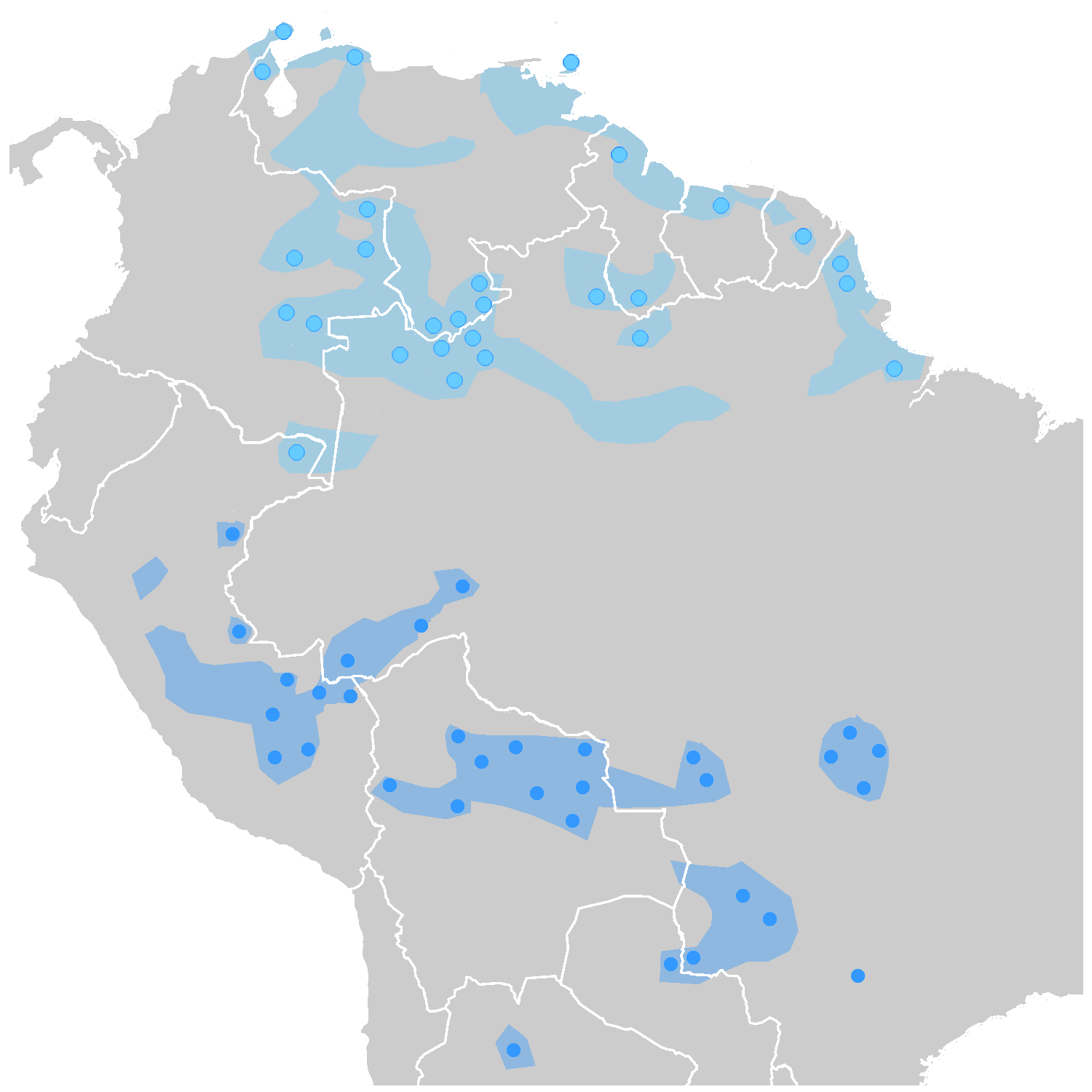
Arawakan (Arahuacan, Maipuran Arawakan, "mainstream" Arawakan, Arawakan proper), also known as Maipurean (also Maipuran, Maipureano, Maipúre), is a language family that developed among ancient Indigenous peoples in South America. Branches migrated to Central America and the Greater Antilles and Lesser Antilles in the Caribbean and the Atlantic, including what is now the Bahamas. Most present-day South American countries are known to have been home to speakers of Arawakan languages, with the exceptions of Ecuador, Uruguay, and Chile. Maipurean may be related to other language families in a hypothetical Macro-Arawakan stock.
The name Maipure was given to the family by Filippo S. Gilii in 1782, after the Maipure language of Venezuela, which he used as a basis of his comparisons. It was renamed after the culturally more important Arawak language a century later. The term Arawak took over, until its use was extended by North American scholars to the broader Macro-Arawakan proposal. At that time, the name Maipurean was resurrected for the core family. See Arawakan vs Maipurean for details.
The Arawakan linguistic matrix hypothesis (ALMH) suggests that the modern diversity of the Arawakan language family stems from the diversification of a trade language or lingua franca that was spoken throughout much of tropical lowland South America. Proponents of this hypothesis include Santos-Granero (2002) and Eriksen (2014). Eriksen (2014) proposes that the Arawakan family had only broken up after 600 CE, but Michael (2020) considers this to be unlikely, noting that Arawakan internal diversity is greater than that of the Romance languages. On the other hand, Blench (2015) suggests a demographic expansion that had taken place over a few thousand years, similar to the dispersals of the Austronesian and Austroasiatic language families in Southeast Asia.
As one of the most geographically widespread language families in all of the Americas, Arawakan linguistic influence can be found in many language families of South America. Jolkesky (2016) notes that there are lexical similarities with the Arawa, Bora-Muinane, Guahibo, Harakmbet-Katukina, Harakmbet, Katukina-Katawixi, Irantxe, Jaqi, Karib, Kawapana, Kayuvava, Kechua, Kwaza, Leko, Macro-Jê, Macro-Mataguayo-Guaykuru, Mapudungun, Mochika, Mura-Matanawi, Nambikwara, Omurano, Pano-Takana, Pano, Takana, Puinave-Nadahup, Taruma, Tupi, Urarina, Witoto-Okaina, Yaruro, Zaparo, Saliba-Hodi, and Tikuna-Yuri language families due to contact. However, these similarities could be due to inheritance, contact, or chance.
Classification of Maipurean is difficult because of the large number of Arawakan languages that are extinct and poorly documented. However, apart from transparent relationships that might constitute single languages, several groups of Maipurean languages are generally accepted by scholars. Many classifications agree in dividing Maipurean into northern and southern branches, but perhaps not all languages fit into one or the other. The three classifications below are accepted by all:
An early contrast between Ta-Arawak and Nu-Arawak, depending on the prefix for "I", is spurious; nu- is the ancestral form for the entire family, and ta- is an innovation of one branch of the family.
Below is a full list of Arawakan language varieties listed by Loukotka (1968), including names of unattested varieties.
The following (tentative) classification is from Kaufman (1994: 57-60). Details of established branches are given in the linked articles. In addition to the family tree detailed below, there are a few languages that are "Non-Maipurean Arawakan languages or too scantily known to classify" (Kaufman 1994: 58), which include these:
Hub AI
Arawakan languages AI simulator
(@Arawakan languages_simulator)
Arawakan languages
Arawakan (Arahuacan, Maipuran Arawakan, "mainstream" Arawakan, Arawakan proper), also known as Maipurean (also Maipuran, Maipureano, Maipúre), is a language family that developed among ancient Indigenous peoples in South America. Branches migrated to Central America and the Greater Antilles and Lesser Antilles in the Caribbean and the Atlantic, including what is now the Bahamas. Most present-day South American countries are known to have been home to speakers of Arawakan languages, with the exceptions of Ecuador, Uruguay, and Chile. Maipurean may be related to other language families in a hypothetical Macro-Arawakan stock.
The name Maipure was given to the family by Filippo S. Gilii in 1782, after the Maipure language of Venezuela, which he used as a basis of his comparisons. It was renamed after the culturally more important Arawak language a century later. The term Arawak took over, until its use was extended by North American scholars to the broader Macro-Arawakan proposal. At that time, the name Maipurean was resurrected for the core family. See Arawakan vs Maipurean for details.
The Arawakan linguistic matrix hypothesis (ALMH) suggests that the modern diversity of the Arawakan language family stems from the diversification of a trade language or lingua franca that was spoken throughout much of tropical lowland South America. Proponents of this hypothesis include Santos-Granero (2002) and Eriksen (2014). Eriksen (2014) proposes that the Arawakan family had only broken up after 600 CE, but Michael (2020) considers this to be unlikely, noting that Arawakan internal diversity is greater than that of the Romance languages. On the other hand, Blench (2015) suggests a demographic expansion that had taken place over a few thousand years, similar to the dispersals of the Austronesian and Austroasiatic language families in Southeast Asia.
As one of the most geographically widespread language families in all of the Americas, Arawakan linguistic influence can be found in many language families of South America. Jolkesky (2016) notes that there are lexical similarities with the Arawa, Bora-Muinane, Guahibo, Harakmbet-Katukina, Harakmbet, Katukina-Katawixi, Irantxe, Jaqi, Karib, Kawapana, Kayuvava, Kechua, Kwaza, Leko, Macro-Jê, Macro-Mataguayo-Guaykuru, Mapudungun, Mochika, Mura-Matanawi, Nambikwara, Omurano, Pano-Takana, Pano, Takana, Puinave-Nadahup, Taruma, Tupi, Urarina, Witoto-Okaina, Yaruro, Zaparo, Saliba-Hodi, and Tikuna-Yuri language families due to contact. However, these similarities could be due to inheritance, contact, or chance.
Classification of Maipurean is difficult because of the large number of Arawakan languages that are extinct and poorly documented. However, apart from transparent relationships that might constitute single languages, several groups of Maipurean languages are generally accepted by scholars. Many classifications agree in dividing Maipurean into northern and southern branches, but perhaps not all languages fit into one or the other. The three classifications below are accepted by all:
An early contrast between Ta-Arawak and Nu-Arawak, depending on the prefix for "I", is spurious; nu- is the ancestral form for the entire family, and ta- is an innovation of one branch of the family.
Below is a full list of Arawakan language varieties listed by Loukotka (1968), including names of unattested varieties.
The following (tentative) classification is from Kaufman (1994: 57-60). Details of established branches are given in the linked articles. In addition to the family tree detailed below, there are a few languages that are "Non-Maipurean Arawakan languages or too scantily known to classify" (Kaufman 1994: 58), which include these:
Recent media