Recent from talks
Contribute something
Nothing was collected or created yet.
Chile
View on Wikipedia
Chile,[a] officially the Republic of Chile,[b] is a country in western South America. It is the southernmost country in the world and the closest to Antarctica, stretching along a narrow strip of land between the Andes Mountains and the Pacific Ocean. Chile had a population of 17.5 million as of the latest census in 2017 and has a territorial area of 756,102 square kilometers (291,933 sq mi),[11][3] sharing borders with Peru to the north, Bolivia to the northeast, Argentina to the east, and the Drake Passage to the south. The country also controls several Pacific islands, including Juan Fernández, Isla Salas y Gómez, Desventuradas, and Easter Island, and claims about 1,250,000 square kilometers (480,000 sq mi) of Antarctica as the Chilean Antarctic Territory.[nb 2] The capital and largest city of Chile is Santiago, and the national language is Spanish.
Key Information
Spain conquered and colonized the region in the mid-16th century, replacing Inca rule; however, they failed to conquer the autonomous tribal Mapuche people who inhabited what is now south-central Chile. Chile emerged as a relatively stable authoritarian republic in the 1830s after their 1818 declaration of independence from Spain. During the 19th century, Chile experienced significant economic and territorial growth, putting an end to Mapuche resistance in the 1880s and gaining its current northern territory in the War of the Pacific (1879–83) by defeating Peru and Bolivia. In the 20th century, up until the 1970s, Chile underwent a process of democratization[12][13] and experienced rapid population growth and urbanization,[14] while relying increasingly on exports from copper mining to support its economy.[15][16] During the 1960s and 1970s, the country was marked by severe left-right political polarization and turmoil, which culminated in the 1973 Chilean coup d'état that overthrew Salvador Allende's democratically elected left-wing government, with support from the United States. This was followed by a 16-year right-wing military dictatorship under Augusto Pinochet, in which the 1980 Chilean Constitution was made with the consultancy of the Ortúzar Commission[17][18] as well as several political and economic reforms,[19] and resulted in more than 3,000 deaths or disappearances.[20] The regime ended in 1990, following a referendum in 1988, and was succeeded by a center-left coalition, which ruled until 2010.
Chile is a high-income economy and is one of the most economically and socially stable nations in South America.[21] Chile also performs well in the region in terms of sustainability of the state and democratic development.[22] Chile is a founding member of the United Nations, the Community of Latin American and Caribbean States (CELAC), and the Pacific Alliance, and joined the OECD in 2010.
Etymology
[edit]There are various theories about the origin of the word Chile. According to 17th-century Spanish chronicler Diego de Rosales,[23] the Incas called the valley of the Aconcagua Chili by corruption of the name of a Picunche tribal chief (cacique) called Tili, who ruled the area at the time of the Incan conquest in the 15th century.[24][25] Another theory points to the similarity of the valley of the Aconcagua with that of the Casma Valley in Peru, where there was a town and valley named Chili.[25]
Other theories say Chile may derive its name from a Native American word meaning either 'ends of the earth' or 'sea gulls';[26] from the Mapuche word chilli, which may mean 'where the land ends'"[27] or from the Quechua chiri,[28] 'cold',[29] or tchili, meaning either 'snow'[29][30] or "the deepest point of the Earth".[31] Another origin attributed to chilli is the onomatopoeic cheele-cheele—the Mapuche imitation of the warble of a bird locally known as trile.[27][32]
The Spanish conquistadors heard about this name from the Incas, and the few survivors of Diego de Almagro's first Spanish expedition south from Peru in 1535–36 called themselves the "men of Chilli".[27] Ultimately, Almagro is credited with the universalization of the name Chile, after naming the Mapocho valley as such.[25] The older spelling "Chili" was in use in English until the early 20th century before switching to "Chile".[33]
History
[edit]Early history
[edit]
Stone tool evidence indicates humans sporadically frequented the Monte Verde valley area as long as 18,500 years ago. About 10,000 years ago, migrating Indigenous peoples settled in fertile valleys and coastal areas of what is present-day Chile. Settlement sites from very early human habitation include Monte Verde, Cueva del Milodón and the Pali-Aike Crater's lava tube.[34]
The Incas briefly extended their empire into what is now northern Chile, but the Mapuche (or Araucanians as they were known by the Spaniards) successfully resisted many attempts by the Inca Empire to subjugate them, despite their lack of state organization.[35] They fought against the Sapa Inca Tupac Yupanqui and his army. The result of the bloody three-day confrontation known as the Battle of the Maule was that the Inca conquest of the territories of Chile ended at the Maule river.[36]
Spanish colonization
[edit]
In 1520, while attempting to circumnavigate the globe, Ferdinand Magellan discovered the southern passage now named after him (the Strait of Magellan) thus becoming the first European to set foot on what is now Chile. The next Europeans to reach Chile were Diego de Almagro and his band of Spanish conquistadors, who came from Peru in 1535 seeking gold. The Spanish encountered various cultures that supported themselves principally through slash-and-burn agriculture and hunting.[36]
The conquest of Chile began in earnest in 1540 and was carried out by Pedro de Valdivia, one of Francisco Pizarro's lieutenants, who founded the city of Santiago on 12 February 1541. Although the Spanish did not find the extensive gold and silver they sought, they recognized the agricultural potential of Chile's central valley, and Chile became part of the Spanish Empire.[36]
Conquest took place gradually, and the Europeans suffered repeated setbacks. A massive Mapuche insurrection that began in 1553 resulted in Valdivia's death and the destruction of many of the colony's principal settlements. Subsequent major insurrections took place in 1598 and in 1655. Each time the Mapuche and other native groups revolted, the southern border of the colony was driven northward. The abolition of slavery by the Spanish crown in 1683 was done in recognition that enslaving the Mapuche intensified resistance rather than cowing them into submission. Despite royal prohibitions, relations remained strained from continual colonialist interference.[41][verification needed]
Cut off to the north by desert, to the south by the Mapuche, to the east by the Andes Mountains, and to the west by the ocean, Chile became one of the most centralized, homogeneous territories in Spanish America. Serving as a sort of frontier garrison, the colony found itself with the mission of forestalling encroachment by both the Mapuche and Spain's European enemies, especially the English and the Dutch. Buccaneers and pirates menaced the colony in addition to the Mapuche, as was shown by Sir Francis Drake's 1578 raid on Valparaíso, the colony's principal port. Chile hosted one of the largest standing armies in the Americas, making it one of the most militarized of the Spanish possessions, as well as a drain on the treasury of the Viceroyalty of Peru.[27]

The first general census was conducted by the government of Agustín de Jáuregui between 1777 and 1778; it indicated that the population consisted of 259,646 inhabitants: 73.5% of European descent, 7.9% mestizos, 8.6% indigenous peoples and 9.8% blacks. Francisco Hurtado, Governor of the province of Chiloé, conducted a census in 1784 and found the population consisted of 26,703 inhabitants, 64.4% of whom were whites and 33.5% of whom were natives. The Diocese of Concepción conducted a census in areas south of the Maule river in 1812, but did not include the indigenous population or the inhabitants of the province of Chiloé. The population was estimated at 210,567, 86.1% of whom were Spanish or of European descent, 10% of whom were indigenous and 3.7% of whom were mestizos, blacks and mulattos.[42]
A 2021 study by Baten and Llorca-Jaña shows that regions with a relatively high share of North European migrants developed faster in terms of numeracy, even if the overall number of migrants was small. This effect might be related to externalities: the surrounding population adopted a similar behavior as the small non-European immigrant group, and new schools were created. Ironically, there might have been positive spillover effects from the educational investment made by migrants, at the same time numeracy might have been reduced by the greater inequality in these regions. However, the positive effects of immigration were apparently stronger.[43]
Independence and nation building
[edit]
In 1808, Napoleon's enthronement of his brother Joseph as the Spanish King precipitated the drive by Chile for independence from Spain. A national junta in the name of Ferdinand – heir to the deposed king – was formed on 18 September 1810. The Government Junta of Chile proclaimed an autonomous government for Chile within the Spanish monarchy (in memory of this day, Chile celebrates its National Day on 18 September each year).
After these events, a movement for total independence, under the command of José Miguel Carrera (one of the most renowned patriots) and his two brothers Juan José and Luis Carrera, soon gained a wider following. Spanish attempts to re-impose arbitrary rule during what was called the Reconquista led to a prolonged struggle, including infighting from Bernardo O'Higgins, who challenged Carrera's leadership.
Intermittent warfare continued until 1817. With Carrera in prison in Argentina, O'Higgins and anti-Carrera cohort José de San Martín, hero of the Argentine War of Independence, led an army that crossed the Andes into Chile and defeated the royalists. On 12 February 1818, Chile was proclaimed an independent republic. The political revolt brought little social change, however, and 19th-century Chilean society preserved the essence of the stratified colonial social structure, which was greatly influenced by family politics and the Roman Catholic Church. A strong presidency eventually emerged, but wealthy landowners remained powerful.[36] Bernardo O'Higgins once planned to expand Chile by liberating the Philippines from Spain and incorporating the islands. In this regard he tasked the Scottish naval officer, Lord Thomas Cochrane, in a letter dated 12 November 1821, expressing his plan to conquer Guayaquil, the Galapagos Islands, and the Philippines. There were preparations, but the plan did not push through because O'Higgins was exiled.[44]

Chile slowly started to expand its influence and to establish its borders. By the Tantauco Treaty, the archipelago of Chiloé was incorporated in 1826. The economy began to boom due to the discovery of silver ore in Chañarcillo, and the growing trade of the port of Valparaíso, which led to conflict with Peru over maritime supremacy in the Pacific. At the same time, attempts were made to strengthen sovereignty in southern Chile intensifying penetration into Araucanía and colonizing Llanquihue with German immigrants in 1848. Through the founding of Fort Bulnes by the Schooner Ancud under the command of John Williams Wilson, the Magallanes Region started to be controlled by country in 1843, while the Antofagasta Region, at the time in dispute with Bolivia, began to fill with people.
After the Chilean Civil War of 1829–1830 in which the conservatives won, under the Joaquín Prieto Administration, the Chilean Constitution of 1833 was written and put into effect with high influence from the triple minister Diego Portales. Two other civil wars happened in Chile in the 1850s, one in 1851 and the other one in 1859.

Toward the end of the 19th century, the government in Santiago consolidated its position in the south by the Occupation of Araucanía. The Boundary treaty of 1881 between Chile and Argentina confirmed Chilean sovereignty over the Strait of Magellan but also made the country renounce its claims in the rest of East Patagonia after a dispute that started in 1842.[46] As a result of the War of the Pacific with Peru and Bolivia (1879–83), Chile expanded its territory northward by almost one-third, eliminating Bolivia's access to the Pacific, and acquired valuable nitrate deposits, the exploitation of which led to an era of national affluence. Chile had joined the stand as one of the high-income countries in South America by 1870.[47]
On 9 September 1888, Chile took possession of Easter Island by the signing of a mutual will agreement with the local king, thanks to the efforts of the Bishop of Tahiti, Monsignor José María Verdier since the island was constantly attacked by slave merchants. The naval officer Policarpo Toro represented the Chilean Government and Atamu Tekena was the head of the Council of Rapanui. The Rapa Nui elders ceded sovereignty, without renouncing their titles as chiefs, the ownership of their lands, the validity of their culture and traditions on equal terms. The Rapa Nui sold nothing and were integrated in equal conditions into Chile.[48]
The 1891 Chilean Civil War brought about a redistribution of power between the President and Congress, and Chile established a parliamentary style democracy. However, the Civil War had also been a contest between those who favored the development of local industries and powerful Chilean banking interests, particularly the House of Edwards which had strong ties to foreign investors. Soon after, the country engaged in a vastly expensive naval arms race with Argentina amid escalating geopolitical competition and the Puna de Atacama dispute.
The War of the Pacific (1879–1883) against Peru and Bolivia resulted in Chile annexing resource-rich territory from both countries and further consolidating its status as a regional power. It subsequently emerged as a leading naval power in the Americas, even sending a ship to protest United States involvement in the Panama crisis of 1885. Chile potentially threatened U.S. hegemony in the Western Hemisphere, with the two countries almost going to war during the Baltimore crisis in 1891.[49]
20th century
[edit]
The early 20th century saw Chile fully consolidate its territory and resolve long-running diplomatic and territorial disputes. Its current borders with Argentina were finalized through British arbitration in 1902 and a bilateral settlement of the Puna de Atacama dispute the following year. In 1904, Chile and Bolivia signed a Treaty of Peace and Friendship which clarified the border between both countries.
The Chilean economy partially degenerated into a system protecting the interests of a ruling oligarchy. By the 1920s, the emerging middle and working classes were powerful enough to elect a reformist president, Arturo Alessandri, whose program was frustrated by a conservative congress. In the 1920s, Marxist groups with strong popular support arose.[36]
A military coup led by General Luis Altamirano in 1924 set off a period of political instability that lasted until 1932. Of the ten governments that held power in that period, the longest lasting was that of General Carlos Ibáñez del Campo, who briefly ruled as de facto dictator in 1925 and then again between 1927 and 1931. These authoritarian governments were comparatively less harsh and corrupt than counterparts elsewhere in Latin America.[50][51]
By relinquishing power to a democratically elected successor, Ibáñez del Campo retained the respect of a large enough segment of the population to remain a viable politician for more than thirty years, in spite of the vague and shifting nature of his ideology. When constitutional rule was restored in 1932, a strong middle-class party, the Radicals, emerged. It became the key force in coalition governments for the next 20 years. During the period of Radical Party dominance (1932–52), the state increased its role in the economy. In 1952, voters returned Ibáñez del Campo to office for another six years. Jorge Alessandri succeeded Ibáñez del Campo in 1958, bringing Chilean conservatism back into power democratically for another term.
The 1964 presidential election of Christian Democrat Eduardo Frei Montalva by an absolute majority initiated a period of major reform. Under the slogan "Revolution in Liberty", the Frei administration embarked on far-reaching social and economic programs, particularly in education, housing, and agrarian reform, including rural unionization of agricultural workers. By 1967, however, Frei encountered increasing opposition from leftists, who charged that his reforms were inadequate, and from conservatives, who found them excessive. At the end of his term, Frei had not fully achieved his party's ambitious goals.[36]

In the 1970 election, Senator Salvador Allende of the Socialist Party of Chile (then part of the "Popular Unity" coalition which included the Communists, Radicals, Social-Democrats, dissident Christian Democrats, the Popular Unitary Action Movement, and the Independent Popular Action),[36] achieved a partial majority in a plurality of votes in a three-way contest, followed by candidates Radomiro Tomic for the Christian Democrat Party and Jorge Alessandri for the Conservative Party. Allende was not elected with an absolute majority, receiving fewer than 35% of the votes.
The Chilean Congress conducted a runoff vote between the leading candidates, Allende and former president Jorge Alessandri, and, keeping with tradition, chose Allende by a vote of 153 to 35. Frei refused to form an alliance with Alessandri to oppose Allende, on the grounds that the Christian Democrats were a workers' party and could not make common cause with the right wing.[52][53]
An economic depression that began in 1972 was exacerbated by capital flight, plummeting private investment, and withdrawal of bank deposits in response to Allende's socialist program. Production fell and unemployment rose. Allende adopted measures including price freezes, wage increases, and tax reforms, to increase consumer spending and redistribute income downward.[54] Joint public-private public works projects helped reduce unemployment.[55][page needed] Much of the banking sector was nationalized. Many enterprises within the copper, coal, iron, nitrate, and steel industries were expropriated, nationalized, or subjected to state intervention. Industrial output increased sharply and unemployment fell during the Allende administration's first year.[55]
Allende's program included advancement of workers' interests,[55][56] replacing the judicial system with "socialist legality",[57] nationalization of banks and forcing others to bankruptcy,[57] and strengthening "popular militias" known as MIR.[57] Started under former President Frei, the Popular Unity platform also called for nationalization of Chile's major copper mines in the form of a constitutional amendment. The measure was passed unanimously by Congress. As a result,[58] the Richard Nixon administration organized and inserted secret operatives in Chile, in order to swiftly destabilize Allende's government.[59] In addition, US financial pressure restricted international economic credit to Chile.[60]
The economic problems were also exacerbated by Allende's public spending, financed mostly through printing money, and by poor credit ratings given by commercial banks.[61] Simultaneously, opposition media, politicians, business guilds and other organizations helped to accelerate a campaign of domestic political and economical destabilization, some of which was backed by the United States.[60][62] By early 1973, inflation was out of control. On 26 May 1973, Chile's Supreme Court, which was opposed to Allende's government, unanimously denounced Allende's disruption of the legality of the nation. Although illegal under the Chilean constitution, the court supported and strengthened Pinochet's soon-to-be seizure of power.[57][63]
Pinochet era (1973–1990)
[edit]
On 11 September 1973, a military coup overthrew Allende, who apparently committed suicide as the armed forces bombarded the presidential palace.[64][65] The degree to which the United States was involved in the coup remains debated; after Allende was overthrown, U.S. Secretary of State Henry Kissinger told U.S. president Richard Nixon that the United States had "helped" the coup indirectly.[66] Historian Sebastián Hurtado contends there is no documentary evidence to support that the U.S. government was actively involved in the coordination and execution the coup; however, upon Allende's election in 1970, Kissinger had stated "I don't see why we need to stand by and watch a country go Communist due to the irresponsibility of its own people",[67][68] while Nixon had expressed that the Allende government should not be consolidated and acted decisively to destabilize his government.[68][69]
A military junta, led by General Augusto Pinochet, took control of the country. His regime was marked by widespread human rights violations. Chile initiated and actively participated in Operation Condor, a U.S.-backed campaign to suppress leftists and their sympathizers.[70] In October 1973, at least 72 people were murdered by the Caravan of Death.[71] According to the Rettig Report and Valech Commission, during the Pinochet regime's 15-year rule, at least 2,115 were killed,[72] and at least 27,265[73] were tortured (including 88 children younger than 12 years old);[73] many were detained, tortured, and executed at the national stadium. In 2011, Chile recognized an additional 9,800 victims, bringing the total number killed, tortured or imprisoned for political reasons to 40,018.[74] Among the victims was internationally known poet-singer Víctor Jara.

A new Constitution was approved by a controversial plebiscite on 11 September 1980, and General Pinochet became president of the republic for an eight-year term. After Pinochet obtained rule of the country, several hundred committed Chilean revolutionaries joined the Sandinista army in Nicaragua, guerrilla forces in Argentina or training camps in Cuba, Eastern Europe and Northern Africa.[75]
In the late 1980s, largely as a result of events such as the 1982 economic collapse[76] and mass civil resistance in 1983–1988, the government gradually permitted greater freedom of assembly, speech, and association, to include trade union and political activity.[77] The government launched market-oriented reforms with Hernán Büchi as Minister of Finance. Chile moved toward a free market economy that saw an increase in domestic and foreign private investment, although the copper industry and other important mineral resources were not opened to competition. In a plebiscite on 5 October 1988, Pinochet was denied a second eight-year term as president (56% against 44%). Chileans elected a new president and the majority of members of a bicameral congress on 14 December 1989. Christian Democrat Patricio Aylwin, the candidate of a coalition of 17 political parties called the Concertación, received an absolute majority of votes (55%).[78] President Aylwin served from 1990 to 1994, in what was considered a transition period.
21st century
[edit]
In December 1993, Christian Democrat Eduardo Frei Ruiz-Tagle, the son of previous president Eduardo Frei Montalva, led the Concertación coalition to victory with an absolute majority of votes (58%).[79] Frei Ruiz-Tagle was succeeded in 2000 by Socialist Ricardo Lagos, who won the presidency in an unprecedented runoff election against Joaquín Lavín of the rightist Alliance for Chile.[80] In January 2006, Chileans elected their first female president, Michelle Bachelet Jeria, of the Socialist Party, defeating Sebastián Piñera, of the National Renewal party, extending the Concertación governance for another four years.[81][82] In January 2010, Chileans elected Sebastián Piñera as the first rightist President in 20 years, defeating former President Eduardo Frei Ruiz-Tagle of the Concertación, for a four-year term succeeding Bachelet. Due to term limits, Sebastián Piñera did not stand for re-election in 2013, and his term expired in March 2014 resulting in Michelle Bachelet returning to office.[83] Sebastián Piñera succeeded Bachelet again in 2018 as the President of Chile after winning the December 2017 presidential election.[84][85]
On 27 February 2010, Chile was struck by an 8.8 Mw earthquake, the fifth largest ever recorded at the time. More than 500 people died (most from the ensuing tsunami) and over a million people lost their homes. The earthquake was also followed by multiple aftershocks.[86] Initial damage estimates were in the range of US$15–30 billion, around 10% to 15% of Chile's real gross domestic product.[87]
Chile achieved global recognition for the successful rescue of 33 trapped miners in 2010. On 5 August 2010, the access tunnel collapsed at the San José copper and gold mine in the Atacama Desert near Copiapó in northern Chile, trapping 33 men 700 meters (2,300 ft) below ground. A rescue effort organized by the Chilean government located the miners 17 days later. All 33 men were brought to the surface two months later on 13 October 2010 over a period of almost 24 hours, an effort that was carried on live television around the world.[88]

From 2019 to 2022, Chile endured a series of nationwide protests in response to a rise in the Santiago Metro's subway fare, the increased cost of living, privatization, and inequality.[89] On 15 November, most of the political parties represented in the National Congress signed an agreement to call a national referendum in April 2020 regarding the creation of a new Constitution, later postponed to October due to the COVID-19 pandemic.[90] On 25 October 2020, Chileans voted 78.28 percent in favor of a new constitution, while 21.72 percent rejected the change; voter turnout was 51 percent. An election for the members of the Constitutional Convention was held in Chile between 15 and 16 May 2021;[91] the results saw a complete rearrangement of the political system established since the end of Pinochet's dictatorship in 1990, with various independent and leftist candidates performing strongly relative to conventional center-right and center-left parties.
On 19 December 2021, a leftist candidate, the 35-year-old former student protest leader Gabriel Boric, won Chile's presidential election to become the country's youngest leader.[92] On 11 March 2022, Boric was sworn in as president to succeed outgoing President Sebastian Piñera.[93] The majority of Boric's Cabinet—14 out of 24—are women, which is a first in the Western Hemisphere.[94]
On 4 September 2022, voters rejected the new constitution proposal in the constitutional referendum, which was put forward by the left-leaning Constitutional Convention.[95] On 17 December 2023, voters rejected a second new constitution proposal in a new constitutional referendum, written by the conservative-led Constitutional Council.[96][97][98]
Geography
[edit]A long and narrow coastal Southern Cone country on the west side of the Andes Mountains, Chile stretches over 4,300 km (2,670 mi) north to south, but only 350 km (217 mi) at its widest point east to west[99] and 64 km (40 mi) at its narrowest point east to west, with an average width of 175 km (109 mi). This encompasses a large variety of climates and landscapes. It contains 756,950 square kilometers (292,260 sq mi) of land area. It is situated within the Pacific Ring of Fire. Excluding its Pacific islands and Antarctic claim, Chile lies between latitudes 17° and 56°S, and longitudes 66° and 75°W.
Chile is among the longest north–south countries in the world. If one considers only mainland territory, Chile is unique within this group in its narrowness from east to west, with the other long north–south countries (including Brazil, Russia, Canada, and the United States, among others) all being wider from east to west by a factor of more than 10. Chile also claims 1,250,000 km2 (480,000 sq mi) of Antarctica as part of its territory (Chilean Antarctic Territory). However, this latter claim is suspended under the terms of the Antarctic Treaty, of which Chile is a signatory.[100] It is the world's southernmost country that is geographically on the mainland.[101]
Chile controls Easter Island and Sala y Gómez Island, the easternmost islands of Polynesia, which it incorporated to its territory in 1888, and the Juan Fernández Islands, more than 600 km (370 mi) from the mainland. Also controlled but only temporarily inhabited (by some local fishermen) are the small islands of San Ambrosio and San Felix. These islands are notable because they extend Chile's claim to territorial waters out from its coast into the Pacific Ocean.[102]
The northern Atacama Desert contains great mineral wealth, primarily copper and nitrates. The relatively small Central Valley, which includes Santiago, dominates the country in terms of population and agricultural resources. This area is also the historical center from which Chile expanded in the late 19th century when it integrated the northern and southern regions. Southern Chile is rich in forests, grazing lands, and features a string of volcanoes and lakes. The southern coast is a labyrinth of fjords, inlets, canals, twisting peninsulas, and islands. The Andes Mountains are located on the eastern border.
Topography
[edit]
Chile is located along a highly seismic and volcanic zone, part of the Pacific Ring of Fire, due to the subduction of the Nazca and Antarctic plates in the South American Plate. In the late Paleozoic, 251 million years ago, Chile belonged to the continental block called Gondwana. It was just a depression that accumulated marine sediments began to rise at the end of the Mesozoic, 66 million years ago, due to the collision between the Nazca Plate and South American Plate, resulting in the Andes. The territory would be shaped over millions of years by the folding of the rocks, forming the current relief.
The Chilean relief consists of the central depression, which crosses the country longitudinally, flanked by two mountain ranges that make up about 80% of the territory: the Andes Mountains to the east-natural border with Bolivia and Argentina in the region of Atacama and the Coastal Range west-minor height from the Andes. Chile's highest peak is the Nevado Ojos del Salado, at 6891.3 m, which is also the highest volcano in the world. The highest point of the Coastal Range is Vicuña Mackenna, at 3114 meters, located in the Sierra Vicuña Mackenna, the south of Antofagasta. Among the coastal mountains and the Pacific is a series of coastal plains, of variable length, which allow the settlement of coastal towns and big ports. Some areas of the plains territories encompass territory east of the Andes, and the Patagonian steppes and Magellan, or are high plateaus surrounded by high mountain ranges, such as the Altiplano or Puna de Atacama.
The Far North is the area between the northern boundary of the country and the parallel 26° S, covering the first three regions. It is characterized by the presence of the Atacama Desert, the most arid in the world. The desert is fragmented by streams that originate in the area known as the pampas Tamarugal. The Andes, split in two and whose eastern arm runs through Bolivia, has a high altitude and volcanic activity, which has allowed the formation of the Andean altiplano and salt structures as the Salar de Atacama, due to the gradual accumulation of sediments over time.
To the south is the Norte Chico, extending to the Aconcagua River. Los Andes begin to decrease its altitude to the south and closer to the coast, reaching 90 km away at the height of Illapel, the narrowest part of the Chilean territory. The two mountain ranges intersect, virtually eliminating the intermediate depression. The existence of rivers flowing through the territory allows the formation of transverse valleys, where agriculture has developed strongly in recent times, while the coastal plains begin to expand.

The Central area is the most populated region of the country. The coastal plains are wide and allow the establishment of cities and ports along the Pacific. The Andes maintain altitudes above 6000m but descend slowly in height to 4000 meters on average. The intermediate depression reappears becoming a fertile valley that allows agricultural development and human settlement, due to sediment accumulation. To the south, the Cordillera de la Costa reappears in the Cordillera de Nahuelbuta while glacial sediments create a series of lakes in the area of La Frontera.
Patagonia extends from within Reloncavi, at the height of parallel 41°S, to the south. During the last glaciation, this area was covered by ice that strongly eroded Chilean relief structures. As a result, the intermediate depression sinks in the sea, while the coastal mountains rise to a series of archipelagos, such as Chiloé and the Chonos, disappearing in Taitao peninsula, in the parallel 47°S. The Andes mountain range loses height and erosion caused by the action of glaciers has caused fjords. East of the Andes, on the continent, or north of it, on the island of Tierra del Fuego are located relatively flat plains, which in the Strait of Magellan cover large areas. The Andes, as he had done previously Cordillera de la Costa, begins to break in the ocean causing a myriad of islands and islets and disappear into it, sinking and reappearing in the Southern Antilles arc and then the Antarctic Peninsula, where it is called Antartandes, in the Chilean Antarctic Territory, lying between the meridians 53°W and 90°W.
In the middle of the Pacific, the country has sovereignty over several islands of volcanic origin, collectively known as Insular Chile. The archipelago of Juan Fernandez and Easter Island is located in the fracture zone between the Nazca plate and the Pacific plate known as East Pacific Rise.
Climate and hydrography
[edit]
The diverse climate of Chile ranges from the world's driest desert in the north—the Atacama Desert—through a Mediterranean climate in the center, tropical in Easter Island,[103] to an oceanic climate, including alpine tundra and glaciers in the east and south.[20] According to the Köppen system, Chile within its borders hosts at least eighteen major climatic subtypes.[104] There are four seasons in most of the country: summer (December to February), autumn (March to May), winter (June to August), and spring (September to November).
Due to the characteristics of the territory, Chile is crossed by numerous rivers generally short in length and with low flow rates. They commonly extend from the Andes to the Pacific Ocean, flowing from East to West. Because of the Atacama desert, in the Norte Grande there are only short endorheic character streams, except for the Loa River, the longest in the country 440 km.[105] In the high valleys, wetland areas generate Chungará Lake, located at 4500 meters above sea level. It and the Lauca River are shared with Bolivia, as well as the Lluta River. In the center-north of the country, the number of rivers that form valleys of agricultural importance increases. Noteworthy are the Elqui with 75 km[105] long, 142 km Aconcagua, Maipo with 250 km[105] and its tributary, the Mapocho with 110 km, and Maule with 240 km. Their waters mainly flow from Andean snowmelt in the summer and winter rains. The major lakes in this area are the artificial lake Rapel, the Colbun Maule lagoon and the lagoon of La Laja.
Climate change is expected to alter the frequency and severity of various natural hazards in Chile, including wildfires, floods, landslides, droughts and rising sea levels. Key sectors vulnerable to climate change impacts include agriculture, fisheries, agriculture and water security.[106]
Biodiversity
[edit]
The flora and fauna of Chile are characterized by a high degree of endemism, due to its particular geography. In continental Chile, the Atacama Desert in the north and the Andes mountains to the east are barriers that have led to the isolation of flora and fauna. Add to that the enormous length of Chile (over 4,300 km (2,672 mi)) and this results in a wide range of climates and environments that can be divided into three general zones: the desert provinces of the north, central Chile, and the humid regions of the south.
The native flora of Chile consists of relatively fewer species compared to the flora of other South American countries. The northernmost coastal and central region is largely barren of vegetation, approaching the most absolute desert in the world.[107]
On the slopes of the Andes, in addition to the scattered tola desert brush, grasses are found. The central valley is characterized by several species of cacti, the hardy espinos, the Chilean pine, the southern beeches and the copihue, a red bell-shaped flower that is Chile's national flower.[107]
In southern Chile, south of the Biobío River, heavy precipitation has produced dense forests of laurels, magnolias, and various species of conifers and beeches, which become smaller and more stunted to the south.[108]
The cold temperatures and winds of the extreme south preclude heavy forestation. Grassland is found in East Magallanes Province and northern Tierra del Fuego (in Patagonia). Much of the Chilean flora is distinct from that of neighboring Argentina, indicating that the Andean barrier existed during its formation.[108]

Some of Chile's flora has an Antarctic origin due to land bridges which formed during the Cretaceous ice ages, allowing plants to migrate from Antarctica to South America.[109] Chile had a 2018 Forest Landscape Integrity Index mean score of 7.37/10, ranking it 43rd globally out of 172 countries.[110]
Just over 3,000 species of fungi are recorded in Chile,[111][112] but this number is far from complete. The true total number of fungal species occurring in Chile is likely to be far higher, given the generally accepted estimate that only about 7 percent of all fungi worldwide have so far been discovered.[113] Although the amount of available information is still very small, a first effort has been made to estimate the number of fungal species endemic to Chile, and 1995 species have been tentatively identified as possible endemics of the country.[114]
Chile's geographical isolation has restricted the immigration of faunal life so that only a few of the many distinctive South American animals are found. Among the larger mammals are the puma or cougar, the llama-like guanaco and the fox-like chilla. In the forest region, several types of marsupials and a small deer known as the pudu are found.[107]
There are many species of small birds, but most of the larger common Latin American types are absent. Few freshwater fish are native, but North American trout have been successfully introduced into the Andean lakes.[107] Owing to the vicinity of the Humboldt Current, ocean waters abound with fish and other forms of marine life, which in turn support a rich variety of waterfowl, including several penguins. Whales are abundant, and some six species of seals are found in the area.[107]
Government and politics
[edit]


The current Constitution of Chile was drafted by Jaime Guzmán in 1980[115] and subsequently approved via a national plebiscite—regarded as "highly irregular" by some observers[27]—in September of that year, under the military dictatorship of Augusto Pinochet. It entered into force in March 1981. After Pinochet's defeat in the 1988 plebiscite, the constitution was amended to ease provisions for future amendments to the Constitution. In September 2005, President Ricardo Lagos signed into law several constitutional amendments passed by Congress. These include eliminating the positions of appointed senators and senators for life, granting the President authority to remove the commanders-in-chief of the armed forces, and reducing the presidential term from six to four years.[116]
Chile's judiciary is independent and includes a court of appeal, a system of military courts, a constitutional tribunal, and the Supreme Court of Chile. In June 2005, Chile completed a nationwide overhaul of its criminal justice system.[117] The reform has replaced inquisitorial proceedings with an adversarial system with greater similarity to that of common law jurisdictions such as the United States.
For parliamentary elections, between 1989 and 2013 the binominal system was used, which promoted the establishment of two majority political blocs -Concertación and Alliance- at the expense of the exclusion of non-majority political groups. The opponents of this system approved in 2015 a moderate proportional electoral system that has been in force since the 2017 parliamentary elections, allowing the entry of new parties and coalitions. The Congress of Chile has a 50-seat Senate and a 155-member Chamber of Deputies. Senators serve for eight years with staggered terms, while deputies are elected every 4 years. The last congressional elections were held on 21 November 2021, concurrently with the presidential election. The Congress is located in the port city of Valparaíso, about 140 kilometers (90 miles) west of the capital, Santiago.
The main existing political coalitions in Chile are:
Government:
- Apruebo Dignidad (Approve Dignity) is a left-wing coalition that has its origin in the 2021 Chilean Constitutional Convention election. After the success in that election, it held presidential primaries, in which Gabriel Boric (CS, FA) was the winner. It is formed by the coalition Frente Amplio (Broad Front) and the coalition Chile Digno (Worthy Chile) formed by the Communist Party of Chile and other left-wing parties.
- Democratic Socialism is a center-left coalition, successor of the Constituent Unity coalition, itself a successor of the Concertation coalition – which supported the "NO" option in the 1988 plebiscite and subsequently governed the country from 1990 to 2010. This pact is formed by the Socialist, for Democracy, Radical, and Liberal parties.
Opposition:
- Chile Vamos (Let's go Chile) is a center-right coalition with roots of liberal conservatism, formed by the parties Renovación Nacional (National Renewal), Unión Demócrata Independiente (Independent Democratic Union) and Evópoli. It has its origins in the Alliance coalition, formed by the main parties that supported the "YES" option in the 1988 plebiscite, although it has used different names since then. It was the ruling coalition during the first and second government of Sebastián Piñera, (2010–2014) and (2018–2022).
In the National Congress, Chile Vamos has 52 deputies and 24 senators, while the parliamentary group of Apruebo Dignidad is formed by 37 deputies and 6 senators. Democratic Socialism is the third political force with 30 deputies and 13 senators. The other groups with parliamentary representation are the Republican Party (15 deputies and 1 senator), the Christian Democratic Party (8 deputies and 5 senators), the Party of the People (8 deputies) and the independents outside of a coalition (5 deputies and 1 senator).
According to International IDEA’s Global State of Democracy (GSoD) Indices and Democracy Tracker, Chile performs in the mid to high range on overall democratic measures, with particular strengths in freedom of movement, freedom of religion, and elected government.[118][119][120]
Administrative divisions
[edit]In 1978 Chile was administratively divided into regions,[121] and in 1979 subdivided into provinces and these into communes.[122][123] The country has 16 regions,[124][125] 56 provinces and 348 communes.[126]
Each region was designated by a name and a Roman numeral assigned from north to south, except for the Santiago Metropolitan Region, which did not have a number. The creation of two new regions in 2007, Arica and Parinacota (XV) and Los Ríos (XIV), and a third region in 2018, Ñuble (XVI) made this numbering lose its original order meaning.

| Administrative divisions of Chile | ||||||
|---|---|---|---|---|---|---|
| Region[121][124][125] | Population[11] | Area (km2)[2] | Density | Capital | ||
| Arica y Parinacota | 224,548 | 16,873.3 | 13.40 | Arica | ||
| Tarapacá | 324,930 | 42,225.8 | 7.83 | Iquique | ||
| Antofagasta | 599,335 | 126,049.1 | 4.82 | Antofagasta | ||
| Atacama | 285,363 | 75,176.2 | 3.81 | Copiapó | ||
| Coquimbo | 742,178 | 40,579.9 | 18.67 | La Serena | ||
| Valparaíso | 1,790,219 | 16,396.1 | 110.75 | Valparaíso | ||
| Santiago Metropolitan | 7,036,792 | 15,403.2 | 461.77 | Santiago | ||
| Libertador General Bernardo O'Higgins | 908,545 | 16,387 | 54.96 | Rancagua | ||
| Maule | 1,033,197 | 30,296.1 | 34.49 | Talca | ||
| Ñuble | 480,609 | 13,178.5 | 36.47 | Chillán | ||
| Biobío | 1,556,805 | 23,890.2 | 112.08 | Concepción | ||
| Araucanía | 938,626 | 31,842.3 | 30.06 | Temuco | ||
| Los Ríos | 380,181 | 18,429.5 | 20.88 | Valdivia | ||
| Los Lagos | 823,204 | 48,583.6 | 17.06 | Puerto Montt | ||
| Aysén del General Carlos Ibáñez del Campo | 102,317 | 108,494.4 | 0.95 | Coyhaique | ||
| Magallanes and Chilean Antarctica | 165,593 | 132,297.2(1) | 1.26 | Punta Arenas | ||
| Chile | 17,373,831 | 756,102.4(2) | 23.24 | Santiago | ||
(1)Including the Chilean Antarctic Territory, its surface reaches 1,382,554.8 km2
(2)Including the Chilean Antarctic Territory, its surface reaches 2,006,360 km2
Foreign relations
[edit]
Since the early decades after independence, Chile has always had an active involvement in foreign affairs. In 1837, the country aggressively challenged the dominance of Peru's port of Callao for preeminence in the Pacific trade routes, defeating the short-lived alliance between Peru and Bolivia, the Peru–Bolivian Confederation (1836–39) in the War of the Confederation. The war dissolved the confederation while distributing power in the Pacific. A second international war, the War of the Pacific (1879–83), further increased Chile's regional role, while adding considerably to its territory.[27]
During the 19th century, Chile's commercial ties were primarily with Britain, which helped shape the Chilean navy. France influenced Chile's legal and educational systems, with French style architecture dominating the capital in the boom years at the turn of the 20th century. German influence came from the organization and training of the army by Prussians.[27]
Since the late 19th century, Chilean military and foreign policy has been shaped by the maximum neighbor hypothesis, which holds that in the event of a conflict with a neighbor, the other two would join against Chile.[127][128][129][130][131][132] This consideration has led to Chile historically pursuing a strong military deterrence; balanced bilateral relations with neighbors; and strong ties with countries outside the region.
On 26 June 1945, Chile participated as a founding member of the United Nations being among 50 countries that signed the United Nations Charter in San Francisco, California.[133][134] With the military coup of 1973, Chile became isolated politically as a result of widespread human rights abuses.[27]
Since its return to democracy in 1990, Chile has been an active participant in the international political arena. Chile completed a two-year non-permanent position on the UN Security Council in January 2005. Jose Miguel Insulza, a Chilean national, was elected Secretary General of the Organization of American States in May 2005 and confirmed in his position, being re-elected in 2009. Chile is currently serving on the International Atomic Energy Agency (IAEA) Board of Governors, and the 2007–2008 chair of the board is Chile's ambassador to the IAEA, Milenko E. Skoknic. The country is an active member of the UN family of agencies and participates in UN peacekeeping activities. It was re-elected as a member of the UN Human Rights Council in 2011 for a three-year term.[135] It was also elected to one of five non-permanent seats on the UN Security Council in 2013.[136] Chile hosted the Defense Ministerial of the Americas in 2002 and the APEC summit and related meetings in 2004. It also hosted the Community of Democracies ministerial in April 2005 and the Ibero-American Summit in November 2007. An associate member of Mercosur and a full member of APEC, Chile has been a major player in international economic issues and hemispheric free trade.[36]
Military
[edit]

The Armed Forces of Chile are subject to civilian control exercised by the president through the Minister of Defense. The president has the authority to remove the commanders-in-chief of the armed forces.[36]
The commander-in-chief of the Chilean Army is Army General Javier Iturriaga del Campo. The Chilean Army is 45,000 strong and is organized with an Army headquarters in Santiago, six divisions throughout its territory, an Air Brigade in Rancagua, and a Special Forces Command in Colina. The Chilean Army is one of the most professional and technologically advanced armies in Latin America.[36]
Admiral Julio Leiva Molina directs the around 25,000-person Chilean Navy,[137] including 2,500 Marines. Of the fleet of 29 surface vessels, only eight are operational major combatants (frigates). Those ships are based in Valparaíso.[138] The Navy operates its own aircraft for transport and patrol; there are no Navy fighter or bomber aircraft. The Navy also operates four submarines based in Talcahuano.[36][139]
Air Force General (four-star) Jorge Rojas Ávila heads the 12,500-strong Chilean Air Force. Air assets are distributed among five air brigades headquartered in Iquique, Antofagasta, Santiago, Puerto Montt, and Punta Arenas. The Air Force also operates an airbase on King George Island, Antarctica. The Air Force took delivery of the final two of ten F-16s, all purchased from the U.S., in March 2007 after several decades of U.S. debate and previous refusal to sell. Chile also took delivery in 2007 of a number of reconditioned Block 15 F-16s from the Netherlands, bringing to 18 the total of F-16s purchased from the Dutch.[36]
After the military coup in September 1973, the Chilean national police (Carabineros) were incorporated into the Defense Ministry. With the return of democratic government, the police were placed under the operational control of the Interior Ministry but remained under the nominal control of the Defense Ministry. Gen. Gustavo González Jure is the head of the national police force of 40,964[140] men and women who are responsible for law enforcement, traffic management, narcotics suppression, border control, and counter-terrorism throughout Chile.[36]
In 2017, Chile signed the UN treaty on the Prohibition of Nuclear Weapons.[141]
Chile is the 64th most peaceful country in the world, according to the 2024 Global Peace Index.[142]
National symbols
[edit]The national flower is the copihue (Lapageria rosea, Chilean bellflower), which grows in the woods of southern Chile.
The coat of arms depicts the two national animals: the condor (Vultur gryphus, a very large bird that lives in the mountains) and the huemul (Hippocamelus bisulcus, an endangered white tail deer). It also has the legend Por la razón o la fuerza (By reason or by force).
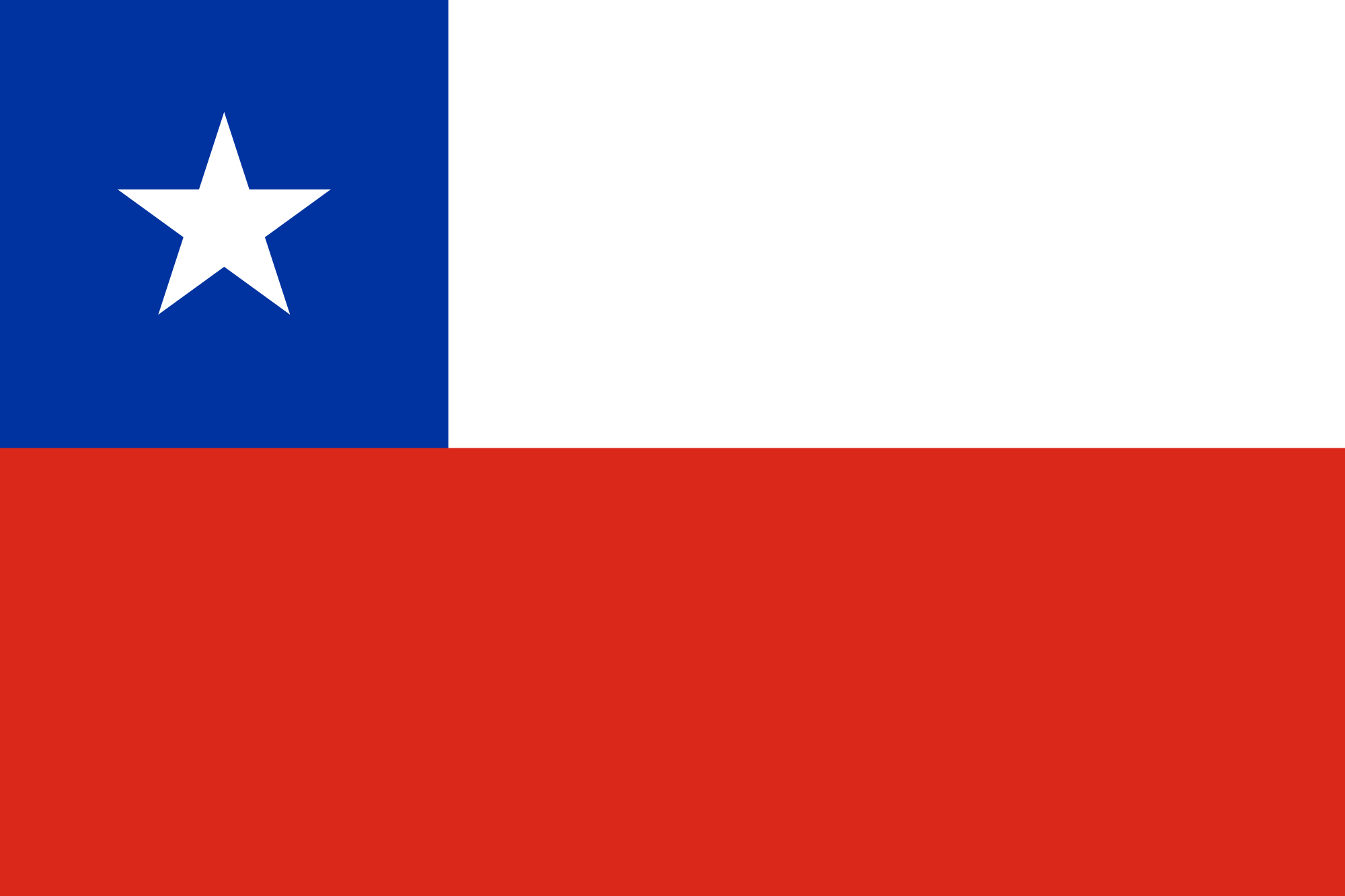
The flag of Chile consists of two equal horizontal bands of white (top) and red; there is a blue square the same height as the white band at the hoist-side end of the white band; the square bears a white five-pointed star in the center representing a guide to progress and honor; blue symbolizes the sky, white is for the snow-covered Andes, and red stands for the blood spilled to achieve independence. The flag of Chile is similar to the Flag of Texas, although the Chilean flag is 21 years older. However, like the Texan flag, the flag of Chile is modeled after the flag of the United States.[143]
Economy
[edit]This section needs to be updated. (May 2025) |
The Central Bank of Chile in Santiago serves as the central bank for the country. The Chilean currency is the Chilean peso (CLP). Chile is one of South America's most stable and prosperous nations,[20] leading Latin American nations in human development, competitiveness, globalization, economic freedom, and low perception of corruption.[21] Since July 2013, Chile is considered by the World Bank as a "high-income economy".[144][145][146]
The think tank The Heritage Foundation states that Chile has the highest degree of economic freedom in South America (ranking 22nd worldwide), owing to its independent and efficient judicial system and prudent public finance management.[147] In May 2010 Chile became the first South American country to join the OECD.[148] In 2006, Chile became the country with the highest nominal GDP per capita in Latin America.[149] As of 2020, Chile ranks third in Latin America (behind Uruguay and Panama) in nominal GDP per capita.
Copper mining makes up 20% of Chilean GDP and 60% of exports.[150] Escondida is the largest copper mine in the world, producing over 5% of global supplies.[150] Overall, Chile produces a third of the world's copper.[150] Codelco, the state mining firm, competes with private copper mining companies.[150]
Sound economic policies, maintained consistently since the 1980s, have contributed to steady economic growth in Chile and have more than halved poverty rates.[151][36] Chile began to experience a moderate economic downturn in 1999. The economy remained sluggish until 2003, when it began to show clear signs of recovery, achieving 4.0% GDP growth.[152] The Chilean economy finished 2004 with growth of 6%. Real GDP growth reached 5.7% in 2005 before falling back to 4% in 2006. GDP expanded by 5% in 2007.[36] Faced with the 2008 financial crisis, the government announced an economic stimulus plan to spur employment and growth, and despite the Great Recession, aimed for an expansion of between 2% and 3% of GDP for 2009. Nonetheless, economic analysts disagreed with government estimates and predicted economic growth at a median of 1.5%.[153] Real GDP growth in 2012 was 5.5%. Growth slowed to 4.1% in the first quarter of 2013.[154]

The unemployment rate was 7.8% in 2022, according to The World Bank.[155] There are reported labor shortages in agriculture, mining, and construction.[154] The percentage of Chileans with per capita household incomes below the poverty line—defined as twice the cost of satisfying a person's minimal nutritional needs—fell from 45.1% in 1987 to 11.5% in 2009, according to government surveys.[156][157] Critics in Chile, however, argue that true poverty figures are considerably higher than those officially published.[158] Using the relative yardstick favoured in many European countries, 27% of Chileans would be poor, according to Juan Carlos Feres of the ECLAC.[159]
As of November 2012[update], about 11.1 million people (64% of the population) benefit from government welfare programs,[160][clarification needed] via the "Social Protection Card", which includes the population living in poverty and those at a risk of falling into poverty.[161] The privatized national pension system (AFP) has encouraged domestic investment and contributed to an estimated total domestic savings rate of approximately 21% of GDP.[162] Under the compulsory private pension system, most formal sector employees pay 10% of their salaries into privately managed funds.[36]
Chile has signed free trade agreements (FTAs) with a whole network of countries, including an FTA with the United States that was signed in 2003 and implemented in January 2004.[163] Internal Government of Chile figures show that even when factoring out inflation and the recent high price of copper, bilateral trade between the U.S. and Chile has grown over 60% since then.[36] Chile's total trade with China reached US$8.8 billion in 2006, representing nearly 66% of the value of its trade relationship with Asia.[36] Exports to Asia increased from US$15.2 billion in 2005 to US$19.7 billion in 2006, a 29.9% increase.[36] Year-on-year growth of imports was especially strong from a number of countries: Ecuador (123.9%), Thailand (72.1%), South Korea (52.6%), and China (36.9%).[36]
Chile's approach to foreign direct investment is codified in the country's Foreign Investment Law. Registration is reported to be simple and transparent, and foreign investors are guaranteed access to the official foreign exchange market to repatriate their profits and capital.[36] The Chilean Government has formed a Council on Innovation and Competition, hoping to bring in additional FDI to new parts of the economy.[36]
Standard & Poor's gives Chile a credit rating of A.[164] The Government of Chile continues to pay down its foreign debt, with public debt only 3.9% of GDP at the end of 2006.[36] The Chilean central government is a net creditor with a net asset position of 7% of GDP at end 2012.[154] The current account deficit was 4% in the first quarter of 2013, financed mostly by foreign direct investment.[154] 14% of central government revenue came directly from copper in 2012.[154] Chile was ranked 1st in the Global Innovation Index in 2024.[165]
Mineral resources
[edit]
Chile is rich in mineral resources, especially copper and lithium. It is thought that due to the importance of lithium for batteries for electric vehicles and stabilization of electric grids with large proportions of intermittent renewables in the electricity mix, Chile could be strengthened geopolitically. However, this perspective has also been criticized for underestimating the power of economic incentives for expanded production in other parts of the world.[166]
The country was, in 2019, the world's largest producer of copper,[167] iodine[168] and rhenium,[169] the second largest producer of lithium[170] and molybdenum,[171] the sixth largest producer of silver,[172] the seventh largest producer of salt,[173] the eighth largest producer of potash,[174] the thirteenth producer of sulfur[175] and the thirteenth producer of iron ore[176] in the world. In 2023, it was fourth largest silver producer globally.[177] The country also has considerable gold production: between 2006 and 2017, the country produced annual amounts ranging from 35.9 tonnes in 2017 to 51.3 tonnes in 2013,[178] where the gold production in 2015 is 43 metric tonnes.[179]
Agriculture
[edit]
Agriculture in Chile encompasses a wide range of different activities due to its particular geography, climate and geology and human factors. Historically agriculture is one of the bases of Chile's economy. Now agriculture and allied sectors like forestry, logging and fishing account for only 4.9% of the GDP as of 2007[update] and employ 13.6% of the country's labor force. Chile is one of the 5 largest world producers of cherry and blueberry, and one of the 10 largest world producers of grape, apple, kiwi, peach, plum and hazelnut, focusing on exporting high-value fruits.[180] Some other major agriculture products of Chile include pears, onions, wheat, maize, oats, garlic, asparagus, beans, beef, poultry, wool, fish, timber and hemp. Due to its geographical isolation and strict customs policies Chile is free from diseases and pests such as mad cow disease, fruit fly and Phylloxera. This, its location in the Southern Hemisphere, which has quite different harvesting times from the Northern Hemisphere, and its wide range of agriculture conditions are considered Chile's main comparative advantages. However, Chile's mountainous landscape limits the extent and intensity of agriculture so that arable land corresponds only to 2.62% of the total territory. Chile currently utilizes 14,015 Hectares of agricultural land.[181]
Chile is the world's second largest producer of salmon, after Norway. In 2019, it was responsible for 26% of the global supply.[182] In wine, Chile is usually among the 10 largest producers in the world. In 2018 it was in 6th place.[183]
Tourism
[edit]


Tourism in Chile has experienced sustained growth over the last few decades. In 2005, tourism grew by 13.6%, generating more than 4.5 billion dollars of which 1.5 billion was attributed to foreign tourists. According to the National Service of Tourism (Sernatur), 2 million people a year visit the country. Most of these visitors come from other countries in the American continent, mainly Argentina; followed by a growing number from the United States, Europe, and Brazil with a growing number of Asians from South Korea and China.[184]
The main attractions for tourists are places of natural beauty situated in the extreme zones of the country: San Pedro de Atacama, in the north, is very popular with foreign tourists who arrive to admire the Incaic architecture, the altiplano lakes, and the Valley of the Moon.[citation needed] In Putre, also in the north, there is the Chungará Lake, as well as the Parinacota and the Pomerape volcanoes, with altitudes of 6,348 m and 6,282 m, respectively. Throughout the central Andes there are many ski resorts of international repute,[citation needed] including Portillo, Valle Nevado and Termas de Chillán.
The main tourist sites in the south are national parks (the most popular is Conguillío National Park in the Araucanía)[185] and the coastal area around Tirúa and Cañete with the Isla Mocha and the Nahuelbuta National Park, Chiloé Archipelago and Patagonia, which includes Laguna San Rafael National Park, with its many glaciers, and the Torres del Paine National Park. The central port city of Valparaíso, which is World Heritage with its unique architecture, is also popular.[186] Finally, Easter Island in the Pacific Ocean is one of the main Chilean tourist destinations.
For locals, tourism is concentrated mostly in the summer (December to March), and mainly in the coastal beach towns.[187] Arica, Iquique, Antofagasta, La Serena and Coquimbo are the main summer centers in the north, and Pucón on the shores of Lake Villarrica is the main center in the south. Because of its proximity to Santiago, the coast of the Valparaíso Region, with its many beach resorts, receives the largest number of tourists. Viña del Mar, Valparaíso's more affluent northern neighbor, is popular because of its beaches, casino, and its annual song festival, the most important musical event in Latin America.[citation needed] Pichilemu in the O'Higgins Region is widely known as South America's "best surfing spot" according to Fodor's.[citation needed]
In November 2005 the government launched a campaign under the brand "Chile: All Ways Surprising" intended to promote the country internationally for both business and tourism.[188] Museums in Chile such as the Chilean National Museum of Fine Arts built in 1880, feature works by Chilean artists.
Chile is home to the world-renowned Patagonian Trail that resides on the border between Argentina and Chile. Chile recently launched a massive scenic route for tourism in hopes of encouraging development based on conservation. The Route of Parks covers 1,740 miles (2,800 km) and was designed by Tompkin Conservation (founders Douglas Tompkins and wife Kristine).[189]
Transport
[edit]
Due to Chile's topography a functioning transport network is vital to its economy. In 2020, Chile had 85,984 km (53,428 mi) of highways, with 21,289 km (13,228 mi) paved.[190] In the same year, the country had 3,347 km (2,080 mi) of duplicated highways, the second largest network in South America, after Brazil.[191] Since the mid-1990s, there has been a significant improvement in the country's roads, through bidding processes that allowed the construction of an efficient road network, with emphasis on the duplication of continuous 1,950 km (1,212 mi) of the Panamerican Highway (Chile Route 5) between Puerto Montt and Caldera (in addition to the planned duplication in the Atacama Desert area),[192] the excerpts in between Santiago, Valparaiso and the Central Coast, and the northern access to Concepción and the large project of the Santiago urban highways network, opened between 2004 and 2006.[193] Buses are now the main means of long-distance transportation in Chile, following the decline of its railway network.[194] The bus system covers the entire country, from Arica to Santiago (a 30-hour journey) and from Santiago to Punta Arenas (about 40 hours, with a change at Osorno).
Chile has a total of 372 runways (62 paved and 310 unpaved). Important airports in Chile include Chacalluta International Airport (Arica), Diego Aracena International Airport (Iquique), Andrés Sabella Gálvez International Airport (Antofagasta), Carriel Sur International Airport (Concepción), El Tepual International Airport (Puerto Montt), Presidente Carlos Ibáñez del Campo International Airport (Punta Arenas), La Araucanía International Airport (Temuco), Mataveri International Airport (Easter Island), the most remote airport in the world, as defined by distance to another airport, and the Arturo Merino Benítez International Airport (Santiago) with a traffic of 12,105,524 passengers in 2011. Santiago is headquarters of Latin America's largest airline holding company and Chilean flag carrier LATAM Airlines.
Internet and telecommunications
[edit]
Chile has a telecommunication system which covers much of the country, including Chilean insular and Antarctic bases. Privatization of the telephone system began in 1988; Chile has one of the most advanced telecommunications infrastructure in South America with a modern system based on extensive microwave radio relay facilities and a domestic satellite system with 3 earth stations.[151] In 2012, there were 3.276 million main lines in use and 24.13 million mobile cellular telephone subscribers.[151]
According to a 2012 database of the International Telecommunication Union (ITU), 61.42% of the Chilean population uses the internet, making Chile the country with the highest internet penetration in South America.[195]
The Chilean internet country code is ".cl".[196] In 2017 the government of Chile launched its first cyber security strategy, which receives technical support from the Organization of American States (OAS) Cyber Security Program of the Inter-American Committee against Terrorism (CICTE).[197]
Energy
[edit]
Chile's total energy supply (TES) was 23.0GJ per capita in 2020.[198] Energy in Chile is dominated by fossil fuels, with coal, oil and gas accounting for 73.4% of the total primary energy. Biofuels and waste account for another 20.5% of primary energy supply, with the rest sourced from hydro and other renewables.[198]
Electricity consumption was 68.90 TWh in 2014. Main sources of electricity in Chile are hydroelectricity, gas, oil and coal. Renewable energy in the forms of wind and solar energy are also coming into use, encouraged by collaboration since 2009 with the United States Department of Energy. The electricity industry is privatized with ENDESA as the largest company in the field.
In 2021, Chile had, in terms of installed renewable electricity, 6,807 MW in hydropower (28th largest in the world), 3,137 MW in wind power (28th largest in the world), 4,468 MW in solar (22nd largest in the world), and 375 MW in biomass.[199] As the Atacama Desert has the highest solar irradiation in the world, and Chile has always had problems obtaining oil, gas and coal (the country basically does not produce them, so it has to import them), renewable energy is seen as the solution for the country's shortcomings in the energy field.[200][201]
In 2023 Chile emitted 107.99 million tonnes of greenhouse gases, equivalent to around 0.2% of the global total.[202] In recent years Chile has emerged as a global leader in clean energy, particularly solar and wind.[203] and has committed to net zero by 2050. According to Climate Action Tracker, the nation is making "considerable progress" in climate action by expanding renewables and phasing-out coal.[204]
Demographics
[edit]Chile's 2017 census reported a population of 17,574,003. Its rate of population growth has been decreasing since 1990, due to a declining birth rate.[205] By 2050 the population is expected to reach approximately 20.2 million people.[206]
Urbanization
[edit]About 85% of the country's population lives in urban areas, with 40% living in Greater Santiago. The largest agglomerations according to the 2002 census are Greater Santiago with 5.6 million people, Greater Concepción with 861,000 and Greater Valparaíso with 824,000.[207]
| Rank | Name | Region | Pop. | ||||||
|---|---|---|---|---|---|---|---|---|---|
| 1 | Santiago Metropolis | Santiago Metropolitan Region | 5,428,590 | ||||||
| 2 | Greater Valparaíso | Valparaíso Region | 803,683 | ||||||
| 3 | Greater Concepción | Biobío Region | 666,381 | ||||||
| 4 | Greater La Serena | Coquimbo Region | 296,253 | ||||||
| 5 | Antofagasta | Antofagasta Region | 285,255 | ||||||
| 6 | Greater Temuco | Araucanía Region | 260,878 | ||||||
| 7 | Rancagua conurbation | O'Higgins Region | 236,363 | ||||||
| 8 | Talca | Maule Region | 191,154 | ||||||
| 9 | Arica | Arica and Parinacota Region | 175,441 | ||||||
| 10 | Chillán conurbation | Ñuble Region | 165,528 | ||||||
Ancestry and ethnicity
[edit]- Undeclared (87.7%)
- Indigenous (11.4%)
- Blacks (0.94%)


Mexican professor Francisco Lizcano, of the National Autonomous University of Mexico, estimated that 52.7% of Chileans were white, 39.3% were mestizo, and 8% were Amerindian.[209] According to the Encyclopædia Britannica, as of the year 2002, only 22% of Chileans were white and 72% were mestizo.[210]
In 1984, a study from the Revista de Pediatría de Chile titled Sociogenetic Reference Framework for Public Health Studies in Chile determined an ancestry of 67.9% European, and 32.1% Native American.[211][212] In 1994, a biological study determined that the Chilean composition was 64% European and 35% Amerindian.[213] The recent study in the Candela Project establishes that the genetic composition of Chile is 52% of European origin, with 44% of the genome coming from Native Americans (Amerindians), and 4% coming from Africa, making Chile a primarily mestizo country with traces of African descent present in half of the population.[214] Another genetic study conducted by the University of Brasília in several South American countries shows a similar genetic composition for Chile, with a European contribution of 51.6%, an Amerindian contribution of 42.1%, and an African contribution of 6.3%.[215] In 2015, another study established genetic composition in 57% European, 38% Native American, and 2.5% African.[216]
A public health booklet from the University of Chile states that 30% of the population is of Caucasian origin; "predominantly White" Mestizos are estimated to amount to a total of 65%, while Native Americans (Amerindians) comprise the remaining 5%.[217]
Despite the genetic considerations, many Chileans, if asked, would self-identify as White. The 2011 Latinobarómetro survey asked respondents in Chile what race they considered themselves to belong to. Most answered "White" (59%), while 25% said "Mestizo" and 8% self-classified as "indigenous".[218] A 2002 national poll revealed that a majority of Chileans believed they possessed some (43.4%) or much (8.3%) "indigenous blood", while 40.3% responded that they had none.[219]
Chile is one of 22 countries to have signed and ratified the only binding international law concerning indigenous peoples, the Indigenous and Tribal Peoples Convention, 1989.[220] It was adopted in 1989 as the International Labour Organization (ILO) Convention 169. Chile ratified it in 2008. A Chilean court decision in November 2009, considered to be a landmark ruling on indigenous rights, made use of the convention. The Supreme Court decision on Aymara water rights upheld rulings by both the Pozo Almonte tribunal and the Iquique Court of Appeals and marks the first judicial application of ILO Convention 169 in Chile.[221]
The earliest European immigrants were Spanish colonizers who arrived in the 16th century.[222] The Amerindian population of central Chile was absorbed into the Spanish settler population in the beginning of the colonial period to form the large mestizo population that exists in Chile today; mestizos create modern middle and lower classes. In the 18th and 19th centuries, many Basques came to Chile where they integrated into the existing elites of Castilian origin. Postcolonial Chile was never a particularly attractive destination for migrants, owing to its remoteness and distance from Europe.[223][224] Europeans preferred to stay in countries closer to their homelands instead of taking the long journey through the Straits of Magellan or crossing the Andes.[223] European migration did not result in a significant change in the ethnic composition of Chile, except in the region of Magellan.[225] Spaniards were the only major European migrant group to Chile,[223] and there was never large-scale immigration such as that to Argentina or Brazil.[224] Between 1851 and 1924, Chile only received 0.5% of European immigration to Latin America, compared to 46% to Argentina, 33% to Brazil, 14% to Cuba, and 4% to Uruguay.[223] However, it is undeniable that immigrants have played a significant role in Chilean society.[224]
Immigrants to Chile during the 19th and 20th centuries came from France,[226] Great Britain,[227] Germany,[228] and Croatia,[229] among others. Descendants of different European ethnic groups often intermarried in Chile. This intermarriage and mixture of cultures and races have helped to shape the present society and culture of the Chilean middle and upper classes.[230] Also, roughly 500,000 of Chile's population is of full or partial Palestinian origin,[231][232] and 800,000 Arab descents.[233] Chile currently has 1.5 million of Latin American immigrants, mainly from Venezuela, Peru, Haiti, Colombia, Bolivia and Argentina; 8% of the total population in 2019, without counting descendants.[234][235] According to the 2002 national census, Chile's foreign-born population has increased by 75% since 1992.[236] As of November 2021, numbers of people entering Chile from elsewhere in Latin America have grown swiftly in the last decade, tripling in the last three years to 1.5 million, with arrivals stemming from humanitarian crises in Haiti (ca. 180,000) and Venezuela (ca 460,000).[237]
Languages
[edit]
The Spanish spoken in Chile is distinctively accented and quite unlike that of neighboring South American countries because final syllables are often dropped, and some consonants have a soft pronunciation.[clarification needed] Accent varies only very slightly from north to south; more noticeable are the differences in accent based on social class or whether one lives in the city or the country. That the Chilean population was largely formed in a small section at the center of the country and then migrated in modest numbers to the north and south helps explain this relative lack of differentiation, which was maintained by the national reach of radio, and now television, which also helps to diffuse and homogenize colloquial expressions.[36]
There are several indigenous languages spoken in Chile: Mapudungun, Aymara, Rapa Nui, Chilean Sign Language and (barely surviving) Qawasqar and Yaghan, along with non-indigenous German, Italian, English, Greek and Quechua. After the Spanish conquest, Spanish took over as the lingua franca and the indigenous languages have become minority languages, with some now extinct or close to extinction.[239]
German is still spoken to some extent in southern Chile,[240] either in small countryside pockets or as a second language among the communities of larger cities.
Through initiatives such as the English Opens Doors Program, the government made English mandatory for students in fifth grade and above in public schools. Most private schools in Chile start teaching English from kindergarten.[241] Common English words have been absorbed and appropriated into everyday Spanish speech.[242]
Religion
[edit]
Historically, the indigenous peoples in Chile observed a variety of religions before the Spanish conquest in the 16th century. During Spanish rule and the first century of Chilean independence, the Catholic Church was one of the most powerful institutions in the country. In the late 19th century, liberal policies (the so-called Leyes laicas or "lay laws") started to reduce the influence of the clergy and the promulgation of a new Constitution in 1925 established the separation of church and state.[244]
As of 2012[update], 66.6%[245] of Chilean population over 15 years of age claimed to adhere to the Catholic Church, a decrease from the 70%[246] reported in the 2002 census. In the same census of 2012, 17% of Chileans reported adherence to an Evangelical church ("Evangelical" in the census referred to all Christian denominations other than the Catholic and Orthodox—Greek, Persian, Serbian, Ukrainian, and Armenian—churches, the Church of Jesus Christ of Latter-day Saints, Seventh-day Adventists, and Jehovah's Witnesses: essentially, those denominations generally still termed "Protestant" in most English-speaking lands, although Adventism is often considered an Evangelical denomination as well). Approximately 90% of Evangelical Christians are Pentecostal. but Wesleyan, Lutheran, Anglican, Episcopalian, Presbyterian, other Reformed, Baptist, and Methodist churches also are present amongst Chilean Evangelical churches.[247] Irreligious people, atheists, and agnostics account for around 12% of the population.
By 2015, the major religion in Chile remained Christianity (68%), with an estimated 55% of Chileans belonging to the Catholic Church, 13% to various Evangelical churches, and just 7% adhering to any other religion. Agnostics and atheist were estimated at 25% of the population.[248]
According to the 2024 census, 53.7% of Chileans aged 15 years or older were Catholics, 25.7% had no religion, 16.2% were Protestants, and 3.8% professed another religion.[1]
Chile has a Baháʼí religious community, and is home to the Baháʼí mother temple, or continental House of Worship, for Latin America. Completed in 2016, it serves as a space for people of all religions and backgrounds to gather, meditate, reflect, and worship.[249] It is formed from cast glass and translucent marble and has been described as innovative in its architectural style.[250]
The Constitution guarantees the right to freedom of religion, and other laws and policies contribute to generally free religious practice. The law at all levels fully protects this right against abuse by either governmental or private actors.[247] Church and state are officially separate in Chile. A 1999 law on religion prohibits religious discrimination. However, the Catholic church for mostly historical and social reasons enjoys a privileged status and occasionally receives preferential treatment.[251] Government officials attend Catholic events as well as major Evangelical Christian and Jewish ceremonies.[247]
The Chilean government treats the religious holidays of Christmas, Good Friday, the Feast of the Virgin of Carmen, the Feast of Saints Peter and Paul, the Feast of the Assumption, All Saints' Day, and the Feast of the Immaculate Conception as national holidays.[247] Recently, the government declared 31 October, Reformation Day, to be an additional national holiday, in honor of the Evangelical churches of the country.[252][253]
The patron saints of Chile are Our Lady of Mount Carmel and Saint James the Greater (Santiago).[254] In 2005, Pope Benedict XVI canonized Alberto Hurtado, who became the country's second native Roman Catholic saint after Teresa de los Andes.[255]
Education
[edit]
In Chile, education begins with preschool until the age of 5. Primary school is provided for children between ages 6 and 13. Students then attend secondary school until graduation at age 17.
Secondary education is divided into two parts: During the first two years, students receive a general education. Then, they choose a branch: scientific humanistic education, artistic education, or technical and professional education. Secondary school ends two years later on the acquirement of a certificate (licencia de enseñanza media).[256]
Chilean education is segregated by wealth in a three-tiered system – the quality of the schools reflects socioeconomic backgrounds:
- city schools (colegios municipales) that are mostly free and have the worst education results, mostly attended by poor students;
- subsidized schools that receive some money from the government which can be supplemented by fees paid by the student's family, which are attended by mid-income students and typically get mid-level results; and
- entirely private schools that consistently get the best results. Many private schools charge attendance fees of 0,5 to 1 median household income.[257]
Upon successful graduation of secondary school, students may continue into higher education. The higher education schools in Chile consist of Chilean Traditional Universities and are divided into public universities or private universities. There are medical schools and both the Universidad de Chile and Universidad Diego Portales offer law schools in a partnership with Yale University.[258]
Health
[edit]
The Ministry of Health (Minsal) is the cabinet-level administrative office in charge of planning, directing, coordinating, executing, controlling and informing the public health policies formulated by the President of Chile. The National Health Fund (Fonasa), created in 1979, is the financial entity entrusted to collect, manage and distribute state funds for health in Chile. It is funded by the public. All employees pay 7% of their monthly income to the fund.[259]
Fonasa is part of the NHSS and has executive power through the Ministry of Health (Chile). Its headquarters are in Santiago and decentralized public service is conducted by various Regional Offices. More than 12 million beneficiaries benefit from Fonasa. Beneficiaries can also opt for more costly private insurance through Isapre.
In the 2024 Global Hunger Index, Chile is one of 22 countries with a GHI score of less than 5.[260]
Culture
[edit]
From the period between early agricultural settlements and up to the late pre-Columbian period, northern Chile was a region of Andean culture that was influenced by altiplano traditions spreading to the coastal valleys of the north, while southern regions were areas of Mapuche cultural activities. Throughout the colonial period following the conquest, and during the early Republican period, the country's culture was dominated by the Spanish. Other European influences, primarily English, French, and German began in the 19th century and have continued to this day. German migrants influenced the Bavarian style rural architecture and cuisine in the south of Chile in cities such as Valdivia, Frutillar, Puerto Varas, Osorno, Temuco, Puerto Octay, Llanquihue, Faja Maisan, Pitrufquén, Victoria, Pucón and Puerto Montt.[261][262][263][264]
Cultural heritage
[edit]
The cultural heritage of Chile consists, first, of its intangible heritage, composed of various cultural events and activities, such as visual arts, crafts, dances, holidays, cuisine, games, music and traditions. Secondly, its tangible heritage consists of those buildings, objects and sites of archaeological, architectural, traditional, artistic, ethnographic, folkloric, historical, religious or technological significance scattered through Chilean territory. Among them, some are declared World Heritage Sites by UNESCO, in accordance with the provisions of the Convention concerning the Protection of World Cultural and Natural Heritage of 1972, ratified by Chile in 1980. These cultural sites are the Rapa Nui National Park (1995), the Churches of Chiloé (2000), the historical district of the port city of Valparaíso (2003), Humberstone and Santa Laura Saltpeter Works (2005) and the mining city Sewell (2006).
In 1999 Cultural Heritage Day was established as a way to honour and commemorate Chile's cultural heritage. It is an official national event celebrated in May every year.[265]
Music and dance
[edit]
Music in Chile ranges from folkloric, popular and classical music. Its large geography generates different musical styles in the north, center and south of the country, including also Easter Island and Mapuche music.[266] The national dance is the cueca. Another form of traditional Chilean song, though not a dance, is the tonada. Arising from music imported by the Spanish colonists, it is distinguished from the cueca by an intermediate melodic section and a more prominent melody.
From the 1950s to the 1970s, native folk musical forms were revitalized with the Nueva canción chilena movement led by composers such as Violeta Parra, Raúl de Ramón and Pedro Messone, which was also associated with political activists and reformers such as Víctor Jara, Inti-Illimani, and Quilapayún. Also, many Chilean rock bands like Los Jaivas, Los Prisioneros, La Ley, Los Tres and Los Bunkers have reached international success, some incorporating strong folk influences, such as Los Jaivas. In February, annual music and comedy festivals are held in Viña del Mar.[267] In recent times, pop music has been at the forefront of Chilean entertainment. Q_ARE, a boy band that takes inspiration from K-Pop, have been the pioneers for a rising genre called “ChisPop”, a play on words on “pop chileno” or “Chilean pop” in English.[268]
Literature
[edit]Chile is a country of poets.[269] Gabriela Mistral was the first Latin American to receive a Nobel Prize in Literature (1945). Chile's most famous poet is Pablo Neruda, who received the Nobel Prize for Literature (1971) and is world-renowned for his extensive library of works on romance, nature, and politics. His three highly personalized homes in Isla Negra, Santiago and Valparaíso are popular tourist destinations.
Among the list of other Chilean poets are Carlos Pezoa Véliz, Vicente Huidobro, Gonzalo Rojas, Pablo de Rokha, Nicanor Parra, Ivonne Coñuecar and Raúl Zurita. Isabel Allende is the best-selling Chilean novelist, with 51 million of her novels sold worldwide.[270] Novelist José Donoso's 1970 novel The Obscene Bird of Night is considered by critic Harold Bloom to be one of the canonical works of 20th-century Western literature. Another internationally recognized Chilean novelist and poet is Roberto Bolaño whose translations into English have had an excellent reception from the critics.[271][272][273]
Folklore
[edit]The folklore of Chile, cultural and demographic characteristics of the country, is the result of the mixture of Spanish and Amerindian elements that occurred during the colonial period. Due to cultural and historical reasons, they are classified and distinguished four major areas in the country: northern areas, central, southern and south. Most of the traditions of the culture of Chile have a festive purpose, but some, such as dances and ceremonies, have religious components. [274]
Chilean mythology is the mythology and beliefs of the Folklore of Chile. This includes Chilote mythology, Rapa Nui mythology and Mapuche mythology.
Cuisine
[edit]
Chilean cuisine is a reflection of the country's topographical variety, featuring an assortment of seafood, beef, fruits, and vegetables. Traditional recipes include asado, cazuela, empanadas, humitas, pastel de choclo, pastel de papas, curanto, and sopaipillas.[275] Crudos is an example of the mixture of culinary contributions from the various ethnic influences in Chile. The raw minced llama, heavy use of shellfish, and rice bread were taken from native Quechua Andean cuisine, (although beef, brought to Chile by Europeans, is also used in place of the llama meat), lemon and onions were brought by the Spanish colonists, and the use of mayonnaise and yogurt was introduced by German immigrants, as was beer.
Sports
[edit]
Chile's most popular sport is association football. Chile has appeared in nine FIFA World Cups which includes hosting the 1962 FIFA World Cup where the national football team finished third. Other results achieved by the national football team include two Copa América titles (2015 and 2016), two runners-up positions, one silver and two bronze medals at the Pan American Games, a bronze medal at the 2000 Summer Olympics and two third places finishes in the FIFA under-17 and under-20 youth tournaments. The top league in the Chilean football league system is the Chilean Primera División, which is named by the IFFHS as the ninth strongest national football league in the world.[276]
The main football clubs are Colo-Colo, Universidad de Chile and Universidad Católica. Colo-Colo is the country's most successful football club, having both the most national and international championships, including the coveted Copa Libertadores South American club tournament. Universidad de Chile was the last international champion (Copa Sudamericana 2011).
Tennis is Chile's most successful sport. Its national team won the World Team Cup clay tournament twice (2003 & 2004), and played the Davis Cup final against Italy in 1976. At the 2004 Summer Olympics the country captured gold and bronze in men's singles and gold in men's doubles (Nicolás Massú obtained two gold medals). Marcelo Ríos became the first Latin American man to reach the number one spot in the ATP singles rankings in 1998. Anita Lizana won the US Open in 1937, becoming the first woman from Latin America to win a Grand Slam tournament. Luis Ayala was twice a runner-up at the French Open and both Ríos and Fernando González reached the Australian Open men's singles finals. González also won a silver medal in singles at the 2008 Summer Olympics in Beijing.
At the Summer Olympic Games Chile boasts a total of two gold medals (tennis), seven silver medals (athletics, equestrian, boxing, shooting and tennis) and four bronze medals (tennis, boxing and football). In 2012, Chile won its first Paralympic Games medal (gold in Athletics).

Rodeo is the country's national sport and is practiced in the more rural areas of the nation. A sport similar to hockey called chueca was played by the Mapuche people during the Spanish conquest. Skiing and snowboarding are practiced at ski centers located in the Central Andes, and in southern ski centers near to cities as Osorno, Puerto Varas, Temuco and Punta Arenas. Surfing is popular at some coastal towns. Polo is professionally practiced within Chile, with the country achieving top prize in the 2008 and 2015 World Polo Championship.
Basketball is a popular sport in which Chile earned a bronze medal in the first men's FIBA World Championship held in 1950 and won a second bronze medal when Chile hosted the 1959 FIBA World Championship. Chile hosted the first FIBA World Championship for Women in 1953 finishing the tournament with the silver medal. San Pedro de Atacama is host to the annual "Atacama Crossing", a six-stage, 250-kilometer (160 mi) footrace which annually attracts about 150 competitors from 35 countries. The Dakar Rally off-road automobile race has been held in both Chile and Argentina since 2009.
See also
[edit]References
[edit]Notes
[edit]- ^ In Chilean Spanish, pronunciation ranges from [ˈʃile] ~ [ˈt͡ʃiːle] on a spectrum from lower to upper classes, respectively, the former being a somewhat-stigmatized basilect. See the "Sample" section for an IPA-transcribed text in a lower-class form of the dialect.
- ^ Since 1961, all claims to Antarctic land are de jure suspended under the Antarctic Treaty System
Citations
[edit]- ^ a b c d "Estadísticas". National Statistics Institute (in Spanish). 30 June 2025. Retrieved 2 August 2025.
- ^ a b "Compendio estadístico 2006" (PDF). Instituto Nacional de Estadísticas. October 2006. Archived (PDF) from the original on 9 October 2022. Retrieved 29 November 2007.
- ^ a b "Chile country profile". BBC News. 17 October 2023. Archived from the original on 11 April 2023. Retrieved 17 October 2023.
- ^ "Surface water and surface water change". Organisation for Economic Co-operation and Development (OECD). Archived from the original on 24 March 2021. Retrieved 11 October 2020.
- ^ "Our World in Data". Archived from the original on 12 January 2024. Retrieved 11 January 2024.
- ^ a b "World Economic Outlook Database, October 2024 Edition. (Chile)". International Monetary Fund. 10 October 2024. Archived from the original on 10 December 2024. Retrieved 9 November 2024.
- ^ a b "Report for Selected Countries and Subjects". IMF.
- ^ "Inequality – Income inequality". OECD. Archived from the original on 1 July 2022. Retrieved 25 July 2021.
- ^ "Human Development Report 2025" (PDF). United Nations Development Programme. 6 May 2025. Archived (PDF) from the original on 6 May 2025. Retrieved 6 May 2025.
- ^ Wells, John C. (2008). Longman Pronunciation Dictionary (3rd ed.). Longman. ISBN 978-1-4058-8118-0.
- ^ a b "Resutados Censo 2017" (PDF). National Statistics Institute. 1 January 2018. Archived (PDF) from the original on 9 October 2022. Retrieved 18 January 2017.
- ^ "Elecciones, sufragio y democracia en Chile (1810–2012)". Memoria Chilena (in Spanish). National Library of Chile. Archived from the original on 6 June 2021. Retrieved 20 June 2021.
- ^ "Sufragio femenino universal". Memoria Chilena (in Spanish). National Library of Chile. Archived from the original on 27 June 2021. Retrieved 20 June 2021.
- ^ "Desarrollo y dinámica de la población en el siglo XX". Memoria Chilena (in Spanish). National Library of Chile. Archived from the original on 11 July 2021. Retrieved 20 June 2021.
- ^ Salazar, Gabriel; Pinto, Julio (2002). Historia contemporánea de Chile III. La economía: mercados empresarios y trabajadores. LOM Ediciones. [ISBN missing]. Pages 124–125.
- ^ Villalobos, Sergio; Silva, Osvaldo; Silva, Fernando; Estelle, Patricio (1974). Historia De Chile (14th ed.). Editorial Universitaria. ISBN 956-11-1163-2. Pages 773–775.
- ^ "Cómo se construyó la Constitución de 1980". Pauta. 30 November 2019. Archived from the original on 12 January 2025. Retrieved 12 January 2025.
- ^ "History of our constitutions". Government of Chile. Archived from the original on 24 July 2024. Retrieved 12 January 2025.
- ^ Ffrench-Davis, Ricardo (2002). Economic reforms in Chile: from dictatorship to democracy. Ann Arbor, Mich: Univ. of Michigan Press. ISBN 9780472112326.
- ^ a b c "Country profile: Chile". BBC News. 16 December 2009. Archived from the original on 14 January 2010. Retrieved 31 December 2009.
- ^ a b "Human and income poverty: developing countries". UNDP. Archived from the original on 12 February 2009.
- ^ "World Development Indicators". World Bank. 17 April 2012. Archived from the original on 26 December 2018. Retrieved 12 May 2012.
- ^ "La Incógnita Sobre el Origen de la Palabra Chile". Chile.com. 15 June 2000. Archived from the original on 15 April 2009. Retrieved 17 December 2009.
- ^ "Picunche (people)". Encyclopædia Britannica. Archived from the original on 22 November 2009. Retrieved 17 December 2009.
- ^ a b c Encina, Francisco A.; Leopoldo Castedo (1961). Resumen de la Historia de Chile. Vol. I (4th ed.). Santiago: Zig-Zag. p. 44. Archived from the original on 5 February 2009.
- ^ "Chile". Encyclopedia Americana. Grolier Online. 2005. Archived from the original on 21 July 2002. Retrieved 2 March 2005.
The name Chile is of Native American origin, meaning possibly 'ends of the earth' or simply 'sea gulls'.
- ^ a b c d e f g h Hudson, Rex A., ed. (1995). "Chile: A Country Study". GPO for the Library of Congress. Archived from the original on 25 June 2015. Retrieved 27 February 2005.
- ^ "chiri in English - Quechua-English Dictionary". Glosbe.
- ^ a b This article incorporates text from a publication now in the public domain: Chisholm, Hugh, ed. (1911). "Chile". Encyclopædia Britannica (11th ed.). Cambridge University Press.
derived, it is said, from the Quichua chiri, cold, or tchili, snow
- ^ "Chile (república)". Enciclopedia Microsoft Encarta Online. 2005. Archived from the original on 10 May 2008. Retrieved 26 February 2005.
The region was then known to its native population as Tchili, a Native American word meaning 'snow'.
- ^ Pearson, Neale J. (2004). "Chile". Grolier Multimedia Encyclopedia. Scholastic Library Publishing. Archived from the original on 10 February 1999. Retrieved 2 March 2005.
Chile's name comes from an Indian word, Tchili, meaning 'the deepest point of the Earth'.
- ^ de Olivares, Miguel; González, SJ (1864) [1736]. "Historia de la Compañía de Jesús en Chile". Colección de historiadores de Chile y documentos relativos a la historia nacional. Vol. 4. Santiago: Imprenta del Ferrocarril.
- ^ Appletons' annual cyclopaedia and register of noteworthy events of the year: 1900. New York: Appletons. p. 87.
- ^ Bower, Bruce (26 December 2015). "People roamed tip of South America 18,500 years ago". Science News. p. 10. Archived from the original on 10 May 2020. Retrieved 26 December 2015.
- ^ Insight Guides: Chile. Langenscheidt Publishing Group. 2002. p. 27. ISBN 978-981-234-890-6. Archived from the original on 21 February 2024. Retrieved 14 July 2013.
- ^ a b c d e f g h i j k l m n o p q r s t u v w x "Development and Breakdown of Democracy, 1830–1973". Country Studies. Library of Congress. 31 March 1994. Archived from the original on 9 July 2011. Retrieved 21 April 2009.
- ^ Eyzaguirre, Jaime (1967). Breve historia de las fronteras de Chile. Editorial Universitaria.
- ^ Lagos Carmona, Guillermo (1985). Los Títulos Históricos: Historia de Las Fronteras de Chile. Andrés Bello.
(p. 197) We note that the Loa river is at 22 degrees and that Baleato, in 1793, indicated 21.5 degrees for the beginning of the Kingdom of Chile, with the Loa at its mouth in the Pacific. (...) (p. 540) According to the Map of Cano y Olmedilla, the limit of the Kingdom of Chile "(...) through the desert of Atacama (...) From here it turns to the S., S.E., S.E., and S., keeping in general this last course until near the 29° parallel, from where it takes a S.E. direction. SE. and S., generally keeping this last course until the vicinity of the 29° parallel, from where it takes a S.E. direction, skirting to the east the 'Province of Cuyo' which, of course, appears to be included in the territory of the Kingdom of Chile. In the latitude of 32°30' the line turns to the S.W. until reaching the Quinto river, which, as the legend says 'communicates by channels with the Saladillo in time of floods'. It follows the river down to the meridian 316°, counting to the E. of Tenerife, where it turns a stretch until it reaches the Hueuque-Leuvu river (or Barrancas river) at 371/2° latitude. From here it runs along the river for a stretch to the S.E., and then turns to the E. and falls into the Atlantic Sea in the vicinity of parallel 37° between Cape Lobos and Cape Corrientes", "a little north of the current Mar del Plata". (...) (p. 543) In this document it is seen that those of the province of Cuyo end to the south at the source of the Diamante River, and that from that point to the east, the dividing line goes to the point where the Quinto River crosses the road that goes from Santiago to Buenos Aires.
- ^ Amunátegui, Miguel Luis (1985). Títulos de la República de Chile a la soberanía i dominio de la Estremidad. Archived from the original on 12 November 2022. Retrieved 14 November 2022.
- ^ Morla Vicuña, Carlos (1903). Estudio histórico sobre el descubrimiento y conquista de la Patagonia y de la Tierra del Fuego. Leipzig: F. A. Brockhaus.
- ^ Caivano, Tommaso (1 April 1882). "Storia della guerra d'America fra Chilì, il Perù e la Bolivia" (in Italian). Torino: Ermanno Loescher – via Internet Archive.
- ^ Silva Castro, Raúl (1953). Censo de 1813. Santiago: Imprenta Chile. p. 370. Archived from the original on 18 August 2024. Retrieved 18 August 2024 – via Biblioteca Nacional de Chile.
- ^ Baten, Joerg; Llorca-Jaña, Manuel (2021). "Inequality, Low-Intensity Immigration and Human Capital Formation in the Regions of Chile, 1820–1939" (PDF). Economics and Human Biology. 43 101030. doi:10.1016/j.ehb.2021.101030. ISSN 1570-677X. PMID 34171763. S2CID 219382958. Archived (PDF) from the original on 9 October 2022.
- ^ Intercolonial Intimacies: Relinking Latin/o America to the Philippines. 1898-1964 By Paula C. Park Archived 1 November 2022 at the Wayback Machine (INTRODUCTION: Residual Intercolonial Intimacies across the "Hispanic" Pacific)
- ^ Eyzaguirre, Jaime (1967). Breve historia de las fronteras de Chile (in Spanish). Editorial Universitaria.
- ^ Mateo Martinic Beros (1971). Presencia de Chile en la Patagonia austral 1843 – 1879 (in Spanish). Editorial Andrés Bello. Archived from the original on 31 March 2023. Retrieved 8 December 2022.
- ^ Baten, Jörg (2016). A History of the Global Economy. From 1500 to the Present. Cambridge University Press. p. 137. ISBN 9781107507180.
- ^ "Historia de la Isla de Pascua: Su Incorporación y Su Conflicto Con La Williamson & Balfour. Daños Patrimoniales, Pretensiones Internacionales e Independentismos". Archived from the original on 21 March 2023. Retrieved 26 January 2024.
- ^ William Sater, Chile and the United States: Empires in Conflict, Athens, GA; University of Georgia Press, ISBN 0-8203-1249-5 p.51
- ^ Fowler, Will (1996). Authoritarianism in Latin America since independence. University of Virginia: Greenwood Press. pp. 30–96. ISBN 0-313-29843-2.
- ^ Frazier, Lessie Jo (17 July 2007). Salt in the Sand: Memory, Violence, and the Nation-State in Chile, 1890 to the Present. Duke University Press. pp. 163–184. ISBN 978-0-8223-4003-4. Archived from the original on 29 November 2023. Retrieved 14 July 2013.
- ^ Mares, David; Francisco Rojas Aravena (2001). The United States and Chile: Coming in from the Cold. Routledge. p. 145. ISBN 978-0-415-93125-0. Archived from the original on 29 November 2023. Retrieved 14 July 2013.
- ^ Trento, Joseph J. (2005). The Secret History of the CIA. Carroll & Graf Publishers. p. 560. ISBN 978-0-7867-1500-8. Archived from the original on 19 March 2015. Retrieved 14 July 2013.
- ^ Lois Hecht Oppenheim (2007). Politics in Chile: Socialism, Authoritarianism, and Market Democracy. Westview Press. p. 52. ISBN 978-0-7867-3426-9. Archived from the original on 29 November 2023. Retrieved 14 July 2013.
- ^ a b c De Vylder, Stefan (5 March 2009). Allende's Chile: The Political Economy of the Rise and Fall of the Unidad Popular. Cambridge University Press. ISBN 978-0-521-10757-0.
- ^ "Allende wins the elections: first coup attempt". Grace.evergreen.edu. Archived from the original on 7 January 2008. Retrieved 17 December 2009.
- ^ a b c d Friedman, Norman (1 March 2007). The Fifty-Year War: Conflict and Strategy in the Cold War. Naval Institute Press. pp. 367–368. ISBN 978-1-59114-287-4. Archived from the original on 29 November 2023. Retrieved 14 July 2013.
- ^ Qureshi, Lubna Z. (2009). Nixon, Kissinger, and Allende: U.S. Involvement in the 1973 Coup in Chile. Lexington Books. pp. 86–97. ISBN 978-0-7391-2655-4. Archived from the original on 29 November 2023. Retrieved 14 July 2013.
- ^ "Report on CIA Chilean Task Force activities". Chile and the United States: Declassified Documents relating to the Military Coup, 1970–1976. The National Security Archive: Electronic Briefing Books (George Washington University). Archived from the original on 11 February 2010. Retrieved 11 March 2010.
- ^ a b "Covert Action In Chile 1963–1973, Staff Report Of The Select Committee To Study Governmental Operations With Respect To Intelligence Activities". Federation of American Scientists. Archived from the original on 3 October 2009. Retrieved 17 December 2009.
- ^ "Tightening the Belt". Time. 7 August 1972. Archived from the original on 22 October 2010.
- ^ "Equipo Nizkor – CIA Activities in Chile – September 18, 2000". Derechos.org. Archived from the original on 13 May 2008. Retrieved 17 December 2009.
- ^ "Transition to Democracy in Latin America: The Role of the judiciary" (PDF). Yale University. Archived from the original (PDF) on 19 August 2013.
- ^ Soto, Óscar (1999). El último día de Salvador Allende. Aguilar. ISBN 978-956-239-084-2.[page needed]
- ^ Ahumada, Eugeno. Chile: La memoria prohibida.[page needed]
- ^ "Kissinger and Chile: the Declassified Record". The National Security Archive. 16 September 2013. Archived from the original on 17 September 2013. Retrieved 16 September 2013.
- ^ Lewis, Anthony (27 February 1975). "The Kissinger Doctrine". The New York Times. Archived from the original on 12 September 2022. Retrieved 8 May 2024.
- ^ a b Juan Paulo Iglesias (25 August 2023). "Sebastián Hurtado, historiador: "Estados Unidos no tuvo participación directa en el Golpe, pero sí quería que Allende cayera"" (in Spanish). La Tercera. Archived from the original on 12 September 2024. Retrieved 12 January 2025.
- ^ Hurtado, Sebastián (10 October 2016). "Chile y Estados Unidos, 1964-1973. Una nueva mirada". Nuevo Mundo Mundos Nuevos (in Spanish). doi:10.4000/nuevomundo.69698.
- ^ Dinges, John. "Operation Condor". latinamericanstudies.org. Columbia University. Archived from the original on 22 July 2018. Retrieved 6 July 2018.
- ^ "Flashback: Caravan of Death". BBC. 25 July 2000. Archived from the original on 26 February 2008. Retrieved 11 March 2008.
- ^ Ministerio del Interior (3 August 1999). "Ministerio del Interior, Programa de Derechos Humanos – ddhh_rettig". Ddhh.gov.cl. Archived from the original on 23 December 2009. Retrieved 17 December 2009.
- ^ a b "Sintesis Ok" (PDF). Archived from the original (PDF) on 27 July 2007. Retrieved 17 December 2009.
- ^ Eva Vergara (18 August 2015). Chile Recognizes 9,800 More Pinochet Victims Archived 31 December 2015 at the Wayback Machine. The Associated Press via The Huffington Post. Retrieved 25 August 2015.
- ^ Pamela Constable; Arturo Valenzuela (1993). A Nation of Enemies: Chile Under Pinochet. W W Norton & Company Incorporated. p. 150. ISBN 978-0-393-30985-0.
- ^ Klein, Naomi (1 April 2010). The Shock Doctrine: The Rise of Disaster Capitalism. Henry Holt and Company (2007). p. 85. ISBN 978-1-4299-1948-7. Archived from the original on 29 November 2023. Retrieved 14 July 2013.
- ^ Huneeus, Carlos (3 September 2009). "Political Mass Mobilization against Authoritarian Rule: Pinochet's Chile, 1983–88". In Adam Roberts; Timothy Garton Ash (eds.). Civil Resistance and Power Politics:The Experience of Non-violent Action from Gandhi to the Present. Oxford University Press. pp. 197–212. ISBN 978-0-19-161917-5. Archived from the original on 29 November 2023. Retrieved 14 July 2013.
- ^ Christian, Shirley (16 December 1989). "Man in the News: Patricio Aylwin; A Moderate Leads Chile". The New York Times. Archived from the original on 29 July 2018. Retrieved 28 July 2018.
- ^ "Chile elects new leader Late president's son wins big". Encyclopedia.com. 12 December 1993. Archived from the original on 26 May 2008. Retrieved 14 July 2013.
- ^ "Moderate socialist Lagos wins Chilean presidential election". CNN. 16 January 2000. Archived from the original on 6 May 2008.
- ^ "Chile elects first woman president". NBC News. 12 January 2006. Archived from the original on 9 November 2013. Retrieved 10 November 2019.
- ^ Reel, Monte (12 March 2006). "Bachelet Sworn in As Chile's President". The Washington Post. Archived from the original on 1 July 2017. Retrieved 22 August 2017.
- ^ "Michelle Bachelet sworn in as Chile's president". BBC News. 11 March 2014. Archived from the original on 12 March 2014. Retrieved 12 August 2021.
- ^ "Chile election: Conservative Piñera elected president". BBC News. 18 December 2017. Archived from the original on 18 December 2017. Retrieved 12 August 2021.
- ^ "Pinera, a conservative billionaire, is sworn in as president of Chile". Yahoo! News. Agence France Presse. 11 March 2018. Archived from the original on 1 August 2021. Retrieved 12 August 2021.
- ^ "US ready to help Chile: Obama". The Australia Times. Archived from the original on 27 April 2011. Retrieved 3 March 2010.
- ^ More Quakes Shake Chile's Infrastructure, Adam Figman, Contract, 1 March 2010 Archived 14 November 2014 at the Wayback Machine
- ^ "Background Note: Chile". Bureau of Western Hemisphere Affairs, United States Department of State. 16 December 2011. Archived from the original on 21 January 2017. Retrieved 19 March 2012.
- ^ Naomi Larsson (26 October 2019). "Chile protests: More than one million bring Santiago to a halt". Al Jazeera. Archived from the original on 26 October 2019. Retrieved 19 November 2019.
- ^ Sandra Cuffe (19 November 2019). "One month on: Protests in Chile persist despite gov't concessions". Al Jazeera. Archived from the original on 17 March 2020. Retrieved 19 November 2019.
- ^ "Presidente Piñera promulga reforma que posterga elecciones al 15 y 16 de mayo". El Mostrador (in Spanish). 6 April 2021. Archived from the original on 5 May 2021. Retrieved 7 April 2021.
- ^ "Leftist Gabriel Boric to become Chile's youngest ever president". BBC News. 20 December 2021. Archived from the original on 20 December 2021. Retrieved 21 December 2021.
- ^ "Gabriel Boric, 36, sworn in as president to herald new era for Chile". The Guardian. 11 March 2022. Archived from the original on 12 March 2022. Retrieved 15 March 2022.
- ^ "Chile's president-elect names progressive, majority-women cabinet". The Guardian. 21 January 2022. Archived from the original on 25 January 2022. Retrieved 15 March 2022.
- ^ "Chile constitution: Voters overwhelmingly reject radical change". BBC News. 5 September 2022. Archived from the original on 5 September 2022. Retrieved 14 September 2022.
- ^ Villegas, A. (18 December 2023). "Chileans reject conservative constitution to replace dictatorship-era text". Reuters. Retrieved 18 December 2023.
- ^ "Chilean voters reject conservative constitution, after defeating leftist charter last year". AP News. 17 December 2023. Archived from the original on 18 December 2023. Retrieved 18 December 2023.
- ^ "Chile rejects second attempt to renew constitution". dw.com. Archived from the original on 18 December 2023. Retrieved 19 December 2023.
- ^ "Chile". Encyclopædia Britannica. Archived from the original on 16 June 2013. Retrieved 7 May 2013.
- ^ "Antarctic Treaty: Information about the Antarctic Treaty and how Antarctica is governed". Polar Conservation Organisation. 1 February 2008. Archived from the original on 10 February 2010. Retrieved 11 March 2010.
- ^ Collin, Robert (2015). Trash Talk: An Encyclopedia of Garbage and Recycling around the World. p. 121.
- ^ Blanco, Alejandro Vergara (1998). Derecho de aguas. Editorial Jurídica de Chile. ISBN 978-956-10-1241-7. Archived from the original on 29 November 2023. Retrieved 14 July 2013.
- ^ K, Ana María Errázuriz (1998). Manual de geografía de Chile (in Spanish). Andres Bello. p. 74. ISBN 978-956-13-1523-5. Archived from the original on 21 November 2023. Retrieved 21 November 2023.
- ^ Santibáñez, F; Uribe, J. 1997. Atlas Agroclimático de Chile. Santiago, Chile. Fondo Nacional de Desarrollo Científico y Tecnológico.
- ^ a b c Niemeyer, Hans; Cereceda, Pilar (1983). "Hydrography". Geography of Chile. 8 (1st ed.). Santiago: Military Geographic Institute.
- ^ World Bank Climate Change Knowledge Portal. "Chile". climateknowledgeportal.worldbank.org. Retrieved 7 February 2025.
- ^ a b c d e "Flora y Fauna de Chilena". Icarito. Archived from the original on 10 April 2006.
- ^ a b Smith-Ramírez, Cecilia; Díaz, Iván; Pliscoff, Patricio; Valdovinos, Claudio; Méndez, Marco A.; Larraín, Juan; Samaniego, Horacio (August 2007). "Distribution patterns of flora and fauna in southern Chilean Coastal rain forests: Integrating Natural History and GIS". Biodiversity and Conservation. 16 (9): 2627–2648. Bibcode:2007BiCon..16.2627S. doi:10.1007/s10531-006-9073-2. S2CID 6879631.
- ^ Posada-Swafford, Ángela. "Chilean and Antarctic Fossils Reveal the Last "Geologic Minutes" of the Age of Dinosaurs [Slide Show]". Scientific American. Archived from the original on 6 April 2017. Retrieved 5 April 2017.
- ^ Grantham, H. S.; Duncan, A.; Evans, T. D.; Jones, K. R.; Beyer, H. L.; Schuster, R.; Walston, J.; Ray, J. C.; Robinson, J. G.; Callow, M.; Clements, T.; Costa, H. M.; DeGemmis, A.; Elsen, P. R.; Ervin, J.; Franco, P.; Goldman, E.; Goetz, S.; Hansen, A.; Hofsvang, E.; Jantz, P.; Jupiter, S.; Kang, A.; Langhammer, P.; Laurance, W. F.; Lieberman, S.; Linkie, M.; Malhi, Y.; Maxwell, S.; Mendez, M.; Mittermeier, R.; Murray, N. J.; Possingham, H.; Radachowsky, J.; Saatchi, S.; Samper, C.; Silverman, J.; Shapiro, A.; Strassburg, B.; Stevens, T.; Stokes, E.; Taylor, R.; Tear, T.; Tizard, R.; Venter, O.; Visconti, P.; Wang, S.; Watson, J. E. M. (2020). "Anthropogenic modification of forests means only 40% of remaining forests have high ecosystem integrity – Supplementary Material". Nature Communications. 11 (1): 5978. Bibcode:2020NatCo..11.5978G. doi:10.1038/s41467-020-19493-3. ISSN 2041-1723. PMC 7723057. PMID 33293507.
- ^ Oehrens, E.B. "Flora Fungosa Chilena". Universidad de Chile, Santiago de Chile, 1980
- ^ "Cybertruffle's Robigalia – Observations of fungi and their associated organisms". cybertruffle.org.uk. Archived from the original on 29 December 2018. Retrieved 9 July 2011.
- ^ Kirk, P.M., Cannon, P.F., Minter, D.W. and Stalpers, J. "Dictionary of the Fungi". Edn 10. CABI, 2008
- ^ "Fungi of Chile – potential endemics". cybertruffle.org.uk. Archived from the original on 27 September 2011. Retrieved 9 July 2011.
- ^ Aislinn Laing; Fabian Cambero (25 October 2020). "Polls open in Chile for historic constitutional plebiscite". Reuters. Archived from the original on 30 October 2020. Retrieved 25 October 2020.
- ^ "Chile scraps Pinochet-era system". BBC. 16 August 2005. Archived from the original on 8 May 2020. Retrieved 31 December 2009.
- ^ "President Lagos: We can make a greater effort to make yesterday's and today's trials equally just". Chilean Government. Archived from the original on 23 April 2008.
- ^ "Chile | The Global State of Democracy". www.idea.int. Retrieved 6 October 2025.
- ^ "Global State of Democracy Indices | The Global State of Democracy". www.idea.int. Retrieved 6 October 2025.
- ^ "Home | The Global State of Democracy". www.idea.int. Retrieved 6 October 2025.
- ^ a b Ministerio del Interior (10 October 1978). "Decreto ley 2339 de 1978". Archived from the original on 29 January 2012. Retrieved 28 June 2011.
- ^ Ministerio del Interior (26 October 1979). "Decreto ley 2867 de 1979". Archived from the original on 10 September 2011. Retrieved 20 March 2011.
- ^ Ministerio del Interior (26 October 1979). "Decreto ley 2868 de 1979". Archived from the original on 10 September 2011. Retrieved 20 March 2011.
- ^ a b Ministerio del Interior (5 April 2007). "Ley 20174 de 2007". Archived from the original on 10 September 2011. Retrieved 20 March 2011.
- ^ a b Ministerio del Interior (11 April 2007). "Ley 20175 de 2007". Archived from the original on 10 September 2011. Retrieved 20 March 2011.
- ^ Instituto Nacional de Estadísticas (18 March 2008). División político-administrativa y censal, 2007 (PDF). Instituto Nacional de Estadísticas. p. 12. ISBN 978-956-7952-68-7. Archived (PDF) from the original on 9 October 2022. Retrieved 27 February 2013.
- ^ Humberto Julio Reyes, General de Brigada (3 November 2022). "Disuasión y estrategia en la crisis de 1978". Unofar. Retrieved 22 March 2025.
- ^ Álvaro Nicolás Cuadra Roos (2024). Breve historia de las fronteras de Chile (PDF). Universidad de Chile.
- ^ Cristián Garay Vera (2009). "Buscando la Certidumbre. Chile, su Seguridad y sus Vecinos". UNISCI Discussion Papers. 21. ISSN 1696-2206.
- ^ González, Javier M. (21 December 2023). "Diciembre de 1978, una Navidad al borde de la guerra entre Chile y Argentina". Nueva Tribuna. Retrieved 22 March 2025.
- ^ "1978: el año en que vivimos en peligro". Interferencia. 23 December 2018. Retrieved 22 March 2025.
- ^ "Conflicto del Beagle: las inéditas imágenes de un diciembre tenso". La Tercera. 1 December 2018. Retrieved 22 March 2025.
- ^ "Founding Member States". United Nations. Archived from the original on 4 July 2019. Retrieved 14 September 2019.
- ^ "Chile". United Nations. Archived from the original on 14 September 2019. Retrieved 14 September 2019.
- ^ "Election (13 May 2010) Human Rights Council". 64th Session. United Nations General Assembly. Archived from the original on 30 June 2017. Retrieved 28 June 2017.
- ^ "Chad, Chile, Lithuania, Nigeria and Saudi Arabia were elected to serve on the UN Security Council". United Nations. 17 October 2013. Archived from the original on 20 October 2013. Retrieved 17 October 2013.
- ^ "Almirante Julio Leiva Nuevo Comandante en Jefe de la Armada". Ministry of Defence of Chile. Archived from the original on 24 September 2017. Retrieved 10 January 2018.
- ^ "The National Fleet". Chilean Navy. Archived from the original on 10 June 2007. Retrieved 30 May 2014.
- ^ "Submarine Force". Archived from the original on 10 June 2007. Retrieved 14 July 2013.
- ^ "Carabineros de Chile". 24 October 2007. Archived from the original on 12 March 2012. Retrieved 13 July 2013.
- ^ "Chapter XXVI: Disarmament – No. 9 Treaty on the Prohibition of Nuclear Weapons". United Nations Treaty Collection. 7 July 2017. Archived from the original on 6 August 2019. Retrieved 19 August 2019.
- ^ "2024 Global Peace Index" (PDF). Archived (PDF) from the original on 19 August 2024. Retrieved 16 August 2024.
- ^ "Chile flag and description". Worldatlas.com. Archived from the original on 18 July 2011. Retrieved 1 August 2011.
- ^ "How does the World Bank classify countries?". World Bank. Archived from the original on 22 May 2020. Retrieved 8 April 2021.
- ^ "High-income economies ($12,616 or more)". Country and Lending Groups. The World Bank. 1 July 2013. Archived from the original on 18 March 2011. Retrieved 14 September 2013.
- ^ "GNI per capita, Atlas method (current US$)". Washington, D.C.: The World Bank. 1 August 2013. Archived from the original (xls) on 21 September 2013. Retrieved 14 September 2013.
GNI-WB
- ^ "Chile Economy: Population, GDP, Inflation, Business, Trade, FDI, Corruption". The Heritage Foundation. Archived from the original on 22 June 2019. Retrieved 13 November 2023.
- ^ "Chile's accession to the OECD". OECD. 7 May 2010. Archived from the original on 29 August 2012. Retrieved 22 July 2016.
- ^ Table 4: The Global Competitiveness Index 2009–2010 rankings and 2008–2009 comparisons Archived 30 October 2010 at the Wayback Machine. The Global Competitiveness Index 2009–2010. World Economic Forum
- ^ a b c d "Mining in Chile: Copper solution". The Economist. 27 April 2013. Archived from the original on 15 July 2013. Retrieved 13 July 2013.
- ^ a b c "Chile". The World Factbook (2025 ed.). Central Intelligence Agency. Retrieved 17 February 2014. (Archived 2014 edition.)
- ^ "Chile GDP – real growth rate". Indexmundi.com. 21 February 2013. Archived from the original on 12 June 2019. Retrieved 13 July 2013.
- ^ "Chile finmin says no recession seen in 2009-report". Reuters. 10 January 2009. Archived from the original on 11 January 2009. Retrieved 17 December 2009.
- ^ a b c d e "Chile: 2013 Article IV Consultation; IMF Country Report 13/198" (PDF). IMF. 14 June 2013. Archived (PDF) from the original on 17 July 2013. Retrieved 13 July 2013.
- ^ "World Bank Open Data". World Bank Open Data. Archived from the original on 26 May 2023. Retrieved 11 November 2023.
- ^ "Casen 2006 en profundidad" (PDF). Libertad y Desarrollo. 22 June 2007. Archived from the original (PDF) on 13 January 2013. Retrieved 22 October 2007.
- ^ "Panorama social de América Latina" (PDF). ECLAC. 2010. Archived from the original (PDF) on 7 July 2011. Retrieved 13 July 2013.
- ^ "Una muy necesaria corrección: Hay cuatro millones de pobres en Chile". El Mercurio. 14 October 2007. Archived from the original on 15 August 2021. Retrieved 22 October 2007.
- ^ "Destitute no more". The Economist. 16 August 2007. Archived from the original on 16 October 2007. Retrieved 22 October 2007.(subscription required)
- ^ "Ficha de Protección Social – Ministerio de Desarrollo Social". Fichaproteccionsocial.gob.cl. 20 November 2012. Archived from the original on 18 May 2016. Retrieved 12 March 2013.
- ^ "Ficha de Protección Social – Ministerio de Desarrollo Social". Fichaproteccionsocial.gob.cl. Archived from the original on 15 September 2012. Retrieved 9 November 2012.
- ^ "The Chilean pension system" (PDF). Archived from the original (PDF) on 12 May 2012. Retrieved 13 July 2013.
- ^ "USA-Chile FTA Final Text". Ustr.gov. Archived from the original on 28 March 2016. Retrieved 13 July 2013.
- ^ "Rating: Chile Credit Rating". 2023. Archived from the original on 12 January 2024.
- ^ Wunsch-Vincent, Sacha; León, Lorena Rivera; Lanvin, Bruno; Dutta, Soumitra (26 September 2024). Global Innovation Index 2024: Unlocking the Promise of Social Entrepreneurship (17th ed.). Geneva: World Intellectual Property Organization. p. 18. doi:10.34667/tind.50062. ISBN 978-92-805-3681-2. Archived from the original on 12 December 2024. Retrieved 6 October 2024.
- ^ Overland, Indra (1 March 2019). "The geopolitics of renewable energy: Debunking four emerging myths" (PDF). Energy Research & Social Science. 49: 36–40. Bibcode:2019ERSS...49...36O. doi:10.1016/j.erss.2018.10.018. ISSN 2214-6296. Archived (PDF) from the original on 9 October 2022.
- ^ "USGS Copper Production Statistics" (PDF). Archived (PDF) from the original on 9 October 2022. Retrieved 11 July 2022.
- ^ "USGS Iodine Production Statistics" (PDF). Archived (PDF) from the original on 25 June 2021. Retrieved 11 July 2022.
- ^ "USGS Rhenium Production Statistics" (PDF). Archived (PDF) from the original on 21 June 2021. Retrieved 11 July 2022.
- ^ "USGS Lithium Production Statistics" (PDF). Archived (PDF) from the original on 9 October 2022. Retrieved 11 July 2022.
- ^ "USGS Molybdenum Production Statistics" (PDF). Archived (PDF) from the original on 9 October 2022. Retrieved 11 July 2022.
- ^ "USGS Silver Production Statistics" (PDF). Archived (PDF) from the original on 15 May 2021. Retrieved 11 July 2022.
- ^ "USGS Salt Production Statistics" (PDF). Archived (PDF) from the original on 9 October 2022. Retrieved 11 July 2022.
- ^ "USGS Potash Product ion Statistics" (PDF). Archived (PDF) from the original on 9 October 2022. Retrieved 11 July 2022.
- ^ "USGS Sulfur Production Statistics" (PDF). Archived (PDF) from the original on 9 October 2022. Retrieved 11 July 2022.
- ^ "USGS Iron Ore Production Statistics" (PDF). Archived (PDF) from the original on 9 October 2022. Retrieved 11 July 2022.
- ^ "USGS Silver Production Statistics" (PDF). Archived (PDF) from the original on 20 December 2024. Retrieved 23 December 2024.
- ^ "Gold Production in Chile". Archived from the original on 18 October 2022. Retrieved 11 July 2022.
- ^ "Gold production". Our World in Data. Archived from the original on 29 November 2023. Retrieved 17 December 2024.
- ^ "Agriculture in Chile, by FAO". Archived from the original on 11 May 2017. Retrieved 11 July 2022.
- ^ "Chile – OECD Data". theOECD. Archived from the original on 25 November 2018. Retrieved 2 November 2018.
- ^ "Algas nocivas matam mais de 4,2 mil toneladas de salmão no Chile". Archived from the original on 24 October 2022. Retrieved 4 September 2022.
- ^ "2019 Statistical Report on World Vitiviniculture" (PDF). International Organisation of Vine and Wine. 2019. Archived (PDF) from the original on 6 February 2021. Retrieved 7 March 2021.
- ^ Blanco, Hernán et al. (August 2007) International Trade and Sustainable Tourism in Chile. International Institute for Sustainable Development
- ^ "Conguillio National Park (Official GANP Park Page)". national-parks.org. Archived from the original on 26 October 2022. Retrieved 26 October 2022.
- ^ Centre, UNESCO World Heritage. "Historic Quarter of the Seaport City of Valparaíso". UNESCO World Heritage Centre. Archived from the original on 27 January 2024. Retrieved 22 January 2024.
- ^ "Best Beaches in Chile - Sandee". sandee.com. Archived from the original on 4 December 2024. Retrieved 24 October 2024.
- ^ "Pro|Chile – Importadores | Selección idiomas". Prochile.us. Archived from the original on 19 July 2014. Retrieved 22 December 2013.
- ^ "Chile unveils huge Patagonia scenic route". BBC News. 27 September 2018. Archived from the original on 24 November 2018. Retrieved 24 November 2018.
- ^ "Data of interest 1 – National Network according to category". Archived from the original on 29 May 2022. Retrieved 11 July 2022.
- ^ "Data of interest 3 – Red vial national de dobles calzadas por región año 2020". Archived from the original on 29 May 2022. Retrieved 11 July 2022.
- ^ "In 2021 they will bid for roads that unite Antofagasta with Caldera and Iquique". 13 March 2019. Archived from the original on 23 October 2022. Retrieved 11 July 2022.
- ^ "115 nuevos km de autopistas". Plataforma Urbana. Archived from the original on 11 July 2022. Retrieved 11 July 2022.
- ^ Omnilineas. "Omnilineas website". Archived from the original on 19 February 2014. Retrieved 17 February 2014.
- ^ "Percentage of Individuals using the Internet 2000". International Telecommunication Union. June 2013. Archived from the original on 9 February 2014. Retrieved 22 June 2013.
- ^ Internet Assigned Numbers Authority. ".cl Domain Delegation Data". www.iana.org. Archived from the original on 20 February 2024. Retrieved 3 April 2024.
- ^ Carlos Solar (2023). Cybersecurity Governance in Latin America: States, Threats, and Alliances. State University of New York Press. ISBN 9781438491424.
- ^ a b "IEA – Report". Archived from the original on 2 February 2017. Retrieved 4 November 2020.
- ^ IRENA (April 2022). "Renewable Capacity Statistics 2022" (PDF). Archived (PDF) from the original on 9 October 2022. Retrieved 8 May 2022.
- ^ "Energia Renovável para a irigação no Deserto do Atacama". Archived from the original on 16 October 2017. Retrieved 11 July 2022.
- ^ "Chile inaugura 1ª planta de energia termossolar da América Latina". Archived from the original on 21 March 2022. Retrieved 11 July 2022.
- ^ Olefs, M.; Formayer, H.; Gobiet, A.; Marke, T.; Schöner, W.; Revesz, M. (1 June 2021). "Past and future changes of the Austrian climate – Importance for tourism". Journal of Outdoor Recreation and Tourism. Editorial: Tourism and Climate Change – an integrated look at the Austrian case. 34 100395. Bibcode:2021JORT...3400395O. doi:10.1016/j.jort.2021.100395. ISSN 2213-0780.
- ^ "Chile". IEA. 1 January 2018. Archived from the original on 18 February 2025. Retrieved 7 February 2025.
- ^ Climate Action Tracker (7 October 2024). "Chile". climateactiontracker.org. Archived from the original on 7 February 2025. Retrieved 7 February 2025.
- ^ "Anuario Estadísticas Vitales 2003". Instituto National de Estadísticas. Archived from the original on 1 May 2020. Retrieved 30 May 2008.
- ^ "Chile: Proyecciones y Estimaciones de Población. Total País 1950–2050" (PDF). Instituto National de Estadísticas. Archived from the original (PDF) on 30 December 2009.
- ^ "List of Chilean cities". Observatorio Urbano, Ministerio de Vivienda y Urbanismo de Chile. Archived from the original on 4 March 2016.
- ^ Chile: Ciudades, Pueblos, Aldeas y Caseríos 2005, Instituto Nacional de Estadísticas – June 2005.
- ^ Lizcano Fernández, Francisco (August 2005). "Composición Étnica de las Tres Áreas Culturales del Continente Americano al Comienzo del Siglo XXI" [Ethnic Composition of the Three Cultural Areas of the American Continent at the Beginning of the 21st Century]. Convergencia (in Spanish). 12 (38): 185–232. Archived from the original on 22 September 2022. Retrieved 23 November 2020.
- ^ "Chile - Indigenous, Mestizo, European | Britannica". www.britannica.com. 10 December 2024. Archived from the original on 4 December 2024. Retrieved 11 December 2024.
- ^ Valenzuela, C. (1984). "Marco de referencia sociogenético para los estudios de Salud Pública en Chile" [Sociogenetic reference limits for public health studies in Chile]. Revista Chilena de Pediatría (in Spanish). 55 (2): 123–127. PMID 6473850. S2CID 162443939.
- ^ Vanegas L, Jairo; Villalón C, Marcelo; Valenzuela Y, Carlos (May 2008). "Ethnicity and race as variables in epidemiological research about inequity". Revista médica de Chile. 136 (5): 637–644. doi:10.4067/S0034-98872008000500014. PMID 18769813.
- ^ Cruz-Coke, Ricardo (1994). "Genetic epidemiology of single gene defects in Chile". Journal of Medical Genetics. 31 (9): 702–706. doi:10.1136/jmg.31.9.702. PMC 1050080. PMID 7815439.
- ^ "Estudio genético en chilenos muestra desconocida herencia africana | El Dínamo". Eldinamo.cl. 19 August 2013. Archived from the original on 6 July 2014. Retrieved 22 December 2013.
- ^ Godinho, Neide Maria de Oliveira (2008). O impacto das migrações na constituição genética de populações latino-americanas [The impact of migration on the genetic makeup of Latin American populations] (Thesis) (in Portuguese). Archived from the original on 12 November 2020. Retrieved 23 November 2020.
- ^ Homburger, Julian; et al. (2015). "Genomic Insights into the Ancestry and Demographic History of South America". PLOS Genetics. 11 (12). 1005602. doi:10.1371/journal.pgen.1005602. PMC 4670080. PMID 26636962.
- ^ "5.2.6. Estructura racial". La Universidad de Chile. Archived from the original on 16 October 2007. Retrieved 26 August 2007. (Main page Archived 16 September 2009 at the Wayback Machine)
- ^ "Informe Latinobarómetro 2011". Latinobarometro.org. Archived from the original on 13 January 2016. Retrieved 13 July 2013.
- ^ "Encuesta CEP, Julio 2002" (in Spanish). July 2002. Archived from the original on 29 April 2013. Retrieved 18 May 2012.
- ^ "ILOLEX: submits English query". Ilo.org. 9 January 2004. Archived from the original on 25 December 2009.
- ^ "Chile's Supreme Court Upholds Indigenous Water Use Rights". The Santiago Times. 30 November 2009. Archived from the original on 3 March 2010. Retrieved 2 March 2010.
- ^ "Osasuna Saila - Eusko Jaurlaritza". Euskadi.eus (in Basque). Archived from the original on 10 April 2021. Retrieved 1 April 2021.
- ^ a b c d Waldo Ayarza Elorza. "De los Vascos, Oñati y los Elorza" (PDF). pp. 59, 65, 66. Archived from the original (PDF) on 19 August 2013. Retrieved 13 July 2013.
- ^ a b c Salazar Vergara, Gabriel; Pinto, Julio (1999). "La Presencia Inmigrante". Historia contemporánea de Chile: Actores, identidad y movimiento. II. Lom Ediciones. pp. 76–81. ISBN 978-956-282-174-2. Archived from the original on 29 November 2023. Retrieved 14 July 2013.
- ^ "Memoria presentada al Supremo Gobierno por la Comision Central del Censo" (PDF) (in Spanish). 1907. Archived from the original (PDF) on 19 September 2009. Retrieved 13 February 2013.
- ^ Parvex, R. (2014). "Le Chili et les mouvements migratoires". Hommes & Migrations (Nº 1305): 71–76. doi:10.4000/hommesmigrations.2720. Archived from the original on 1 August 2020. Retrieved 21 July 2020.
- ^ Jorge Sanhueza Aviléz. "Historia de Chile: Otros Artículos. Británicos y Anglosajones en Chile durante el siglo XIX". Biografía de Chile. Archived from the original on 12 November 2020. Retrieved 16 March 2012.
- ^ Victoria Dannemann. "Alemanes en Chile: entre el pasado colono y el presente empresarial". Deustche-Welle. Archived from the original on 1 May 2015. Retrieved 21 July 2020.
- ^ "Inmigración a Chile". Domivina. Archived from the original on 2 July 2015.
- ^ "entrevista al Presidente de la Cámara vasca". Deia.com. 22 May 2008. Archived from the original on 11 May 2009.
- ^ "Chile: Palestinian refugees arrive to warm welcome". Adnkronos.com. 7 April 2003. Archived from the original on 24 November 2017. Retrieved 29 October 2009.
- ^ "500,000 descendientes de primera y segunda generación de palestinos en Chile". Laventana.casa.cult.cu. Archived from the original on 22 July 2009. Retrieved 13 July 2013.
- ^ Ghosh P. "Arabs in the Andes? Chile, The Unlikely Long-Term Home of a Large Palestinian Community". International Business Times. Archived from the original on 23 April 2021. Retrieved 29 September 2017.
- ^ Estimación de Población Extranjera en Chile, al 31 de diciembre de 2019 Archived 4 May 2022 at the Wayback Machine, del Departamento de Extranjería y Migración (DEM) del Instituto Nacional de Estadísticas de Chile (INE), pp. 21. Retrieved 29 Juny 2020.
- ^ "Chile: Moving Towards a Migration Policy". Migrationinformation.org. Archived from the original on 15 February 2014. Retrieved 1 August 2011.
- ^ Landaburu, Juan (24 June 2007). "El debate sobre la inmigración ilegal se extiende a la región". La Nación. Archived from the original on 13 February 2009. Retrieved 31 December 2008.
- ^ "Chilean Election Unlikely to Halt New Barriers to Immigration". Global Risk Insights. 20 November 2021. Archived from the original on 21 November 2021. Retrieved 21 November 2021.
- ^ Montrul, Silvina. El Bilinguismo En El Mundo Hispanohablante. Hoboken: John Wiley & Sons Inc, 2013. p. 249
- ^ "Ethnologue report for Chile". Ethnologue.com. Archived from the original on 3 February 2013. Retrieved 1 August 2011.
- ^ Oliver Zoellner. "Oliver Zoellner | Generating Samples of Ethnic Minorities in Chile". Research-worldwide.de. Archived from the original on 2 December 2009. Retrieved 17 December 2009.
- ^ "Repeat after me: Hello, my name is". Globalpost.com. Archived from the original on 11 August 2010. Retrieved 22 February 2010.
- ^ Sáez Godoy, Leopoldo (2005). "Anglicismos en el español de Chile" [Anglicisms in Chilean Spanish]. Atenea (Concepción) (in Spanish) (492): 171–177. doi:10.4067/S0718-04622005000200010.
- ^ "Chile". The World Factbook (2025 ed.). Central Intelligence Agency. Retrieved 29 January 2017. (Archived 2017 edition.)
- ^ H., Smith, Brian (2014). The Church and Politics in Chile Challenges to Modern Catholicism. Princeton University Press. ISBN 978-1-4008-5697-8. OCLC 1170509102.
{{cite book}}: CS1 maint: multiple names: authors list (link) - ^ "Population 15 years of age or older, by religion, region, sex and age groups. (censused population)" (PDF) (in Spanish). 7 September 2015. Archived from the original (.pdf) on 7 February 2017. Retrieved 23 March 2018.
- ^ 7,853,428 out of 11,226,309 people over 15 years of age. "Population 15 years of age or older, by religion, administrative division, sex and age groups" (PDF). Censo 2002 (in Spanish). Archived (PDF) from the original on 19 May 2006. Retrieved 1 March 2014.
- ^ a b c d "Chile". International Religious Freedom Report. United States Department of State. 19 September 2008. Archived from the original on 4 April 2023. Retrieved 22 May 2019.
- ^ "Track semanal de Opinión Pública" [Weekly Public Opinion Track] (PDF) (in Spanish). 7 September 2015. Archived from the original (PDF) on 7 February 2017. Retrieved 11 December 2018.
- ^ Purushotma, Shastri (6 December 2017). "Breathtaking Baha'i Temple Rises in Chile". HuffPost. HuffPost. Archived from the original on 5 December 2016. Retrieved 5 August 2021.
- ^ Purushotma, Shastri (6 December 2017). "Breathtaking Baha'i Temple Rises in Chile". HuffPost. HuffPost. Archived from the original on 5 December 2016. Retrieved 21 February 2019.
- ^ Bill Kte'pi, "Chile", in Robert E. Emery, Cultural Sociology of Divorce: An Encyclopedia, Volume 1 (London: Sage, 2013), 266–68. books.google.com/books?id=wzJdSIfeeTQC&pg=PA266 ISBN 9781412999588
- ^ "Hola, Luther". The Economist. 6 November 2008. Archived from the original on 10 December 2008.
- ^ Andrea Henríquez (31 October 2008). "Los evangélicos tienen su feriado". BBC Mundo. Archived from the original on 25 June 2018. Retrieved 17 December 2009.
- ^ "Patron Saints: 'C'". Catholic Online. Archived from the original on 9 April 2019. Retrieved 28 June 2012.
- ^ "Las fechas del proceso de Canonización del Padre Hurtado" (in Spanish). Archived from the original on 22 January 2008. Retrieved 9 January 2008.
- ^ "Chile". UNESCO International Centre for Technical and Vocational Education and Training. TVET Country Profiles. Archived from the original on 29 April 2014. Retrieved 29 April 2014.
- ^ "Mensualidad de los colegios con los mejores puntajes en la PSU supera los mil". Emol.com. 30 December 2013. Archived from the original on 19 July 2014. Retrieved 18 July 2014.
- ^ "Program in Chile | Yale Law School". Law.yale.edu. Archived from the original on 24 December 2013. Retrieved 22 December 2013.
- ^ "¿Cuál es la cotización legal para salud de un trabajador activo y en qué plazo deben ser declaradas y pagadas?". supersalud.gob.cl. Superintendence of Health. Archived from the original on 26 September 2021. Retrieved 26 September 2021.
- ^ "Global Hunger Index Scores by 2024 GHI Rank". Global Hunger Index (GHI) - peer-reviewed annual publication designed to comprehensively measure and track hunger at the global, regional, and country levels. Archived from the original on 25 February 2022. Retrieved 13 December 2024.
- ^ "Valdivia Chile". Allsouthernchile.com. Archived from the original on 19 September 2009. Retrieved 1 August 2011.
- ^ "Latin America :: Chile". Global Adrenaline. Archived from the original on 11 July 2011. Retrieved 1 August 2011.
- ^ "Learning About Each Other". Learnapec.org. Archived from the original on 29 April 2011. Retrieved 1 August 2011.
- ^ "Chile Foreign Relations". Country-studies.com. Archived from the original on 8 July 2011. Retrieved 1 August 2011.
- ^ "Día del patrimonio cultural". chileatiende.gob.cl/. 14 May 2019. Archived from the original on 20 June 2020. Retrieved 13 May 2020.
- ^ "Memoria Chilena". Memoriachilena.cl. Archived from the original on 12 January 2009. Retrieved 6 December 2008.
- ^ Martinez, Jessica. "Top Cultural Celebrations and Festivals in Chile". USA Today. Archived from the original on 8 May 2020. Retrieved 27 September 2013.
- ^ Chilevisión. ""Viva el chispop": Q_ARE, la boyband chilena del momento que emuló spot viral de Katseye - Chilevisión". www.chilevision.cl (in Spanish). Retrieved 19 October 2025.
- ^ "Un mapa por completar: la joven poesia chilena – ¿Por qué tanta y tan variada poesía?". Uchile.cl. Archived from the original on 10 May 2020. Retrieved 17 December 2009.
- ^ "Latin American Herald Tribune – Isabel Allende Named to Council of Cervantes Institute". Laht.com. Archived from the original on 30 April 2011. Retrieved 14 November 2010.
- ^ Grossman, Lev (10 November 2008). "Bolaño's 2666: The Best Book of 2008". Time. Archived from the original on 15 November 2008. Retrieved 28 April 2010.
- ^ Sarah Kerr (18 December 2008). "The Triumph of Roberto Bolaño". The New York Review of Books. Archived from the original on 4 March 2010. Retrieved 20 February 2010.
- ^ Wood, James (15 April 2007). "The Visceral Realist". The New York Times. Archived from the original on 11 April 2009. Retrieved 1 April 2010.
- ^ Whole paragraph same as in Ravi Jyee et al., eds., World Encyclopaedia of American Countries, vol. 1 New Delhi: Afro-Asian-American Chamber of Commerce Occupational Research and Development, 2016. 179–80. http://164.100.47.193/Ebooks/Writereaddate/52_2017.pdf Archived 3 February 2020 at the Wayback Machine
- ^ Maria Baez Kijac (2003). The South American Table: The Flavor and Soul of Authentic... Harvard Common Press. ISBN 978-1-55832-249-3. Archived from the original on 29 November 2023. Retrieved 14 July 2013.
- ^ "The strongest National League in the World 2011". IFFHS. Archived from the original on 5 November 2018. Retrieved 18 April 2012.
Further reading
[edit]- Christian Balteum: The Strip. A Marxist critique of a semicomparador economy, University of Vermont Press, 2018
- Simon Collier and William F. Sater, A History of Chile, 1808–1894, Cambridge University Press, 1996
- Paul W. Drake, and others., Chile: A Country Study, Library of Congress, 1994
- Luis Galdames, A History of Chile, University of North Carolina Press, 1941
- Lamoureux, Andrew Jackson; and three others (1911). . Encyclopædia Britannica. Vol. 6 (11th ed.). pp. 142–160.
- Brian Lovemen, Chile: The Legacy of Hispanic Capitalism, 3rd ed., Oxford University Press, 2001
- John L. Rector, The History of Chile, Greenwood Press, 2003
External links
[edit]- Official Chile Government website
- ThisIsChile Tourism & Commerce Website Archived 20 December 2019 at the Wayback Machine
- Chile. The World Factbook. Central Intelligence Agency.
- Chile from UCB Libraries GovPubs
- Chile profile from the BBC News
- Road maps of Chile, interactive
- World Bank Summary Trade Statistics Chile
Wikimedia Atlas of Chile
Geographic data related to Chile at OpenStreetMap- Key Development Forecasts for Chile from International Futures
- Chile Cultural Society
Chile
View on GrokipediaEtymology
Origins and interpretations of the name
The name "Chile" originates from a pre-Columbian indigenous term for the region, first attested in Spanish chronicles as "Chili" in 1545, during the initial European expeditions led by figures like Diego de Almagro.[5] This early usage indicates the term was already in local parlance among native groups inhabiting the narrow Andean valley and coastal areas south of the Inca Empire's southern frontier, rather than a Spanish invention or later corruption with the unrelated Nahuatl-derived "chile" for chili pepper.[5] Etymological interpretations remain debated and lack definitive consensus, with most theories tracing the root to descriptive terms in indigenous languages reflecting the territory's geography or climate. One prominent hypothesis derives it from the Mapuche language (Mapudungun), where "chilli" may signify "where the land ends" or "deep land," alluding to the country's elongated shape culminating at the southern tip of South America or its steep Andean topography plunging toward the Pacific.[6] [7] Alternative proposals link it to Quechua "chiri," meaning "cold," consistent with Inca observations of the frigid southern latitudes during their brief 15th-century incursions into northern Chile.[6] A less common Aymara-derived theory suggests "chili" as "where the land ends," emphasizing the abrupt termination of habitable terrain at the Atacama Desert's edge.[8] Other interpretations include onomatopoeic origins from Mapuche imitations of the "cheele cheele" call of local birds, or references to a specific valley, chieftain, or exclamation of resistance encountered by early Spanish forces.[6] 17th-century chronicler Diego de Rosales attributed it to an Inca corruption of a local leader's name for the Aconcagua Valley, though this relies on retrospective Inca nomenclature rather than direct Mapuche or Picunche attestation.[9] These accounts, drawn from colonial records, highlight the challenges in verifying oral indigenous etymologies against sparse pre-contact evidence, with no single theory substantiated by linguistic reconstruction or archaeological toponyms.[5]History
Pre-Columbian era
Human presence in the territory of modern Chile dates back at least 14,500 years, as evidenced by artifacts and organic remains at the Monte Verde site in southern Chile, including tools, hearths, and plant materials indicating a coastal settlement with diverse resource use.[10] These findings challenge earlier models of human migration solely via an inland ice-free corridor, suggesting maritime or southern routes facilitated early peopling of the Americas.[10] In northern Chile, the Chinchorro culture emerged around 7000 BCE as sedentary hunter-gatherers reliant on marine resources in the arid Atacama Desert coastal zone.[11] They developed the world's oldest known artificial mummification practices, with the earliest examples dated to approximately 5050 BCE, involving evisceration, defleshing, and reconstruction with reeds and clay, applied to adults, children, and even fetuses, reflecting complex ritual behaviors rather than elite preservation.[12] This practice persisted until about 1500 BCE across three evolving styles—black, red, and mud-coated—demonstrating sustained cultural continuity amid environmental stability from upwelling ocean currents supporting fish and shellfish abundance.[13] Subsequent northern cultures, such as the Animas and Molle, from around 1000 BCE, focused on mining copper and other minerals, with archaeological evidence of burial sites and dwellings indicating semi-sedentary lifestyles adapted to high-altitude valleys.[14] Tiwanaku influence reached northern Chile circa 500–1000 CE, introducing agro-pastoral techniques and ceramic styles, before Inca expansion incorporated the region starting in the 1470s CE under Tupac Inca Yupanqui, establishing administrative centers like Turi and Quilmes with road networks and mit'a labor systems until Spanish arrival in the 1530s.[15] In central Chile, groups like the Diaguita, active from roughly 900–1500 CE in the Coquimbo and Atacama provinces, practiced agriculture with maize, quinoa, and llamas, producing distinctive black-on-red pottery and metallurgical works in copper and gold, while maintaining hilltop settlements for defense.[16] Further south, the Picunche and Promaucaes cultivated beans, potatoes, and chili in river valleys, forming chiefdoms with wooden fortifications.[17] Southern Chile was dominated by the Mapuche (including Huilliche subgroups), organized in decentralized, kin-based communities (lof) led by lonkos, engaging in slash-and-burn agriculture of crops like maize and potatoes alongside hunting and gathering in forested terrains; they repelled Inca advances beyond the Maule River around 1480 CE, preserving autonomy through guerrilla tactics and alliances.[18] Pre-Columbian Mapuche population estimates reach up to 1–2 million across both sides of the Andes, underscoring their demographic significance without forming expansive states.[19] Overall, Chile's pre-Columbian societies exhibited regional adaptations to diverse ecologies—from desert oases to temperate rainforests—without overarching empires, emphasizing localized polities resilient to Andean imperial pressures.Spanish conquest and colonial period (1535–1810)
The Spanish conquest of Chile began with Diego de Almagro's expedition from Peru in 1535, which penetrated southward but encountered harsh terrain, cold weather, and hostile indigenous groups, ultimately returning in 1537 without establishing permanent settlements due to the lack of discoverable mineral wealth.[20] In 1540, Pedro de Valdivia led a more determined force southward, founding Santiago on February 12, 1541, in the Mapocho Valley as the colonial capital and establishing initial control over the central valley's more sedentary indigenous populations through encomienda labor systems and fortified settlements.[20] Valdivia extended Spanish presence by founding cities such as Concepción in 1550, but efforts to subdue the fiercely independent Mapuche people south of the Bío-Bío River sparked the protracted Arauco War starting around 1546.[21] Mapuche resistance proved formidable, with leaders like Lautaro orchestrating ambushes that culminated in Valdivia's death during the Battle of Tucapel in December 1553, where Mapuche forces destroyed a Spanish fort and killed the governor amid a broader uprising.[20][21] Subsequent Spanish campaigns under Francisco de Villagra recaptured some ground, defeating Lautaro at the Battle of Mataquito in 1557 and executing resistance leader Caupolicán in 1558, yet Mapuche warriors continued guerrilla tactics, preventing permanent Spanish domination south of the Bío-Bío River, a natural boundary that held for centuries.[20] The conflict intensified with the Disaster of Curalaba on December 21, 1598, when Mapuche forces under Pelantaru ambushed and killed Spanish governor Martín García Óñez de Loyola, triggering a widespread uprising that destroyed seven southern forts and forced Spanish withdrawal to the Bío-Bío line by 1604, marking a de facto frontier.[22][21] Colonial administration initially fell under the Viceroyalty of Peru, with Chile designated a captaincy general in 1541, governed by royal appointees like Valdivia who held both military and civil authority, supported by local cabildos for municipal governance.[20] A royal audiencia was established in Santiago in 1609 to oversee judicial matters, enhancing local autonomy while maintaining loyalty to the Spanish crown.[20] Bourbon reforms in the late 18th century elevated Chile to a separate captaincy general in 1778, primarily to improve defense against foreign threats and streamline administration amid growing trade needs, detaching it more fully from Peruvian oversight.[23] Under Captain-General Ambrosio O'Higgins, appointed in 1788, significant reforms modernized the colony, including the abolition of the encomienda system to end forced indigenous labor, construction of military roads linking Santiago to Valparaíso and Concepción, establishment of Andean communication posts for year-round links to Buenos Aires, and surveys of mineral and agricultural resources to boost economic potential.[24] The economy centered on agriculture, with central valley estates producing wheat, cattle, and hides exported to Peru in exchange for luxury goods, supplemented by limited gold mining in the south and copper in the north, though Chile remained a peripheral supplier rather than a mining powerhouse like neighboring regions.[20] Society was rigidly stratified, with peninsulares (Spain-born elites) and criollos (American-born whites) dominating governance and landownership, while mestizos formed the growing majority through intermarriage, and indigenous groups, African slaves, and remaining natives occupied lower strata under the Roman Catholic Church's influence for social cohesion and frontier missions.[20] External threats, such as English privateer Francis Drake's raid on Valparaíso in 1578, underscored Chile's vulnerability, prompting fortified defenses but not altering the colony's marginal status until late reforms fostered gradual prosperity.[20]Wars of independence and early republic (1810–1891)
The push for Chilean independence accelerated following the 1808 Napoleonic invasion of Spain, which created a power vacuum and prompted criollo elites to form the Primera Junta on September 18, 1810, establishing provisional self-government in Santiago. [25] This body asserted authority amid the deposition of Spanish King Ferdinand VII, though initial efforts focused on autonomy rather than full separation from Spain. [26] Royalist forces reconquered central Chile by 1814 after the Battle of Rancagua on October 1, 1814, forcing patriot leaders into exile in Argentina. [27] Patriot forces regrouped under José de San Martín and Bernardo O'Higgins, who led the Army of the Andes across the cordillera starting January 1817, comprising approximately 5,000 men despite logistical challenges from altitude and weather. [28] They defeated Spanish troops at the Battle of Chacabuco on February 12, 1817, near Santiago, enabling O'Higgins to assume control as Supreme Director. [29] Formal independence was declared on February 12, 1818, in Talca, with the Act of Independence affirming separation from Spain. [30] Decisive victory at the Battle of Maipú on April 5, 1818, involving 5,000 patriots against 5,200 royalists, expelled main Spanish armies from central Chile, though holdouts persisted in Chiloé until 1826. [28] O'Higgins governed as Supreme Director from 1817 to 1823, implementing reforms including abolition of titles of nobility in 1817, establishment of the Chilean Navy in 1818 under Lord Cochrane, and promotion of education and infrastructure. [28] His authoritarian style and centralist policies alienated federalist factions and provincial elites, leading to his resignation in 1823 amid economic strains from war debts exceeding 10 million pesos. [31] Subsequent instability featured competing constitutions—1823, 1826, 1828—and civil conflicts between centralists favoring strong executive power and federalists seeking regional autonomy, culminating in conservative victory by 1830. [31] Diego Portales emerged as a key conservative influencer, advocating disciplined authoritarianism to stabilize the republic; his assassination in 1836 during a mutiny underscored elite divisions but reinforced conservative dominance. [32] The 1833 Constitution, enacted under Francisco Antonio Pinto's influence and enduring until 1925, centralized power in the presidency while incorporating Catholic Church privileges and property qualifications for voting, limiting suffrage to about 5% of adult males. [33] Conservative presidents Manuel Bulnes (1841–1851) and Manuel Montt (1851–1861) oversaw economic growth via wheat exports to California and Australia gold rushes, with population rising from 1.1 million in 1835 to 1.6 million by 1865, alongside European immigration incentives. [31] Liberal challenges erupted in the Revolution of 1851, triggered by Montt's disputed election and opposition to conservative clerical influence, involving urban intellectuals and provincial landowners seeking expanded freedoms; government forces suppressed rebels at the Battle of Loncomilla on December 17, 1851, resulting in over 2,000 casualties. [33] A smaller 1859 uprising, led by liberals demanding electoral reforms, collapsed after defeats at Ochagavía and other engagements, solidifying conservative control under José Joaquín Pérez (1861–1871). [34] These conflicts reflected tensions between landed oligarchy interests and emerging merchant classes, without fundamentally altering power structures. [33] Territorial consolidation advanced southward through the Araucanía campaigns, incorporating Mapuche lands via military forts and treaties from the 1860s, achieving de facto control by 1881 after decades of intermittent warfare costing thousands of lives on both sides. [35] Northward expansion precipitated the War of the Pacific (1879–1884), sparked by Bolivia's 1878 tax hikes on Chilean nitrate operations in the Atacama Desert, jointly administered under a 1874 treaty but rich in guano and nitrates generating millions in revenue. [36] Chile responded with naval superiority, capturing Antofagasta on November 14, 1879, and declaring war on Peru after its secret alliance with Bolivia surfaced; key victories included the naval Battle of Iquique on May 21, 1879, and land captures of Tarapacá (1879) and Lima (1881). [37] The war concluded with the Treaty of Ancón on October 20, 1883, ceding Peru's Tarapacá Province to Chile outright, with Tacna and Arica under Chilean administration pending a plebiscite (resolved in Chile's favor in 1929); Bolivia surrendered its Litoral Province via the 1904 Pact of Peace, becoming landlocked. [38] Chile's triumph, enabled by modern ironclad navy investments and disciplined army of 30,000 men against disorganized foes, boosted nitrates to 70% of exports by 1890, funding infrastructure but fostering dependency. [39] Tensions between executive and legislative branches escalated under President José Manuel Balmaceda (1886–1891), whose refusal to convene Congress over 1891 budget disputes—claiming fiscal authority for public works—prompted congressional impeachment and navy defection on January 16, 1891. [40] Congressional forces, backed by Valparaíso ports and European loans, prevailed in battles like Placilla on August 28, 1891, with 2,000 government deaths; Balmaceda suicided on September 18, 1891, ushering parliamentary dominance and reduced presidential powers. [40] This conflict, rooted in oligarchic rivalries over nitrate spoils, marked the transition from presidential authoritarianism to parliamentary era.[41]Parliamentary era and civil conflicts (1891–1925)
The Chilean Civil War of 1891 arose from escalating tensions between President José Manuel Balmaceda and the National Congress over fiscal authority and executive powers, culminating when Congress refused to approve the 1891 budget, prompting Balmaceda to extend the 1890 budget by decree on January 16, 1891.[42] The Chilean Navy, aligned with congressional interests dominated by nitrate-exporting elites, rebelled on January 6, 1891, seizing key ships and blockading Valparaíso, which drew army divisions into the fray and escalated the conflict into full-scale war by April.[40] Congressional forces, leveraging naval superiority, secured victories in northern battles like Pozo Almonte in July and the decisive Battle of Concón on August 21, followed by Placilla on August 28, leading to the collapse of Balmaceda loyalists; Balmaceda resigned and died by suicide on September 18, 1891, marking the end of hostilities with over 10,000 casualties.[40] [42] This congressional triumph dismantled the strong presidential system under the 1833 Constitution, ushering in the Parliamentary Republic (1891–1925), where Congress—controlled by a plutocratic oligarchy of landowners and mining magnates—held de facto power, rendering presidents ceremonial figures with short, unstable terms averaging under two years across 14 administrations.[43] [44] Electoral laws favored rural elites through indirect voting and plural voting for the literate and propertied, excluding most of the population and fostering clientelism, corruption, and factional parliamentary cabals that negotiated executive selections behind closed doors.[44] Economic reliance on nitrate exports concentrated wealth in congressional hands, stifling broader development and exacerbating urban-rural divides, while limited suffrage—encompassing fewer than 5% of adults—suppressed emerging labor and middle-class voices amid rapid industrialization post-War of the Pacific.[43] Social ferment intensified in the 1910s, fueled by World War I's nitrate boom followed by a 1920 bust that triggered unemployment, inflation, and mass strikes, such as the 1920 Santiago general strike demanding labor rights and wage increases, which Congress quashed through repression rather than reform.[45] Elected in 1920 on promises of modernization, President Arturo Alessandri Palma clashed with Congress over stalled social legislation, including an 8-hour workday bill, leading to his resignation in 1924 amid deadlock.[46] Military discontent, rooted in poor pay and political meddling, erupted on September 5, 1924, when junior officers in the Santiago garrison mutinied, forcing Alessandri's return and passage of reforms before dissolving Congress and forming a junta under General Luis Altamirano.[46] [47] Further unrest culminated in the January 23, 1925, coup led by Colonel Marmaduke Grove, who ousted the junta and briefly installed a socialist-leaning government emphasizing labor protections, but internal divisions prompted a counter-coup by General Arturo Alessandri on March 9, 1925, restoring civilian rule under Alessandri's presidency.[47] These 1924–1925 military interventions, involving artillery bombardments and street fighting with dozens killed, exposed the Parliamentary Republic's paralysis and oligarchic gridlock, paving the way for the 1925 Constitution that reasserted presidential authority, expanded suffrage to literate males, and curtailed congressional dominance to avert systemic collapse.[45] [46] The era's civil strife, while less lethal than 1891, underscored causal links between elite capture of institutions, economic volatility, and institutional fragility, as unchecked parliamentary factions prioritized factional spoils over national governance.[44]20th-century instability and authoritarianism (1925–1973)
The 1925 Constitution marked a shift from the unstable parliamentary system of the preceding decades, restoring a strong presidential executive amid post-World War I economic discontent and social unrest that eroded the traditional oligarchy's prestige.[45] Military officers, having staged coups in 1924 and 1925 to resolve executive-legislative deadlocks exacerbated by economic distress, influenced the drafting process, compromising the armed forces' prior nonpartisan tradition while enabling the new charter's adoption by civilians.[46] The constitution expanded suffrage to women and literacy requirements but centralized power, aiming to stabilize governance after years of cabinet volatility.[48] Under the new framework, General Carlos Ibáñez del Campo seized effective control in 1927 with military backing, establishing an authoritarian regime that lasted until 1931; he dissolved Congress, exiled opponents, curtailed press freedoms, and ruled by decree, initially buoyed by copper export booms that masked underlying fiscal weaknesses.[49] Ibáñez's popularity waned as the Great Depression struck in 1929, collapsing nitrate and copper markets—Chile's primary exports—and triggering hyperinflation exceeding 100% annually by 1931, widespread unemployment, and urban riots that forced his resignation and exile.[50] The ensuing chaos saw rapid government turnover, with provisional leaders like Juan Esteban Montero (July–August 1931) and Manuel Trucco (August–November 1931) unable to consolidate power amid strikes and attempted coups, culminating in a short-lived Socialist Republic in June 1932 that dissolved after naval mutinies.[51] Arturo Alessandri Palma's election in October 1932 ushered in relative democratic stabilization, with no successful military coups until 1973, as the armed forces withdrew from overt politics following pacts that professionalized their role and tied promotions to civilian oversight.[52] Yet underlying instability persisted through fragmented party systems and coalition fragility; from 1924 to 1932 alone, 21 cabinets formed and collapsed amid economic crises and ideological clashes.[53] The Popular Front coalition (1936–1941), uniting Radicals, Socialists, and Communists, elected Pedro Aguirre Cerda in 1938 with 50.3% of the vote, prioritizing state-led import-substitution industrialization, welfare expansion, and infrastructure like 3,000 schools built by 1941, but internal rifts—exacerbated by Aguirre's death in 1941—led to its dissolution.[54] Postwar governments amplified tensions: Gabriel González Videla (1946–1952), initially backed by the Popular Front, outlawed the Communist Party in 1948 via the "Damned Law" after port strikes and Soviet-aligned agitation, arresting over 2,000 members and prompting U.S. aid inflows under Truman's containment policy.[53] Ibáñez's democratic return in 1952 brought authoritarian echoes, with decree powers invoked amid 30% inflation and fiscal deficits, though he completed his term without military overreach.[49] The 1950s–1960s saw chronic economic volatility—GDP growth averaged 4% but punctuated by inflation spikes to 500% in 1955 and recurring strikes involving 10–20% of the workforce annually—fueled by copper price fluctuations and protectionist policies that stifled exports.[55] Eduardo Frei Montalva's Christian Democratic administration (1964–1970), elected with 56% support, pursued partial land reforms redistributing 1,200 estates to 30,000 peasants and copper nationalization via 51% state shares, but unmet expectations from incomplete agrarian changes and rising debt (external debt doubled to $2 billion by 1970) deepened left-right polarization, with Socialist-Communist alliances gaining ground.[52] This era's authoritarian undercurrents manifested in episodic suppressions—like Videla's crackdowns—and military readiness, as officers monitored labor unrest and ideological threats, setting precedents for intervention amid eroding elite consensus on reform pacing.[56] Despite formal democratic continuity, systemic fragilities—party proliferation to over 20 factions, clientelist patronage, and unequal income distribution (top 10% held 40% of wealth)—eroded institutional trust, culminating in the 1970 election's narrow margins that presaged breakdown.[44]Allende administration and economic collapse (1970–1973)
![Salvador Allende Gossens.jpg][float-right] Salvador Allende, leader of the Popular Unity coalition comprising socialists, communists, and other left-wing parties, won Chile's presidential election on September 4, 1970, with 36.6% of the vote in a three-way race against Radomiro Tomic (28%) and Jorge Alessandri (35%), securing victory under the constitutional plurality rule confirmed by Congress on October 24, 1970. Allende's administration immediately pursued radical socialist reforms, including the nationalization of large copper mines—Chile's primary export sector—via a constitutional amendment passed on July 11, 1971, expropriating companies like Anaconda and Kennecott without full compensation, justified under excess profits clauses but leading to legal disputes and capital flight. Land reform accelerated, with over 1,500 properties expropriated by mid-1972 under Decree 135, redistributing land to peasants but disrupting agricultural production amid resistance from owners and lack of compensation. Economic policies emphasized state control and redistribution, including wage increases exceeding 50% in real terms initially, price freezes, and expanded credit, financed by central bank money printing that inflated the money supply by 300% from 1970 to 1973. These measures triggered shortages of basic goods like food and fuel by 1972, as price controls discouraged production and imports declined due to foreign exchange shortages after copper nationalization deterred investment. Inflation soared from 35% in 1971 to 340% by September 1973, eroding purchasing power and fostering black markets where goods fetched prices up to 10 times official rates. GDP contracted by 5.6% in 1972 and further in 1973, with industrial production falling 8% amid supply chain breakdowns and worker expropriations of factories.[57] Opposition mounted as middle-class savers lost wealth to inflation and expropriations, culminating in the October 1972 truckers' strike, where 40,000 drivers halted transport, paralyzing distribution and forcing government seizures of vehicles, which exacerbated shortages and required military intervention. The strike, supported by business associations and opposition parties, highlighted policy failures, with Allende's response—including armed militias and rationing—deepening divisions and economic chaos. By 1973, fiscal deficits reached 30% of GDP, foreign reserves plummeted to negative levels, and capital controls failed to stem outflows, setting the stage for institutional breakdown. Congressional resolutions in August 1973 accused the government of undermining constitutional order, reflecting widespread discontent amid empirical evidence of policy-induced collapse rather than external sabotage alone.Pinochet dictatorship (1973–1990)
The Pinochet dictatorship commenced on September 11, 1973, following a military coup that ousted President Salvador Allende, whose socialist policies had precipitated economic hyperinflation exceeding 500% annually by mid-1973, widespread shortages from price controls and nationalizations, and escalating political violence including armed takeovers of farms and factories by leftist groups.[58] [59] The armed forces, coordinated under General Augusto Pinochet as army commander-in-chief, bombarded the presidential palace, La Moneda, leading to Allende's suicide amid the assault; Pinochet headed the ensuing four-man junta, which immediately suspended the constitution, dissolved Congress, and banned Marxist parties to avert a perceived communist takeover akin to Cuba's.[59] [60] By late 1973, over 1,260 Chileans had been killed in the coup's suppression of resistance, primarily targeting armed extremists and regime opponents.[61] Pinochet rapidly consolidated power, assuming the title of supreme chief of the nation on December 17, 1974, after sidelining other junta members through institutional maneuvers and loyalty purges within the military.[62] [59] Anti-communist measures intensified with the establishment of the National Intelligence Directorate (DINA) in 1974, a secret police force tasked with dismantling subversive networks linked to Allende's allies, including Cuban-trained militants; DINA operations, involving surveillance, arrests, and executions, eliminated thousands of perceived threats but also fueled disappearances and torture.[63] [64] The regime's doctrine framed these actions as defensive counter-subversion against Marxist infiltration, justified by evidence of Soviet and Cuban support for Allende's government and plots for armed insurrection.[59] Political restructuring emphasized centralized executive authority, with a 1980 plebiscite approving a new constitution that enshrined protected democracy under military oversight, though critics contested its fairness due to restricted opposition.[65] Economically, inheriting 375% inflation and fiscal collapse in 1974, Pinochet empowered the "Chicago Boys"—economists trained at the University of Chicago—to enact neoliberal shock therapy starting in 1975, including drastic spending cuts, privatization of over 500 state enterprises, tariff reductions from 94% to 10%, and labor market deregulation.[66] [67] These reforms curbed inflation to 9% by 1981 and spurred average annual GDP growth of 5.9% from 1984 to 1990 after an initial recession, transforming Chile from stagnation to export-led expansion in copper, agriculture, and manufacturing, laying foundations for subsequent prosperity despite rising inequality.[68] [66] Human rights violations, concentrated in the early years, included systematic detention, torture, and extrajudicial killings targeting leftists, with the 1991 Rettig Commission documenting 2,279 deaths or disappearances attributable to state agents, primarily in operations against armed groups like the MIR guerrilla; broader estimates from later reports added 9,800 torture survivors, though many sources from human rights NGOs, often aligned with leftist perspectives, inflate figures without distinguishing combatants.[69] [70] DINA's excesses, including Operation Condor collaborations with other Southern Cone regimes to assassinate exiles, drew international condemnation, leading to U.S. sanctions under Carter but tacit support under Reagan for anti-communist rationale. [71] The dictatorship's endgame unfolded via the 1980 constitution's timeline: a 1988 plebiscite on extending Pinochet's rule saw the "No" option prevail 55.99% to 44.01%, propelled by economic recovery, opposition unity under the Concertación coalition, and campaigns highlighting abuses; this triggered open presidential elections in 1989, won by Patricio Aylwin, culminating in Pinochet's handover of power on March 11, 1990, while retaining military command until 1998.[65] [72] The transition preserved core economic policies and constitutional elements, crediting the era's reforms for Chile's later stability amid Latin America's volatility.[62]Political restructuring and anti-communist measures
Immediately after the September 11, 1973 coup, the military junta dissolved the National Congress on September 13, 1973, effectively ending legislative opposition and centralizing power under military authority.[59] This restructuring eliminated democratic institutions perceived as enabling Marxist influence during the Allende era, with the junta assuming supreme legislative and executive functions.[59] On October 15, 1973, Supreme Decree No. 128 outlawed seven political parties that had backed Salvador Allende, including the Communist Party, Socialist Party, and Radical Party, classifying them as promoters of class struggle and threats to social order.[73] These bans, justified by the regime as necessary to eradicate communist infiltration following Allende's policies of nationalization and alliances with Soviet-backed groups, extended to prohibiting their ideologies in public life and purging sympathizers from government and education.[73] Remaining parties were either suspended or required to align with the junta's anti-Marxist framework. To operationalize anti-communist security, the junta created the Dirección de Inteligencia Nacional (DINA) in June 1974 as a centralized intelligence agency reporting directly to Pinochet, tasked with identifying and neutralizing subversives linked to communist guerrillas like the MIR and foreign influences.[63] DINA's counter-subversion doctrine, drawing from doctrines against gradual communist takeover, involved surveillance, arrests, and operations targeting over 100,000 suspected leftists by 1977, when it was restructured into the less autonomous Centro Nacional de Información (CNI) amid internal scandals and international pressure.[74] [63] Long-term political architecture culminated in the 1980 Constitution, drafted by a Pinochet-appointed commission and ratified via plebiscite on September 11, 1980, with 67% approval under controlled conditions lacking independent oversight.[62] This document enshrined a "protected democracy" with strong executive powers, including nine appointed senators to safeguard military interests, a binominal electoral system favoring coalitions over majoritarian left forces, and tutelage clauses allowing armed forces intervention against perceived threats, thereby institutionalizing anti-communist safeguards into the state's core.[62] The reforms prioritized stability against ideological extremism, reflecting causal links between Allende's 1970-1973 governance failures—such as hyperinflation exceeding 300% and armed group violence—and the junta's preventive measures.[75]Economic reforms and the Chilean economic miracle
Following the 1973 military coup that ousted President Salvador Allende, Chile inherited an economy ravaged by hyperinflation exceeding 500% annually, widespread shortages, and a GDP contraction of approximately 5.6% in 1975 amid nationalizations and price controls under the prior socialist administration.[76] [77] The junta initially stabilized finances through austerity measures, but comprehensive reforms began in 1975 under the influence of the "Chicago Boys," a group of University of Chicago-trained economists led by figures like Sergio de Castro, who advocated free-market policies emphasizing deregulation, privatization, and openness to international trade.[66] [78] These technocrats implemented "shock therapy" starting with drastic cuts in government spending from 30% of GDP to under 20% by the late 1970s, alongside the elimination of subsidies and price controls that had distorted markets.[66] Trade barriers were slashed, reducing average tariffs from over 90% to around 10% by 1979, fostering export-led growth in sectors like copper and agriculture.[66] Over 500 state-owned enterprises, nationalized under Allende, were privatized between 1974 and 1989, including utilities, banks, and industries, while labor markets were deregulated to reduce union power and minimum wage rigidities.[79] A landmark reform was the 1981 privatization of the pension system, replacing pay-as-you-go public pensions with individual capitalization accounts managed by private firms, which boosted domestic savings rates from 10% to over 20% of GDP.[78] Inflation, which had surged to 375% in 1974, was curbed through monetary restraint, falling below 10% by the early 1990s.[76] However, the reforms triggered a severe recession in 1982 due to external debt vulnerabilities and fixed exchange rate policies, with GDP plummeting 14% and unemployment reaching 30%.[80] In response, the regime under Finance Minister Pablo Baraona abandoned the rigid exchange rate for a more flexible crawling peg, further deregulated banking, and accelerated privatizations, setting the stage for recovery.[66] From 1984 to 1990, Chile experienced robust expansion, with real GDP growth averaging 6.5-7% annually, transforming it from stagnation to one of Latin America's top performers.[81] Exports tripled as a share of GDP, driven by competitive non-traditional sectors like fruits and wine, while poverty rates, which had hovered around 45% in the early 1980s, began a sustained decline through job creation and rising wages in export industries.[76] These outcomes stemmed causally from market liberalization enabling efficient resource allocation and foreign investment inflows exceeding $1 billion annually by the late 1980s, though inequality metrics like the Gini coefficient rose from 0.45 to 0.55 due to uneven benefits favoring skilled workers and capital owners.[80] The model's longevity, enduring beyond Pinochet's 1990 exit, underscores its foundation in institutional changes rather than transient authoritarian enforcement.[82]Human rights abuses and international response
The military junta under Augusto Pinochet systematically repressed political opposition through state security agencies, particularly the Dirección de Inteligencia Nacional (DINA, 1974–1977) and its successor, the Central Nacional de Informaciones (CNI), employing tactics such as arbitrary detentions, torture, extrajudicial executions, and enforced disappearances targeting suspected Marxists, union leaders, and intellectuals.[83] The National Commission on Truth and Reconciliation (Rettig Commission), established in 1990, documented 2,279 victims of politically motivated killings or disappearances from September 11, 1973, to August 8, 1978, with 2,115 confirmed deaths (including 1,102 executions and 96 deaths under torture) and 164 unresolved disappearances, attributing over 95% to state agents or affiliated groups.[69] A subsequent National Commission on Political Imprisonment and Torture (Valech Commission, 2004–2005, updated 2011) recognized 28,459 survivors of torture and political detention, raising the total acknowledged victims of regime abuses to approximately 40,018 when including earlier findings, with common methods encompassing electric shocks, sexual violence, mock executions, and submersion in water across at least 1,132 clandestine centers.[70][84] These violations peaked in the early years post-coup, with operations like the 1976 assassination of Orlando Letelier in Washington, D.C., by DINA agents using a car bomb, highlighting extraterritorial reach coordinated via Operation Condor with other Southern Cone dictatorships.[83] Official commissions noted that while many victims were affiliated with armed groups like the Movimiento de Izquierda Revolucionaria (MIR) or engaged in subversive activities amid Allende-era violence, the state's response often disregarded due process and extended to non-combatants, including clergy and civilians.[69] Pinochet's 1978 amnesty decree shielded perpetrators from prosecution until judicial reinterpretations post-1990, though enforcement remained limited, with fewer than 150 convictions by 2023.[85] Internationally, responses varied by geopolitical alignment. The United States under Richard Nixon and Gerald Ford tacitly endorsed the 1973 coup as a bulwark against communism, providing economic aid and intelligence support while initially minimizing abuse reports, but Jimmy Carter's administration shifted in 1976–1977, suspending military sales (valued at $60 million annually) and arms transfers after Inter-American Commission on Human Rights findings of over 1,500 political executions by 1974.[59][86] The United Nations General Assembly condemned Chile's practices in resolutions from 1975 onward, citing systematic torture and disappearances, while Amnesty International and Human Rights Watch documented thousands of cases, pressuring multilateral lenders like the World Bank to condition aid.[83][87] European nations imposed trade restrictions in the late 1970s, yet allies such as Margaret Thatcher's UK valued Pinochet's 1982 intelligence aid during the Falklands conflict, blocking extradition efforts until his 1998 London arrest on Spanish warrants for 3,000 murders and torture.[87] Ronald Reagan's policy from 1981 reinstated some U.S. support, prioritizing anti-Soviet stability over isolated sanctions, reflecting broader Cold War tensions where human rights critiques from left-leaning NGOs often amplified regime opponents' narratives amid contested casualty attributions.[86]Transition to democracy (1990–2010)
Patricio Aylwin of the Christian Democratic Party, leading the Concertación coalition, was elected president on December 14, 1989, with 55.2% of the vote, assuming office on March 11, 1990, as the first democratically elected leader after 17 years of military rule.[88] His administration balanced continuity of the neoliberal economic framework—credited with stabilizing the country post-Allende—with initial steps toward accountability for dictatorship-era abuses, establishing the National Commission on Truth and Reconciliation (Rettig Commission) in April 1990 to investigate politically motivated killings and disappearances, which ultimately documented 2,279 deaths.[89] Despite military resistance, including Pinochet's retention as army commander until 1998, Aylwin's government achieved robust economic expansion, with GDP growing at an average annual rate of 7.3% from 1990 to 1994, driven by exports and foreign investment while initiating modest social spending increases.[90] Eduardo Frei Ruiz-Tagle, also of the Christian Democrats, succeeded Aylwin in March 1994 after winning 58% of the vote, focusing on infrastructure modernization and deeper global integration, including free trade agreements with Canada and Mercosur members.[91] His term saw continued GDP growth averaging 5.1% annually until the 1998 Asian financial crisis triggered a recession, with unemployment peaking at 11.5% in 1999, yet poverty rates continued declining due to prior expansions.[92] Key events included Pinochet's 1998 arrest in London on Spanish extradition warrants for human rights violations, leading to his 2000 return under house arrest after health-related release, underscoring the military's lingering influence amid incomplete prosecutions.[62] Ricardo Lagos, a Socialist and the first non-Christian Democrat Concertación president, took office in March 2000 following a narrow runoff victory, advancing pragmatic reforms like the 2005 constitutional amendments that eliminated appointed senators and the military's fiscal oversight role, diluting authoritarian "enclaves" from the 1980 constitution while preserving its market-oriented core.[93] His administration negotiated free trade pacts with the United States (2003) and European Union (2002), boosting exports, and implemented AUGE health reforms to expand coverage, coinciding with GDP growth averaging 4.5% amid recovery from the dot-com bust.[94] Michelle Bachelet, a Socialist and Chile's first female president, assumed power in March 2006 with 53.5% support, emphasizing gender equality and social protections, including pension reforms and education initiatives, though her term faced the 2008 global financial crisis, which slowed growth to 0.4% in 2009 before rebounding.[95] From 1990 to 2010, Concertación governance sustained the "Chilean economic miracle," with cumulative GDP per capita rising over 80% and poverty falling from 38.6% in 1990 to 13.7% by 2006, largely attributable to sustained growth rather than redistribution alone, as economic expansion explained about 85% of poverty reductions in the early 1990s.[90][92] Inequality remained high, with Gini coefficients around 0.55, reflecting structural features of the export-led model inherited from the dictatorship, which Concertación leaders pragmatically retained despite ideological tensions and calls for deeper overhaul from leftist factions.[96] Human rights progress included further commissions like Valech (2003), acknowledging over 28,000 torture victims, but prosecutions lagged due to amnesty laws, with only sporadic convictions until after 2010, highlighting the transition's incremental nature constrained by elite pacts prioritizing stability over retribution.[97] By 2010, Chile boasted Latin America's strongest institutions and growth trajectory, though persistent disparities sowed seeds for future unrest.[98]Contemporary challenges (2010–present)
Chile has faced ongoing socioeconomic tensions since 2010, characterized by high income inequality— with a Gini coefficient remaining above 0.44 despite declines from earlier peaks— inadequate pension replacement rates averaging around 25-30% of pre-retirement income, rising education costs, and perceptions of elite capture in resource allocation, despite sustained GDP growth averaging 3-4% annually in the decade prior to 2019.[99] [100] These issues fueled periodic student-led protests over education reform from 2011 onward and broader discontent with privatized services in health and utilities, exacerbating a sense of social pact breakdown under the Concertación and Nueva Mayoría governments.[101] COVID-19 exacerbated strains, with emergency pension withdrawals depleting savings by up to 20-30% for many affiliates and highlighting systemic vulnerabilities in the privatized pension model established in 1981.[102]2019 social outbreak and its causes
The 2019 social outbreak erupted on October 18, triggered by a 4% increase in Santiago Metro fares, but rapidly expanded into nationwide protests driven by accumulated grievances over inequality, low pensions, high living costs, and unequal access to quality education and healthcare.[103] [104] Protesters demanded systemic changes, including constitutional reform to replace the 1980 document associated with Pinochet-era neoliberalism, though the movement lacked centralized leadership and devolved into widespread vandalism, looting, and arson, resulting in over 30 deaths, 460 cases of sexual violence reported during unrest, and damages estimated at $3-4 billion USD.[101] [105] President Sebastián Piñera declared a state of emergency on October 19, deploying the military for the first time since 1990, imposing curfews, and leading to clashes that injured thousands and strained emergency health services with a surge in trauma cases.[106] The unrest subsided after the October 15 Agreement, where political parties pledged a constitutional rewrite, but it exposed deep societal fractures, with empirical analyses attributing persistence to unmet expectations from post-dictatorship growth rather than absolute poverty, as Chile's poverty rate had fallen below 10% by 2017.[107] [99]Failed constitutional processes (2020–2023)
In response to the 2019 unrest, a October 2020 plebiscite approved replacing the 1980 constitution by 78%, leading to elections in May 2021 for a 155-member convention tasked with drafting a new text within nine months.[108] The convention, dominated by independents and left-leaning delegates (over 50% from progressive or indigenous-aligned groups), produced a draft emphasizing plurinational recognition, environmental rights, gender parity mandates, and abolition of private pensions, but it alienated moderates by proposing radical changes like weakening property rights and centralizing authority without broad consensus.[109] Voters rejected it in a September 4, 2022, referendum by 62% to 38%, citing fears of instability and overreach, as polls showed concerns over ideological extremism and failure to address practical issues like security.[110] [108] A second process ensued, with a December 2022 plebiscite approving a new assembly mechanism; the resulting advisory body, more balanced with right-wing influence, drafted a conservative-leaning text retaining market elements and binominal representation tweaks.[111] This too failed in a December 17, 2023, referendum (55.8% no), as the draft was criticized for insufficient innovation on social demands while echoing the status quo, amid voter fatigue, polarization, and low turnout signaling disillusionment with elite-driven processes.[112] [113] Analysts attribute both failures to institutional distrust, inability of extremes to compromise, and procedural flaws like non-majoritarian selection, which prioritized ideological purity over pragmatic governance, ultimately reinforcing the 1980 constitution's amendments as a stabilizing framework despite its origins.[114]Boric presidency and policy outcomes (2022–2025)
Gabriel Boric, a 35-year-old leftist elected in December 2021 with 55.9% in a runoff, assumed office on March 11, 2022, pledging transformative reforms in pensions, taxes, and health to address inequality, but encountered resistance from a fragmented congress, economic headwinds, and rising insecurity.[115] His administration passed a diluted pension reform in 2024, mandating higher employer contributions (to 8.5% by 2025) and state co-financing while preserving the private AFP system, projected to boost replacement rates by 10-15% but falling short of full nationalization demands amid fiscal pressures from COVID withdrawals.[102] [116] Tax and royalty reforms increased mining levies, raising revenue by 1-2% of GDP, but contributed to inflation peaking at 14.1% in 2022 and GDP contraction of 2.1% that year, with growth rebounding modestly to 2.4% in 2023 before stagnating around 2% in 2024-2025.[117] Security deteriorated, with homicides rising 60% from 2020 to 2023 due to organized crime and Venezuelan migration surges, prompting a 2023 state of emergency in northern regions and legislative pushes for tougher policing, though Boric's initial reluctance drew criticism for leniency. Approval ratings plummeted from 50% to below 30% by mid-2023, reflecting unmet promises and constitutional setbacks, leading to right-wing gains in 2024 local elections and a market rally in early 2025 on expectations of conservative policy shifts ahead of November 2025 presidential polls.[118] [119] Boric's tenure highlights causal trade-offs in expansive social spending—public debt rose to 40% of GDP—against growth imperatives, with empirical outcomes showing persistent inequality gaps in education and gender labor participation, underscoring limits of ideological agendas without broad economic buy-in.[120] [117]2019 social outbreak and its causes
![Marcha Mas Grande De Chile 2019 Plaza Baquedano Drone.jpg][float-right] The 2019 social outbreak in Chile, known as the estallido social, commenced on October 18, 2019, when high school students in Santiago initiated protests against a 4% increase in metro fares, equivalent to 30 Chilean pesos or approximately US$0.04 per ride, by evading turnstiles and blocking station access.[121] [122] Clashes with police escalated rapidly, resulting in the arson of at least 20 metro stations and widespread vandalism that halted the system's operations.[123] On October 19, President Sebastián Piñera declared a state of emergency, deploying the military to restore order, while reversing the fare hike the following day; however, demonstrations persisted and expanded beyond transport costs.[124] [122] Protests quickly evolved into a nationwide movement involving millions, marked by both peaceful marches and episodes of violence, including looting, property destruction estimated at over US$3 billion, and at least 36 deaths amid confrontations.[101] Initial triggers symbolized deeper grievances, but surveys indicated that 55% of participants cited inequality as a primary driver, alongside demands for reforms in pensions, education, healthcare, and water management.[103] The unrest reflected a crisis in political representation, exacerbated by corruption scandals and disillusionment with established parties, despite Chile's post-1990 economic growth reducing extreme poverty from around 40% to under 9% by 2017 through market-oriented policies.[101] [125] Underlying socioeconomic factors included persistent income disparities, with Chile's Gini coefficient standing at 0.49 in recent years—among the highest in the OECD—stemming from unequal access to quality education and privatized systems yielding inadequate pension returns relative to rising living costs.[126] High household debt, stagnant real wages for many amid inflation in essentials like utilities and housing, and regional neglect outside Santiago fueled resentment, even as overall GDP per capita had tripled since the 1990s.[100] [101] Critics of the neoliberal model, inherited from the Pinochet era and continued by Concertación and subsequent governments, argued it prioritized growth over equitable distribution, though empirical data showed absolute living standards improving for most, with inequality declining modestly from 0.57 in 1990 to 0.47 by 2017.[105] [125] The outbreak's leaderless nature, amplified by social media, allowed diverse grievances to coalesce, but also enabled organized groups to incite violence, undermining claims of purely spontaneous discontent.[127] Piñera's initial characterization of the protests as a "war" against an "advanced democracy" highlighted governmental disconnect, contributing to approval ratings plummeting below 10%.[101] While mainstream analyses from academic and media sources often attribute the unrest primarily to inequality—a view prevalent in left-leaning institutions—these overlook how policy inertia across ideologically diverse administrations failed to address expectations of upward mobility in a society that had achieved Latin America's highest human development index.[103] [100]Failed constitutional processes (2020–2023)
Following the 2019 social protests, Chile held a plebiscite on October 25, 2020, where 78.28% of voters approved initiating a process to draft a new constitution replacing the 1980 charter, with turnout at 50.89%.[128] The first phase involved electing a 155-member Constitutional Convention on May 15–16, 2021, resulting in a body dominated by left-wing parties, independents aligned with protest movements, and reserved seats for indigenous groups, reflecting the electorate's response to demands for addressing inequality and Pinochet-era legacies.[129] The convention, installed on July 4, 2021, produced a draft by July 4, 2022, which included provisions for a plurinational state granting territorial autonomy to indigenous peoples, abolition of the Senate in favor of a unicameral assembly, nationalization of key resources like lithium, elimination of private pension funds, and expansive environmental and social rights potentially subordinating private property.[110] This draft was rejected in a September 4, 2022, plebiscite with 61.86% voting "Reject" and 38.14% "Approve," at 85.65% turnout; opposition stemmed from perceptions of the text as ideologically extreme, risking economic instability by curtailing market mechanisms that had driven Chile's growth since the 1980s, weakening checks and balances, and prioritizing identity-based divisions over unified national governance. [110] In response, political parties agreed in December 2022 on a second process featuring a 50-member elected Constitutional Council, a 24-member expert commission for initial drafting, and stricter rules requiring supermajorities for changes. Elections on May 7, 2023, yielded a right-wing majority, with the Republican Party securing 22 seats and Chile Vamos 23, enabling a conservative-leaning draft emphasizing private property protections, a presidential system with enhanced executive powers, defined family structures excluding expansive gender ideologies, and reduced state intervention in the economy while maintaining some social guarantees.[130] The resulting text, finalized in October 2023, faced criticism from the left for insufficient emphasis on abortion rights, indigenous plurinationalism, and environmental regulations, and from centrists for potentially entrenching hierarchies without broad reforms.[131] It was rejected on December 17, 2023, with 55.78% voting "Against" and 44.22% "In Favor," at 84.48% turnout, as voters—many preferring the amended 1980 constitution's proven framework for stability and prosperity—rejected both radical departures amid polarization exacerbated by campaign rhetoric and incomplete consensus-building.[132] [133] The dual failures underscored causal factors including procedural flaws like the first convention's lack of veto mechanisms allowing unchecked ideological proposals, overpromising on transformative change without economic safeguards, and societal attachment to institutions fostering Chile's relative success in Latin America—GDP per capita rising from $2,500 in 1990 to over $15,000 by 2022 under the existing charter. [109] Mainstream analyses often attributed rejections to voter conservatism or misinformation, yet empirical turnout and polling indicated deliberate choices for incrementalism over untested overhauls, with the 1980 text—amended 58 times since 1989—retaining legitimacy for enabling rule of law and growth despite its authoritarian origins.[134] These outcomes halted further rewriting attempts under President Boric's term, reverting reforms to congressional channels.[135]Boric presidency and policy outcomes (2022–2025)
Gabriel Boric, a leftist independent supported by a coalition including the Communist Party, assumed the presidency on March 11, 2022, following his victory in the December 2021 runoff election against right-wing candidate José Antonio Kast. At 36 years old, Boric became Chile's youngest president, campaigning on promises to address inequality stemming from the 2019 social unrest, including pension and tax reforms, environmental protections, and a new constitution to replace the 1980 Pinochet-era document.[136] His administration initially pursued an ambitious progressive agenda but faced congressional fragmentation, economic headwinds, and rising public discontent, leading to policy moderation and low approval ratings.[137] Boric's flagship effort to rewrite the constitution failed twice, reflecting voter preference for incremental change over radical overhaul. In September 2022, 62% rejected a progressive draft produced by a left-leaning constituent assembly, citing concerns over excessive social rights expansions and weakened institutional checks.[131] A second attempt, with a right-wing council drafting a more conservative text emphasizing private property and law enforcement, was rejected by 56% in December 2023, as it was seen as too regressive on issues like abortion and indigenous rights.[132][130] Boric abandoned further processes, acknowledging the need to prioritize governance amid economic pressures.[138] On economic fronts, Boric achieved partial success with pension reform approved by Congress on January 29, 2025, which gradually raises employer contributions from 10% to 17% by 2030 while retaining private pension funds (AFPs) alongside a new state-managed pillar.[139][140] The measure is projected to boost average pensions by 20-30% for 2.8 million retirees, though critics argue it burdens businesses without fully addressing low replacement rates from the privatized system.[141] Tax reform proposals, aimed at increasing revenue from high earners and corporations to fund social spending, advanced slowly; a July 2025 bill sought to raise effective rates but faced opposition over impacts on investment.[142] GDP growth averaged under 2% annually through 2024 (0.2% in 2023, 2.2% in 2024), hampered by inflation peaking at 13.2% in 2022 and global commodity fluctuations, with 2025 projections at 2.4-2.6% driven by copper and lithium exports.[57][117] Unemployment hovered at 8-8.8%, with informal employment persisting as a challenge.[143] Security deteriorated markedly, eroding public trust despite Chile's historically low regional crime rates. Homicides surged 43% in 2022 to 6.7 per 100,000 inhabitants—the highest on record—fueled by organized crime linked to Venezuelan migration and drug trafficking, with kidnappings up 77%.[137][144] A 6% homicide decline in 2023 offered limited relief, as 80% of Chileans perceived rising visible crime by mid-2025.[145][119] Boric responded with a rightward shift, proposing stricter penalties, military deployments in northern regions, and anti-mafia units, though implementation lagged amid congressional hurdles.[146] These issues contributed to approval ratings plummeting to 22% in May 2025 before a partial rebound to 36% by July, with disapproval consistently above 60%.[147][148] As of October 2025, Boric's term nears its end with a fragmented legacy: moderated reforms amid fiscal constraints (2.7% deficit) and upcoming November elections favoring conservatives like Evelyn Matthei, signaling voter fatigue with left-wing experimentation.[149][150] Policies emphasized social equity and green transitions, such as lithium strategy adjustments for state involvement, but outcomes underscored the limits of ideological agendas in a market-dependent economy facing external shocks.[151][152]Geography
Topography and geological features
Chile is characterized by a narrow, ribbon-like territory stretching approximately 4,300 kilometers north to south along the Pacific coast of South America, with an average width of about 180 kilometers, encompassing diverse topographic features from hyper-arid deserts in the north to glaciated fjords in the south.[153] The country's landscape is predominantly mountainous, with over 80% of its terrain classified as such, featuring around 10,761 named peaks.[154] This elongation results in extreme variations in elevation and landforms, including the towering Andes cordillera dominating the eastern border, the parallel Chilean Coastal Range along the western seaboard, and the intervening Central Valley, a tectonic depression filled with sedimentary deposits.[155] The Andes form an unbroken chain of high peaks and volcanoes rising to elevations exceeding 6,000 meters, with Ojos del Salado at 6,893 meters serving as Chile's highest point and the world's highest active volcano.[156] The Coastal Range, lower in elevation at typically 1,000 to 2,000 meters, interrupts the otherwise straight coastline with headlands and bays, while narrowing or merging with the Andes in certain latitudes, such as near Santiago.[155] The Central Valley, extending over 1,000 kilometers from near Santiago southward to Puerto Montt, averages 40 to 80 kilometers in width and supports fertile alluvial plains critical for viticulture and agriculture, though it transitions into swampy lowlands further south.[155] In the extreme south, the topography shifts to dissected plateaus, ice fields, and fjords shaped by Pleistocene glaciation, with Patagonia featuring rugged archipelagos and channels.[157] Geologically, Chile's features arise from its position astride the convergent boundary of the Nazca and South American plates within the Pacific Ring of Fire, where subduction of the oceanic Nazca Plate beneath the continental South American Plate at rates of 6 to 10 centimeters per year generates compressional forces, uplift, and magmatism.[158] This process has built the Andean orogeny over millions of years, producing a thick continental crust up to 70 kilometers in places and fueling volcanism, with Chile hosting 90 Holocene volcanoes, of which dozens remain potentially active.[159] Seismic activity is pervasive, as evidenced by the 2010 Maule earthquake of magnitude 8.8, which caused subsidence of nearby volcanic edifices by up to 15 centimeters due to slip along the megathrust fault.[160] Fault lines and subduction-related trenches parallel the coast, contributing to frequent earthquakes and tsunamis, while volcanic arcs like the Northern Volcanic Zone manifest as stratovolcanoes built on thick ignimbrite plateaus.[161] These dynamics underscore Chile's vulnerability to geological hazards, with the subduction zone's variable coupling leading to both slow slip events and great earthquakes.[158]Climate variations and environmental zones
Chile's climate exhibits extreme variations due to its elongated north-south orientation spanning over 4,300 kilometers, combined with the rain-shadow effects of the Andes mountains, the cooling influence of the Humboldt Current along the Pacific coast, and diverse latitudinal positions from tropical to subpolar latitudes. These factors create a progression from hyper-arid deserts in the north to temperate rainforests and cold steppes in the south, with alpine tundra in high elevations across much of the country.[162][163] In the northern regions, encompassing the Atacama Desert, the climate is classified primarily as hot desert (BWh) and cold desert (BWk) under the Köppen-Geiger system, characterized by minimal precipitation—some areas receive less than 0.04 inches annually, with certain locations recording no rainfall in historical measurements—and diurnal temperature swings exceeding 30°C. The Central Andean Dry Puna features semi-arid conditions with under 400 mm of annual rainfall, supporting sparse montane grasslands and shrublands adapted to cold nights and intense solar radiation. These arid environmental zones host low biodiversity, dominated by endemic succulents like cacti and hardy fauna such as foxes and lizards, constrained by the persistent subsidence of dry air masses and coastal fog that rarely penetrates inland due to topographic barriers.[163][162][164] Central Chile, between approximately 32°S and 37°S, experiences a Mediterranean climate (Csa and Csb), with hot, dry summers averaging up to 35°C and cool, wet winters delivering 300–800 mm of precipitation concentrated from May to August; for instance, Santiago records about 355 mm annually with mean temperatures around 14°C. This zone transitions into sclerophyllous forests and shrublands, where the Humboldt Current moderates coastal temperatures but the Andes create drier interiors, fostering ecosystems with high floral endemism including species like the Chilean palm. Further south, the climate shifts to temperate oceanic (Cfb and Cfc), with year-round rainfall exceeding 1,500 mm in areas like the Valdivian temperate rainforests, supporting dense evergreen broadleaf and mixed forests rich in biodiversity, including ancient monkey puzzle trees and unique mammals like the pudú deer.[163][162][164] In the far south, including Patagonia, subpolar oceanic and tundra (ET) conditions prevail, with cold temperatures rarely exceeding 10°C, frequent strong winds, and precipitation often surpassing 4,000 mm annually in coastal zones, grading into the dry, cold Southern Andean Steppe with shrubby grasslands and tussock vegetation suited to harsh, continental-influenced aridity behind the Andes. High-altitude zones throughout Chile, above 3,000 meters, maintain polar tundra climates regardless of latitude, with perpetual snowlines above 5,000 meters in the north dropping to 1,000 meters in the south, limiting vegetation to alpine meadows and cushion plants. These environmental gradients underscore Chile's status as a global hotspot for climatic and biotic diversity, driven by orographic precipitation barriers and oceanic upwelling rather than uniform tropical influences typical of broader South America.[163][164][162]Hydrography, natural resources, and biodiversity
Chile's hydrographic system is characterized by regional disparities driven by its elongated north-south orientation and varied topography. In the arid northern regions, rivers like the Loa, the country's longest at approximately 440 kilometers, originate from Andean snowmelt but often terminate in endorheic basins or salt flats such as the Salar de Atacama, with limited flow to the Pacific. Central basins, including the Maipo River serving the Santiago metropolitan area, rely heavily on Andean glaciers and precipitation, though these have diminished amid a megadrought persisting since 2010, reducing water availability by 10-37% over the past three decades. Southern rivers, such as the Biobío (about 380 kilometers) and Baker (over 170 kilometers), support denser networks fed by rainfall and glacial melt, draining into fjords and contributing to hydropower generation, while Andean foothills host numerous lakes in regions like Los Ríos.[165][166][167] Natural resources underpin Chile's economy, with mining dominating exports. Copper constitutes the primary asset, as Chile accounts for 24% of global production, with output projected to reach 5.5 million metric tons in 2024, bolstered by expansions like Quebrada Blanca. Other minerals include lithium (second globally), molybdenum (third), iodine, rhenium, gold (1.2% of world output), silver, and iron ore, with a mining investment pipeline of US$65.71 billion from 2023 to 2032 across 49 projects. Renewable resources encompass extensive forests in the south, yielding timber, alongside fisheries in the Pacific and potential in hydropower from southern river basins, though extraction pressures exacerbate water scarcity in central areas.[168][169][170] Biodiversity in Chile reflects its ecological isolation and latitudinal span, harboring around 30,000 species with 25% endemism, concentrated in hotspots like the central-southern Valdivian forests. This ecoregion features over 3,893 native plant species, 50.3% endemic, alongside 225 bird species including 12 endemics such as breeding petrels, and unique southern ecosystems with ancient lineages. The Atacama Desert supports specialized flora and fauna adapted to hyper-aridity, while threats from habitat fragmentation, invasive species, and land-use changes—intensified by agriculture and mining—imperil over 1,600 endemic species in protected areas covering key zones.[171][172][173][174]Government and Politics
Constitutional framework and institutions
The Political Constitution of the Republic of Chile of 1980, approved in a national plebiscite on September 11, 1980, and effective from March 11, 1981, remains the foundational legal document governing the country's political system.[45] Drafted under the military regime of Augusto Pinochet, it has been amended over 50 times, with major revisions in 1989, 2005, and subsequent years that phased out transitional authoritarian mechanisms, such as appointed senators and the binominal electoral system, replacing the latter with a proportional representation system in 2015 and 2017.[45] Efforts to draft entirely new constitutions in 2022 and 2023—triggered by a 2020 plebiscite following social unrest—failed in referendums, with 62% rejecting the first proposal on December 4, 2022, and 55.8% rejecting the second on December 17, 2023, thereby retaining the 1980 text as amended.[98] The constitution establishes Chile as a unitary democratic republic emphasizing subsidiarity, where the state acts only when individuals or private entities cannot effectively meet needs, and prioritizes private property rights alongside social market principles.[175] The framework delineates a presidential system with strict separation of powers, vesting sovereignty in the nation and exercised through periodic elections by universal suffrage.[175] Fundamental rights include equality before the law, freedom of expression, private property protections, and habeas corpus, enforceable via judicial review.[175] The state is organized as centralized but with regional decentralization provisions, including 16 regions and elected regional governors since 2021 reforms.[175] Key institutional safeguards include an independent Central Bank, established under Chapter XIII as an autonomous technical entity with its own patrimony, tasked solely with monetary stability and insulated from political interference, a feature enshrined to prevent inflationary financing of deficits as occurred pre-1980.[175][176] The executive branch is headed by the President, elected by absolute majority in a two-round system for a four-year term without immediate re-election, serving as both head of state and government with extensive powers including veto over legislation (overridable by four-sevenths congressional majority), appointment of ministers and judges, command of the armed forces, and treaty negotiation.[175] The legislative branch comprises the bicameral National Congress: the Chamber of Deputies with 155 members and the Senate with 50 members, both elected via proportional representation for four-year terms since alignment in 2021 elections.[177] Congress holds powers to legislate, approve budgets, and oversee the executive, though the constitution requires quorums and procedures that historically favored stability over rapid change.[175] The judiciary is independent, led by the Supreme Court of 21 justices appointed by the President with Senate approval for life until age 75, overseeing a hierarchical system of courts of appeal and lower tribunals responsible for constitutional and ordinary jurisdiction.[175] Complementing this, the Constitutional Tribunal—comprising 10 members (three appointed by the Supreme Court, four by Congress, and three by the President, serving nine-year non-renewable terms)—exclusively reviews the constitutionality of laws, international treaties before ratification, and electoral matters, operating autonomously from the judiciary to guard against legislative overreach.[178] Additional autonomous bodies include the Comptroller General for fiscal oversight and the Electoral Service for administering elections, ensuring checks on executive and legislative actions.[175] This institutional design, while criticized for embedding Pinochet-era protections, has contributed to macroeconomic stability and rule of law, as evidenced by Chile's sustained growth and low corruption perceptions relative to regional peers, though debates persist on its rigidity amid social demands for reform.[179]Executive and legislative branches
The executive branch of Chile's government is headed by the President of the Republic, who serves as both head of state and head of government under the country's presidential system with separation of powers.[180] The President is elected by direct popular vote in a two-round runoff election requiring an absolute majority of valid votes, holding office for a single four-year term without the possibility of immediate reelection.[181] Gabriel Boric, representing a left-wing coalition, took office on March 11, 2022, after securing 55.9% of the vote in the December 2021 runoff.[182] The President's authority includes supreme command of the armed forces, direction of foreign relations and national policy, appointment and removal of ministers and other officials, and the power to declare states of emergency or siege subject to congressional oversight.[183] Additionally, the President can initiate legislation, exercise a partial veto over bills, and issue decree-laws in specific administrative matters.[184] The legislative branch is vested in the bicameral National Congress, consisting of the Chamber of Deputies and the Senate, which together exercise legislative power and provide checks on the executive.[185] The Chamber of Deputies comprises 155 members elected nationwide via open-list proportional representation for four-year terms.[182] [186] The Senate includes 50 members elected similarly for eight-year terms, with half the seats up for election every four years to ensure continuity.[182] Congress approves laws, the national budget, international treaties, and declarations of war; it also holds exclusive powers such as authorizing states of constitutional exception beyond initial presidential declarations and impeaching high officials.[187] The two chambers must concur on most legislation, with disagreements resolved by mixed commissions or, if necessary, by the chamber initiating the bill prevailing after repeated failures to agree.[187] This structure, rooted in the 1980 Constitution as amended, reflects a design emphasizing executive initiative balanced by congressional deliberation, though critics note the system's tendency toward legislative gridlock due to fragmented party representation.[188]Judiciary and rule of law
Chile's judiciary operates as a hierarchical civil law system, with the Supreme Court serving as the highest court and overseeing the application of laws nationwide. The Supreme Court consists of 21 justices appointed for life by the President from a list proposed by the Court itself, subject to Senate approval, and it supervises 17 Courts of Appeals that handle second-instance reviews, alongside numerous lower courts of first instance for civil, criminal, and specialized matters.[189][190] The system underwent significant reform starting in 2000, transitioning from an inquisitorial to an accusatorial criminal procedure model to enhance transparency, with the Public Ministry established as an independent prosecutorial body responsible for investigations and trials.[191] This structure emphasizes judicial review, though the Supreme Court shares constitutional oversight with the separate Constitutional Tribunal. The Constitutional Tribunal, an autonomous body not integrated into the judicial branch, comprises 10 members serving eight-year terms: three designated by the President, four elected by Congress (two from each chamber), and three selected by the Supreme Court.[192] It reviews the constitutionality of laws, electoral matters, and international treaties, issuing rulings that can declare norms inapplicable in specific cases but lacks the power to strike down legislation outright. Judicial independence has historically been robust compared to regional peers, bolstered by lifetime tenure for Supreme Court justices and protections against arbitrary removal, though it faced erosion during the 1973–1990 military regime when courts deferred to executive authority.[193] Post-transition reforms aimed to restore autonomy, yet appointments influenced by political branches have raised concerns about ideological capture, particularly in human rights and constitutional cases.[194] Chile ranks 36th out of 142 countries in the World Justice Project's 2024 Rule of Law Index with a score of 0.66, reflecting strengths in order and security but weaknesses in civil justice accessibility and constraints on government powers.[195] Criminal justice effectiveness scores highlight issues with timely resolution and freedom from improper influence, exacerbated by a backlog of cases from the 2019 social unrest, where over 8,000 investigations into alleged excessive force by security forces remain pending as of 2024.[196] Recent scandals, including the September 2024 suspension of Supreme Court Justice Ángela Vivanco over ties to a military corruption case involving undeclared bonuses, underscore ongoing vulnerabilities to ethical lapses and potential politicization.[197] International bodies like the Inter-American Court of Human Rights have criticized delays in prosecuting dictatorship-era violations, attributing them to institutional inertia rather than systemic bias, though domestic perceptions vary by political affiliation.[198] These factors contribute to public distrust, with surveys indicating lower confidence in judicial impartiality amid polarized debates over accountability for protest-related violence.[199]Political parties, elections, and ideologies
Chile's political system features a presidential republic with elections for the executive and a bicameral National Congress. The president is elected directly by popular vote for a non-renewable four-year term, requiring an absolute majority; if no candidate achieves over 50% in the first round, a runoff occurs between the top two contenders.[200] Congressional elections employ open-list proportional representation: the Chamber of Deputies comprises 155 members elected from 28 multi-member districts (3–8 seats each) for four-year terms, while the Senate has 50 members, with approximately half (23 seats in 2025) renewed every four years from 16 constituencies.[201] Voter turnout has varied, reaching 47.3% in the 2021 presidential first round among 15 million registered voters, reflecting compulsory voting's abolition in 2012.[202] Political parties operate predominantly within coalitions, a legacy of the post-1990 democratic transition emphasizing broad alliances over fragmented individualism. The left-wing Unity for Chile coalition, supporting President Gabriel Boric since 2022, includes the Socialist Party (PS), Communist Party (PC), and parties like Commons and the Liberal Party, advocating policies rooted in social democracy, expanded welfare, and state intervention.[203] Right-wing groupings, such as Chile Vamos (encompassing Renovación Nacional and Unión Demócrata Independiente) and the more conservative Republican Party led by José Antonio Kast, emphasize free-market reforms, law-and-order priorities, and fiscal restraint.[204] Centrist forces, including the Christian Democratic Party, often mediate but have diminished influence amid polarization. Independent movements and populists, like the Party of the People, have emerged, capturing discontent with traditional elites.[201] Ideologically, Chile's spectrum ranges from Marxist-inspired communism on the far left—evident in the PC's inclusion in Boric's coalition despite its historical ties to authoritarian regimes—to conservative nationalism on the right, favoring Pinochet-era institutional legacies like protected property rights.[205] Center ideologies blend Christian democracy with social liberalism, though surveys indicate declining ideological self-placement, with voters prioritizing pragmatic issues like security over abstract left-right divides.[206] This fragmentation stems from the 2019 protests, which amplified anti-establishment sentiments and eroded Concertación-era consensus on neoliberal economics moderated by social spending. Mainstream academic analyses, often left-leaning, underemphasize how ideological rigidity on the left has contributed to governance challenges under Boric, including stalled reforms amid congressional gridlock.[207] In the 2021 presidential election, leftist candidate Gabriel Boric of Apruebo Dignidad secured victory in the December runoff with 55.87% against Kast's 44.13%, marking the first left-wing presidency since Salvador Allende in 1970.[208] Parliamentary outcomes yielded a fragmented Congress, with no coalition holding a majority: officialists (Boric allies) controlled about 37% of the Chamber of Deputies seats post-2021. The 2025 general election, set for November 16, will select Boric's successor alongside all 155 deputy seats and 23 senate seats; pre-election polls show right-wing figures like Evelyn Matthei leading, driven by voter concerns over crime, migration, and economic stagnation, potentially granting conservatives a lower-house majority for the first time since 1990.[209] [210]| 2021 Presidential Runoff Results | Candidate | Coalition | Votes | Percentage |
|---|---|---|---|---|
| Gabriel Boric | Apruebo Dignidad | Left | 4,620,890 | 55.87% |
| José Antonio Kast | Frente Social Cristiano | Right | 3,649,647 | 44.13% |
Military and national security
The Chilean Armed Forces comprise the Army (Ejército de Chile), Navy (Armada de Chile), and Air Force (Fuerza Aérea de Chile), operating under the Ministry of National Defense with the president as supreme commander. Active personnel total approximately 80,000, supported by 40,000 reserves, reflecting a professional, all-volunteer force supplemented by selective conscription only when recruitment quotas are unmet. Military service is voluntary for men and women aged 18-45, with compulsory service authorized for periods ranging from 12 months in the Army to 22 months in the Navy or Air Force if volunteer numbers fall short.[212][213] The Army maintains a divisional structure with six divisions, including motorized infantry brigades, and equips its forces with German Leopard 1 and 2 main battle tanks as primary armor. The Navy emphasizes maritime patrol and power projection, maintaining a fleet capable of securing Chile's extensive coastline and Antarctic interests, while the Air Force operates upgraded F-16 Fighting Falcon fighters for air superiority and defense. Defense spending reached $5.11 billion in 2024, equivalent to about 1.6% of GDP, with projections for 2025 around $5.2 billion amid warnings from military leaders of funding shortfalls constraining operational readiness and expansion of domestic roles.[214][215][216] National security priorities center on internal threats rather than interstate conflict, with drug trafficking and organized crime identified as the paramount risks by public surveys and expert assessments. The military increasingly supports law enforcement in border control, anti-narcotics operations, and disaster response, straining budgets as domestic missions proliferate without proportional funding increases. Cybersecurity emerges as a growing concern, prompting implementation of a national policy including risk assessment methodologies and procurement standards for public tenders, though vulnerabilities persist due to limited private-sector preparedness. Territorial disputes, such as Bolivia's landlocked access claims and Peru's maritime boundary rulings, are managed diplomatically, with no active hostilities; Chile's Antarctic claim is defended through naval presence but adheres to the Antarctic Treaty System's demilitarization provisions.[217][218][219]Foreign relations and international stance
Chile maintains a foreign policy emphasizing economic openness, multilateralism, and adherence to international law, with a network of 33 trade agreements covering 65 economies and representing 88 percent of global GDP as of 2023.[220] This approach prioritizes free trade and investor protections, including bilateral free trade agreements (FTAs) with major partners such as the United States (effective January 1, 2004), the European Union (interim agreement entering force February 1, 2025), and the European Free Trade Association (modernized in 2024).[221][222][223] Chile's participation in the Pacific Alliance with Mexico, Colombia, and Peru further integrates it into Asia-Pacific markets, reflecting a strategic pivot toward diversified trade amid global supply chain shifts.[224] Relations with the United States are among Chile's strongest, characterized by robust commercial ties, defense cooperation, and shared commitments to democracy and rule of law since the 1990 transition to civilian rule.[225] The U.S.-Chile FTA has facilitated $34.7 billion in bilateral goods trade in 2024, with U.S. exports to Chile reaching $18.2 billion despite a 4.4 percent decline from prior levels.[226] High-level dialogues address mutual interests in security, environmental protection, and counter-narcotics, though historical tensions from the 1973 coup—where U.S. involvement supported the overthrow of Salvador Allende—have been largely set aside in favor of pragmatic partnership.[227] Ties with China, Chile's largest trading partner, focus on copper exports and infrastructure, but Chile has balanced this by upholding democratic norms and avoiding alignment with authoritarian blocs.[98] Neighboring relations are generally stable, with resolved maritime boundaries via International Court of Justice (ICJ) rulings, such as the 2014 decision granting Chile most disputed waters with Peru. Tensions persist with Bolivia over Pacific access, stemming from the 1879 War of the Pacific; the ICJ ruled on October 1, 2018, that Chile holds no legal obligation to negotiate sovereign sea access for Bolivia, affirming Chile's territorial sovereignty.[228][229] Under President Gabriel Boric (since March 2022), foreign policy has emphasized multi-vector engagement and equidistance in great-power rivalries, continuing trade liberalization while advancing climate diplomacy and gender equality initiatives, though domestic political constraints have limited shifts from prior pro-market orientations.[230] Chile actively participates in multilateral forums, including non-permanent UN Security Council terms (2003–2004 and 2014–2015), promoting human rights and economic stability without compromising its independent stance.[98]Administrative divisions and local governance
Chile is divided into 16 regions (regiones), which constitute the primary territorial units for governance and planning, further subdivided into 56 provinces (provincias) and 346 communes (comunas).[231][232] Provinces primarily serve administrative and coordinative functions, such as implementing national policies at an intermediate level, while communes form the basic local government entities responsible for direct service delivery.[233] Each region is governed by a regional governor (gobernador regional), elected by direct popular vote for a four-year term, who heads the executive branch of the regional government and presides over the regional council (consejo regional) composed of elected councilors.[234] This structure was formalized by Organic Constitutional Law 21.073, promulgated on March 1, 2018, which replaced appointed intendants with elected governors to promote decentralization.[235] The first such elections occurred on May 15-16, 2021, with subsequent cycles aligned to municipal polls, including the October 27, 2024, vote that renewed positions amid high turnout exceeding 80%.[236] Regional governments manage devolved competencies like infrastructure investment, environmental planning, and cultural promotion, funded partly through the National Regional Development Fund (FNDR), but retain limited fiscal autonomy under central oversight.[237] Provinces, lacking elected executives since the 2020-2021 reforms, are headed by appointed presidential delegates (delegados presidenciales provinciales) who coordinate central government actions and support regional implementation without independent legislative or budgetary powers.[238] This layer emphasizes vertical coordination in Chile's unitary system, where provinces facilitate deconcentration rather than devolution.[239] Communes operate as autonomous municipalities (municipalidades), each led by a mayor (alcalde) elected directly for four years, alongside a municipal council of six to ten concejales depending on population size.[240] Mayors oversee local administration, including primary education, basic health services, waste management, and zoning, deriving authority from the Organic Constitutional Law on Municipalities (Law 18.834 of 1988, with amendments).[240] Council elections use proportional representation, ensuring multipartisan input on budgets and bylaws, with recent cycles like 2024 electing 345 mayors across the communes.[241] Despite these mechanisms, local governance remains constrained by fiscal dependence on central transfers, which account for over 80% of municipal revenues, limiting policy innovation and reinforcing national uniformity.[239]Economy
Macroeconomic overview and growth trends
Chile's economy is classified as high-income by international standards, with a nominal GDP of approximately $335.53 billion in 2023 and projected to reach $347.17 billion in 2025.[242][3] GDP per capita stood at around $16,710 in 2024, reflecting upper-middle-income status within Latin America, though purchasing power parity estimates place it higher at about $35,290.[243][3] The economy features an open-market orientation, with exports—dominated by copper accounting for over 50% of total exports and a significant portion of fiscal revenues—driving external balances.[244] Public debt remains moderate at 39.4% of GDP, supported by fiscal rules including structural balance targets, though recent deficits have averaged around 1.4% of GDP amid commodity price volatility.[245][246] Historical growth trends since the 1990s liberalization reforms have averaged approximately 4-5% annually through the early 2000s, fueled by trade integration, mining booms, and prudent macroeconomic policies that stabilized inflation and external accounts post-1980s debt crisis.[247] Real GDP expanded robustly, with rates exceeding 6% in years like 2004, though subject to copper price cycles and external shocks.[248] This period marked Chile's transition to one of the region's fastest-growing economies, contrasting with peers hampered by protectionism and instability, with cumulative growth transforming it from middle- to high-income status by the 2010s. Recent trends reflect deceleration and volatility: GDP contracted in 2019-2020 due to social unrest and the COVID-19 pandemic, rebounding sharply to 11.33% in 2021 before moderating to 2.06% in 2022 and stabilizing around 2-3% thereafter.[248] Growth in 2024 hovered near 2.2%, with 2025 projections at 2.5%, influenced by copper price recoveries but tempered by domestic political uncertainty, elevated inflation (projected at 4.3%), and unemployment near 9-10%.[249][3][250] Fiscal policy has emphasized countercyclical buffers via sovereign wealth funds tied to copper revenues, mitigating boom-bust cycles, though dependency exposes the economy to global commodity fluctuations and calls for diversification persist.[251][252]Primary sectors: Mining and natural resources
Chile's mining sector forms the backbone of its primary economic activities, driven by abundant mineral deposits in the Andean cordillera and northern deserts. In 2022, mining contributed 13.6% to the country's GDP and accounted for 58% of total exports, underscoring its pivotal role in fiscal revenues and foreign exchange earnings.[168] State-owned Corporación Nacional del Cobre de Chile (Codelco), established in 1976 through nationalization, remains the world's largest copper producer by output, operating mines such as Chuquicamata and El Teniente, while private operations like Escondida—controlled by BHP and Rio Tinto—bolster overall capacity.[253] Copper dominates the sector, with Chile producing approximately 5.4 million metric tons annually in recent years, representing over 25% of global supply and fueling demand from electronics, construction, and renewable energy applications.[254] Production surged to 486,574 metric tons in May 2025 alone, reflecting operational recoveries and investments amid fluctuating prices.[255] Exports of refined and concentrate copper generated over $50 billion in value in 2023, with key markets including China and the United States.[254] Beyond copper, Chile holds significant reserves of lithium, molybdenum, silver, and gold, extracted primarily through open-pit and brine evaporation methods. The country possesses the world's largest lithium reserves, estimated at over 9.6 million tons as of 2023, concentrated in the Salar de Atacama, where evaporation ponds yield lithium carbonate via state-partnered firms SQM and Albemarle.[256] Production reached about 200,000 tons in 2023, positioning Chile as the second-largest global supplier after Australia, though output lags reserves due to environmental constraints on water use in the arid Atacama Desert.[257] Molybdenum, a copper byproduct, adds value through mines like Collahuasi, while iodine from caliche deposits remains a niche export leader.[258] Challenges in the sector include high energy costs, seismic risks, and disputes over indigenous land rights and water allocation, yet technological advances like automation at Codelco's mines have sustained productivity. Government policies emphasize sustainability, with royalty hikes in 2023 aiming to capture more value from private concessions amid global green transition demands.[259]Secondary and tertiary sectors: Industry, agriculture, and services
Chile's secondary sector, encompassing manufacturing and construction, contributed approximately 30.1% to GDP in 2024, with manufacturing alone accounting for 10.4%.[260] Industrial production expanded by 4.6% year-on-year through May 2025, propelled by gains in manufacturing (up 2.7%) and utilities, particularly food processing which rose 3.5%.[261] [262] Key manufacturing subsectors include food and beverages, chemicals, and basic metals, supported by raw materials from primary extraction but constrained by high energy costs and import dependence for machinery.[149] Agriculture, despite classification as a primary activity, forms a vital component of Chile's export-oriented economy, representing 3.9% of GDP in 2024 and employing about 6% of the workforce.[260] [149] The sector achieved record fruit exports exceeding $7 billion in 2024, a 20% increase from 2023, led by cherries valued at over $3.5 billion, alongside growth in pulp (19%) and wine (6.7%).[149] [263] Production benefits from Chile's diverse climates, enabling counter-seasonal exports to Northern Hemisphere markets, though vulnerability to droughts and El Niño effects has prompted irrigation investments and varietal shifts toward resilient crops like blueberries and avocados.[264] The tertiary sector dominates Chile's economy, comprising 56.91% of GDP in 2023 and employing nearly 70% of the labor force, with projections for sustained expansion amid post-pandemic recovery.[265] [266] Services exports reached a record $674 million in the first quarter of 2024, up 42.7% year-on-year, driven by business process outsourcing, transport, and telecommunications.[149] Tourism, finance, and retail are pivotal, with inbound tourism rebounding to pre-2019 levels by 2024, bolstered by natural attractions and improved infrastructure, while banking and insurance sectors leverage regulatory stability to attract foreign investment.[250] Challenges include skill mismatches in high-value services and competition from regional hubs, necessitating digital upskilling and trade liberalization to enhance productivity.[120]Trade policies, exports, and global integration
Chile pursues a liberal trade policy emphasizing unilateral tariff reductions, minimal protectionism, and extensive bilateral and multilateral free trade agreements (FTAs). This approach, initiated in the 1970s and solidified through subsequent reforms, has positioned Chile as one of the most open economies globally, with average applied tariffs below 1% on most goods.[220] As of 2023, Chile has 26 trade agreements in place or under negotiation, including 25 in force covering 65 markets equivalent to 88% of world GDP; notable FTAs encompass the United States (effective June 2004), China (October 2006), Japan (November 2007), South Korea (February 2009), and the European Union (modernized interim trade agreement entering force February 1, 2025).[267] [220] [268] These pacts eliminate or phase out tariffs on over 95% of goods in many cases, while addressing services, investment, and intellectual property, though domestic regulations in areas like agriculture and mining occasionally introduce non-tariff hurdles.[221] Exports form the backbone of Chile's economy, reaching USD 100.163 billion in 2024, a 5.9% rise from 2023, driven primarily by mining commodities amid stable global demand.[269] Copper constitutes approximately 50% of export value, underscoring heavy reliance on mineral resources, supplemented by lithium, fruits (e.g., grapes for wine), salmon, and wood products.[270] [271] Leading destinations include China (38.2% of 2023 exports), the United States (15.9%), Japan (6.9%), South Korea (6.2%), and Brazil (4.5%), reflecting geographic and demand-driven patterns tied to industrial needs in Asia and North America.[269]| Export Partner | Share of Total Exports (2023) |
|---|---|
| China | 38.2% |
| United States | 15.9% |
| Japan | 6.9% |
| South Korea | 6.2% |
| Brazil | 4.5% |