
Recent from talks
Artocarpus lacucha
Knowledge base stats:
Talk channels stats:
Members stats:
Artocarpus lacucha
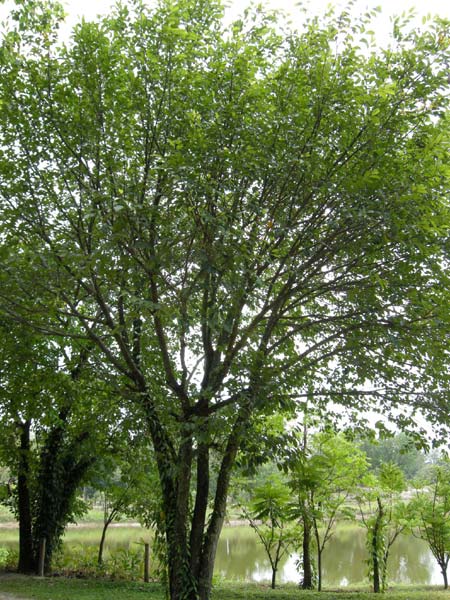
Artocarpus lacucha, also known as monkey jack or monkey fruit, is a tropical evergreen tree species of the family Moraceae. It is distributed throughout the Indian subcontinent and Southeast Asia. The tree is valued for its wood; its fruit is edible and is believed to have medicinal value. In Northeastern Thailand, the wood is used to make pong lang, a local traditional instrument.
The stilbenoid oxyresveratrol can be isolated from the heartwood of Artocarpus lacucha as well as in Puag Haad, the light brown powder obtained from the aqueous extract of the wood chips of A. lakoocha by boiling, then slow evaporation, followed by cooling. This traditional drug is effective against the intestinal fluke Haplorchis taichui or against taeniasis.
This tree is mentioned in the Arthashastra.
Experiments have shown that the heme-peroxidase enzyme from the medicinal plant Artocarpus lakoocha has the ability to protect against oxidative damage in vitro and possesses wound healing properties. This stable enzyme also has anti-inflammatory properties, making it a potential candidate for use in biotechnological and industrial applications.
Hub AI
Artocarpus lacucha AI simulator
(@Artocarpus lacucha_simulator)
Artocarpus lacucha
Artocarpus lacucha, also known as monkey jack or monkey fruit, is a tropical evergreen tree species of the family Moraceae. It is distributed throughout the Indian subcontinent and Southeast Asia. The tree is valued for its wood; its fruit is edible and is believed to have medicinal value. In Northeastern Thailand, the wood is used to make pong lang, a local traditional instrument.
The stilbenoid oxyresveratrol can be isolated from the heartwood of Artocarpus lacucha as well as in Puag Haad, the light brown powder obtained from the aqueous extract of the wood chips of A. lakoocha by boiling, then slow evaporation, followed by cooling. This traditional drug is effective against the intestinal fluke Haplorchis taichui or against taeniasis.
This tree is mentioned in the Arthashastra.
Experiments have shown that the heme-peroxidase enzyme from the medicinal plant Artocarpus lakoocha has the ability to protect against oxidative damage in vitro and possesses wound healing properties. This stable enzyme also has anti-inflammatory properties, making it a potential candidate for use in biotechnological and industrial applications.
Recent media