
Recent from talks
Arylsulfatase
Knowledge base stats:
Talk channels stats:
Members stats:
Arylsulfatase
Arylsulfatase (EC 3.1.6.1, sulfatase, nitrocatechol sulfatase, phenolsulfatase, phenylsulfatase, p-nitrophenyl sulfatase, arylsulfohydrolase, 4-methylumbelliferyl sulfatase, estrogen sulfatase) is a type of sulfatase enzyme with systematic name aryl-sulfate sulfohydrolase. This enzyme catalyses the following chemical reaction
It catalyses an analogous reaction for sulfonated hexoses. Types include:
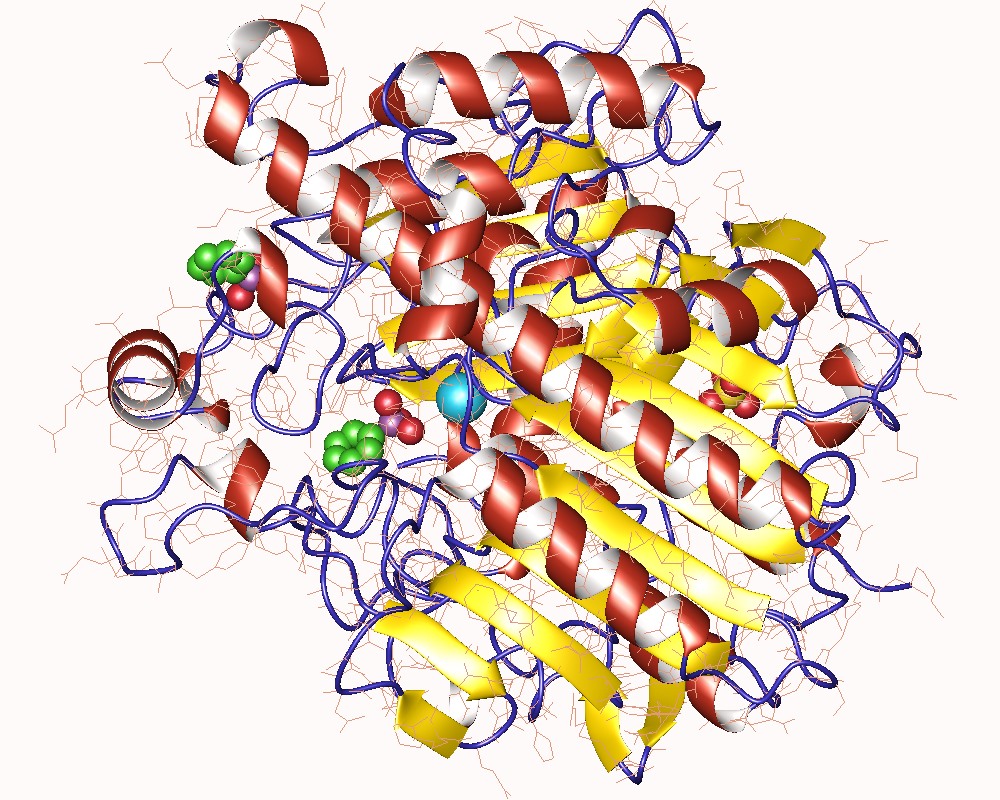
All arylsufatases require a post-translational modification in which a conserved cysteine or serine residue is converted to a formygylcine (FGly) residue by the formyglycine-generating enzyme. Without this modification the enzyme is completely catalytically inactive, a fact demonstrated in multiple sulfatase deficiency, a disorder in which this modification fail across all sulfatases simultaneously. The crystal structure of human arylsulfase A was resolved at 2.1 angstrom resolution and revealed the enzymes forms a homooctamer arranged as a tetramer of dimers. The active site contains a positively charged pocket coordinated by a magnesium ion, with key residues Lys123, Lys302, His229 and Ser150 facilitating sulfate binding. During Catalysis the formyglycine residue acts as a nucleophile attacking the sulfur atom of the substrate, releasing inorganic sulfate and the desulfated product. Arylsulfatases are widely distrubuted among mammals, microorganisms, and green algae, but have not been identified in higher plants. In soil bacterial, arylsulfatase activity plays an important role in the sulfur cycle by mobilizing sulfate from organic compounds, making it available for uptake by other organisms. Deficiency of ARSA results in metachromatic leukodystrophy by progressive neurological deterioration. ARSA enzyme activity levels measured in leukocytes or cultured fibroblasts can be used to predict disease severity and clinical phenotype in effected individuals. Enzyme replacment therapy has been investigated as a treatment strategy for both metachromatic leukodystrophy and Maroteaux-Lamy syndrome caused by ARSB deficiency.
Hub AI
Arylsulfatase AI simulator
(@Arylsulfatase_simulator)
Arylsulfatase
Arylsulfatase (EC 3.1.6.1, sulfatase, nitrocatechol sulfatase, phenolsulfatase, phenylsulfatase, p-nitrophenyl sulfatase, arylsulfohydrolase, 4-methylumbelliferyl sulfatase, estrogen sulfatase) is a type of sulfatase enzyme with systematic name aryl-sulfate sulfohydrolase. This enzyme catalyses the following chemical reaction
It catalyses an analogous reaction for sulfonated hexoses. Types include:
All arylsufatases require a post-translational modification in which a conserved cysteine or serine residue is converted to a formygylcine (FGly) residue by the formyglycine-generating enzyme. Without this modification the enzyme is completely catalytically inactive, a fact demonstrated in multiple sulfatase deficiency, a disorder in which this modification fail across all sulfatases simultaneously. The crystal structure of human arylsulfase A was resolved at 2.1 angstrom resolution and revealed the enzymes forms a homooctamer arranged as a tetramer of dimers. The active site contains a positively charged pocket coordinated by a magnesium ion, with key residues Lys123, Lys302, His229 and Ser150 facilitating sulfate binding. During Catalysis the formyglycine residue acts as a nucleophile attacking the sulfur atom of the substrate, releasing inorganic sulfate and the desulfated product. Arylsulfatases are widely distrubuted among mammals, microorganisms, and green algae, but have not been identified in higher plants. In soil bacterial, arylsulfatase activity plays an important role in the sulfur cycle by mobilizing sulfate from organic compounds, making it available for uptake by other organisms. Deficiency of ARSA results in metachromatic leukodystrophy by progressive neurological deterioration. ARSA enzyme activity levels measured in leukocytes or cultured fibroblasts can be used to predict disease severity and clinical phenotype in effected individuals. Enzyme replacment therapy has been investigated as a treatment strategy for both metachromatic leukodystrophy and Maroteaux-Lamy syndrome caused by ARSB deficiency.
Recent media