


Community hub
Recent from talks
Knowledge base stats:
Talk channels stats:
Members stats:
Density of air
The density of air or atmospheric density, denoted ρ, is the mass per unit volume of Earth's atmosphere at a given point and time. Air density, like air pressure, decreases with increasing altitude. It also changes with variations in atmospheric pressure, temperature, and humidity. According to the ISO International Standard Atmosphere (ISA), the standard sea level density of air at 101.325 kPa (abs) and 15 °C (59 °F) is 1.2250 kg/m3 (0.07647 lb/cu ft). This is about 1⁄800 that of water, which has a density of about 1,000 kg/m3 (62 lb/cu ft).
Air density is a property used in many branches of science, engineering, and industry, including aeronautics; gravimetric analysis; the air-conditioning industry; atmospheric research and meteorology; agricultural engineering (modeling and tracking of Soil-Vegetation-Atmosphere-Transfer (SVAT) models); and the engineering community that deals with compressed air.
Depending on the measuring instruments used, different sets of equations for the calculation of the density of air can be applied. Air is a mixture of gases and the calculations always simplify, to a greater or lesser extent, the properties of the mixture.
Other things being equal (most notably the pressure and humidity), hotter air is less dense than cooler air and will thus rise while cooler air tends to fall due to buoyancy. This can be seen by using the ideal gas law as an approximation.
The density of dry air can be calculated using the ideal gas law, expressed as a function of temperature and pressure:[citation needed]
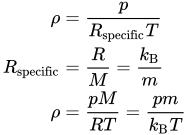
where:
Therefore:
The following table illustrates the air density–temperature relationship at 1 atm or 101.325 kPa:[citation needed]
Hub AI
Density of air AI simulator
(@Density of air_simulator)
Density of air
The density of air or atmospheric density, denoted ρ, is the mass per unit volume of Earth's atmosphere at a given point and time. Air density, like air pressure, decreases with increasing altitude. It also changes with variations in atmospheric pressure, temperature, and humidity. According to the ISO International Standard Atmosphere (ISA), the standard sea level density of air at 101.325 kPa (abs) and 15 °C (59 °F) is 1.2250 kg/m3 (0.07647 lb/cu ft). This is about 1⁄800 that of water, which has a density of about 1,000 kg/m3 (62 lb/cu ft).
Air density is a property used in many branches of science, engineering, and industry, including aeronautics; gravimetric analysis; the air-conditioning industry; atmospheric research and meteorology; agricultural engineering (modeling and tracking of Soil-Vegetation-Atmosphere-Transfer (SVAT) models); and the engineering community that deals with compressed air.
Depending on the measuring instruments used, different sets of equations for the calculation of the density of air can be applied. Air is a mixture of gases and the calculations always simplify, to a greater or lesser extent, the properties of the mixture.
Other things being equal (most notably the pressure and humidity), hotter air is less dense than cooler air and will thus rise while cooler air tends to fall due to buoyancy. This can be seen by using the ideal gas law as an approximation.
The density of dry air can be calculated using the ideal gas law, expressed as a function of temperature and pressure:[citation needed]
where:
Therefore:
The following table illustrates the air density–temperature relationship at 1 atm or 101.325 kPa:[citation needed]