

Recent from talks
Humidity
Knowledge base stats:
Talk channels stats:
Members stats:
Humidity
Humidity is the concentration of water vapor present in the air. Water vapor, the gaseous state of water, is generally invisible to the naked eye. Humidity indicates the likelihood for precipitation, dew, or fog to be present.
Humidity depends on the temperature and pressure of the system of interest. The same amount of water vapor results in higher relative humidity in cool air than warm air. A related parameter is the dew point. The amount of water vapor needed to achieve saturation increases as the temperature increases. As the temperature of a parcel of air decreases it will eventually reach the saturation point without adding or losing water mass. The amount of water vapor contained within a parcel of air can vary significantly. For example, a parcel of air near saturation may contain 8 g of water per cubic metre of air at 8 °C (46 °F), and 28 g of water per cubic metre of air at 30 °C (86 °F)
Three primary measurements of humidity are widely employed: absolute, relative, and specific. Absolute humidity is the mass of water vapor per volume of air (in grams per cubic meter). Relative humidity, often expressed as a percentage, indicates a present state of absolute humidity relative to a maximum humidity given the same temperature. Specific humidity is the ratio of water vapor mass to total moist air parcel mass.
Humidity plays an important role for surface life. For animal life dependent on perspiration (sweating) to regulate internal body temperature, high humidity impairs heat exchange efficiency by reducing the rate of moisture evaporation from skin surfaces. This effect can be calculated using a heat index table, or alternatively using a similar humidex.
The notion of air "holding" water vapor or being "saturated" by it is often mentioned in connection with the concept of relative humidity. This, however, is misleading—the amount of water vapor that enters (or can enter) a given space at a given temperature is almost independent of the amount of air (nitrogen, oxygen, etc.) that is present. Indeed, a vacuum has approximately the same equilibrium capacity to hold water vapor as the same volume filled with air; both are given by the equilibrium vapor pressure of water at the given temperature. There is a very small difference described under "Enhancement factor" below, which can be neglected in many calculations unless great accuracy is required.
Absolute humidity is the total mass of water vapor (gas form of water) present in a given volume or mass of air. It does not take temperature into consideration. Absolute humidity in the atmosphere ranges from near zero to roughly 30 g (1.1 oz) per cubic metre when the air is saturated at 30 °C (86 °F).
Air is a gas, and its volume varies with pressure and temperature, per Boyle's law. Absolute humidity is defined as water mass per volume of air. A given mass of air will grow or shrink as the temperature or pressure varies. So the absolute humidity of a mass of air will vary due to changes in temperature or pressure, even when the proportion of water in that mass of air (its specific humidity) remains constant. This makes the term absolute humidity as defined not ideal for some situations.
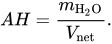
Absolute humidity is the mass of the water vapor , divided by the volume of the air and water vapor mixture , which can be expressed as: In the equation above, if the volume is not set, the absolute humidity varies with changes in air temperature or pressure. Because of this variability, use of the term absolute humidity as defined is inappropriate for computations in chemical engineering, such as drying, where temperature variations might be significant. As a result, absolute humidity in chemical engineering may refer to mass of water vapor per unit mass of dry air, also known as the humidity ratio or mass mixing ratio (see "specific humidity" below), which is better suited for heat and mass balance calculations.[citation needed] Mass of water per unit volume as in the equation above is also defined as volumetric humidity. Because of the potential confusion, British Standard BS 1339 suggests avoiding the term "absolute humidity". Units should always be carefully checked. Many humidity charts are given in g/kg or kg/kg, but any mass units may be used.


Hub AI
Humidity AI simulator
(@Humidity_simulator)
Humidity
Humidity is the concentration of water vapor present in the air. Water vapor, the gaseous state of water, is generally invisible to the naked eye. Humidity indicates the likelihood for precipitation, dew, or fog to be present.
Humidity depends on the temperature and pressure of the system of interest. The same amount of water vapor results in higher relative humidity in cool air than warm air. A related parameter is the dew point. The amount of water vapor needed to achieve saturation increases as the temperature increases. As the temperature of a parcel of air decreases it will eventually reach the saturation point without adding or losing water mass. The amount of water vapor contained within a parcel of air can vary significantly. For example, a parcel of air near saturation may contain 8 g of water per cubic metre of air at 8 °C (46 °F), and 28 g of water per cubic metre of air at 30 °C (86 °F)
Three primary measurements of humidity are widely employed: absolute, relative, and specific. Absolute humidity is the mass of water vapor per volume of air (in grams per cubic meter). Relative humidity, often expressed as a percentage, indicates a present state of absolute humidity relative to a maximum humidity given the same temperature. Specific humidity is the ratio of water vapor mass to total moist air parcel mass.
Humidity plays an important role for surface life. For animal life dependent on perspiration (sweating) to regulate internal body temperature, high humidity impairs heat exchange efficiency by reducing the rate of moisture evaporation from skin surfaces. This effect can be calculated using a heat index table, or alternatively using a similar humidex.
The notion of air "holding" water vapor or being "saturated" by it is often mentioned in connection with the concept of relative humidity. This, however, is misleading—the amount of water vapor that enters (or can enter) a given space at a given temperature is almost independent of the amount of air (nitrogen, oxygen, etc.) that is present. Indeed, a vacuum has approximately the same equilibrium capacity to hold water vapor as the same volume filled with air; both are given by the equilibrium vapor pressure of water at the given temperature. There is a very small difference described under "Enhancement factor" below, which can be neglected in many calculations unless great accuracy is required.
Absolute humidity is the total mass of water vapor (gas form of water) present in a given volume or mass of air. It does not take temperature into consideration. Absolute humidity in the atmosphere ranges from near zero to roughly 30 g (1.1 oz) per cubic metre when the air is saturated at 30 °C (86 °F).
Air is a gas, and its volume varies with pressure and temperature, per Boyle's law. Absolute humidity is defined as water mass per volume of air. A given mass of air will grow or shrink as the temperature or pressure varies. So the absolute humidity of a mass of air will vary due to changes in temperature or pressure, even when the proportion of water in that mass of air (its specific humidity) remains constant. This makes the term absolute humidity as defined not ideal for some situations.
Absolute humidity is the mass of the water vapor , divided by the volume of the air and water vapor mixture , which can be expressed as: In the equation above, if the volume is not set, the absolute humidity varies with changes in air temperature or pressure. Because of this variability, use of the term absolute humidity as defined is inappropriate for computations in chemical engineering, such as drying, where temperature variations might be significant. As a result, absolute humidity in chemical engineering may refer to mass of water vapor per unit mass of dry air, also known as the humidity ratio or mass mixing ratio (see "specific humidity" below), which is better suited for heat and mass balance calculations.[citation needed] Mass of water per unit volume as in the equation above is also defined as volumetric humidity. Because of the potential confusion, British Standard BS 1339 suggests avoiding the term "absolute humidity". Units should always be carefully checked. Many humidity charts are given in g/kg or kg/kg, but any mass units may be used.
Recent media