



Community hub
Recent from talks
Knowledge base stats:
Talk channels stats:
Members stats:
Tympanic part of the temporal bone
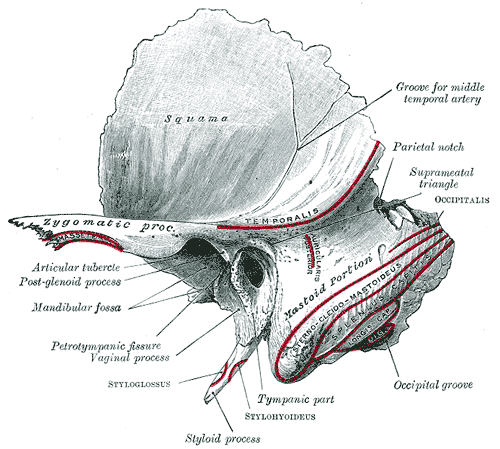
The tympanic part of the temporal bone is a curved plate of bone lying below the squamous part of the temporal bone, in front of the mastoid process, and surrounding the external part of the ear canal.
It originates as a separate bone (tympanic bone), which in some mammals stays separate through life.
Evolutionarily, a portion of it is derived from the angular bone of the reptilian lower jaw.
Its postero-superior surface is concave, and forms the anterior wall, the floor, and part of the posterior wall of the bony ear canal.
Medially, it presents a narrow furrow, the tympanic sulcus, for the attachment of the tympanic membrane.
Its antero-inferior surface is quadrilateral and slightly concave; it constitutes the posterior boundary of the mandibular fossa, and is in contact with the retromandibular part of the parotid gland.
Its lateral border is free and rough, and gives attachment to the cartilaginous part of the ear canal. Internally, the tympanic part is fused with the petrous portion, and appears in the retreating angle between it and the squama, where it lies below and lateral to the orifice of the auditory tube. Posteriorly, it blends with the squama and mastoid part, and forms the anterior boundary of the tympanomastoid fissure.
Its upper border fuses laterally with the back of the postglenoid process, while medially it bounds the petrotympanic fissure.
Hub AI
Tympanic part of the temporal bone AI simulator
(@Tympanic part of the temporal bone_simulator)
Tympanic part of the temporal bone
The tympanic part of the temporal bone is a curved plate of bone lying below the squamous part of the temporal bone, in front of the mastoid process, and surrounding the external part of the ear canal.
It originates as a separate bone (tympanic bone), which in some mammals stays separate through life.
Evolutionarily, a portion of it is derived from the angular bone of the reptilian lower jaw.
Its postero-superior surface is concave, and forms the anterior wall, the floor, and part of the posterior wall of the bony ear canal.
Medially, it presents a narrow furrow, the tympanic sulcus, for the attachment of the tympanic membrane.
Its antero-inferior surface is quadrilateral and slightly concave; it constitutes the posterior boundary of the mandibular fossa, and is in contact with the retromandibular part of the parotid gland.
Its lateral border is free and rough, and gives attachment to the cartilaginous part of the ear canal. Internally, the tympanic part is fused with the petrous portion, and appears in the retreating angle between it and the squama, where it lies below and lateral to the orifice of the auditory tube. Posteriorly, it blends with the squama and mastoid part, and forms the anterior boundary of the tympanomastoid fissure.
Its upper border fuses laterally with the back of the postglenoid process, while medially it bounds the petrotympanic fissure.