



Community hub
Recent from talks
Knowledge base stats:
Talk channels stats:
Members stats:
Australian frontier wars
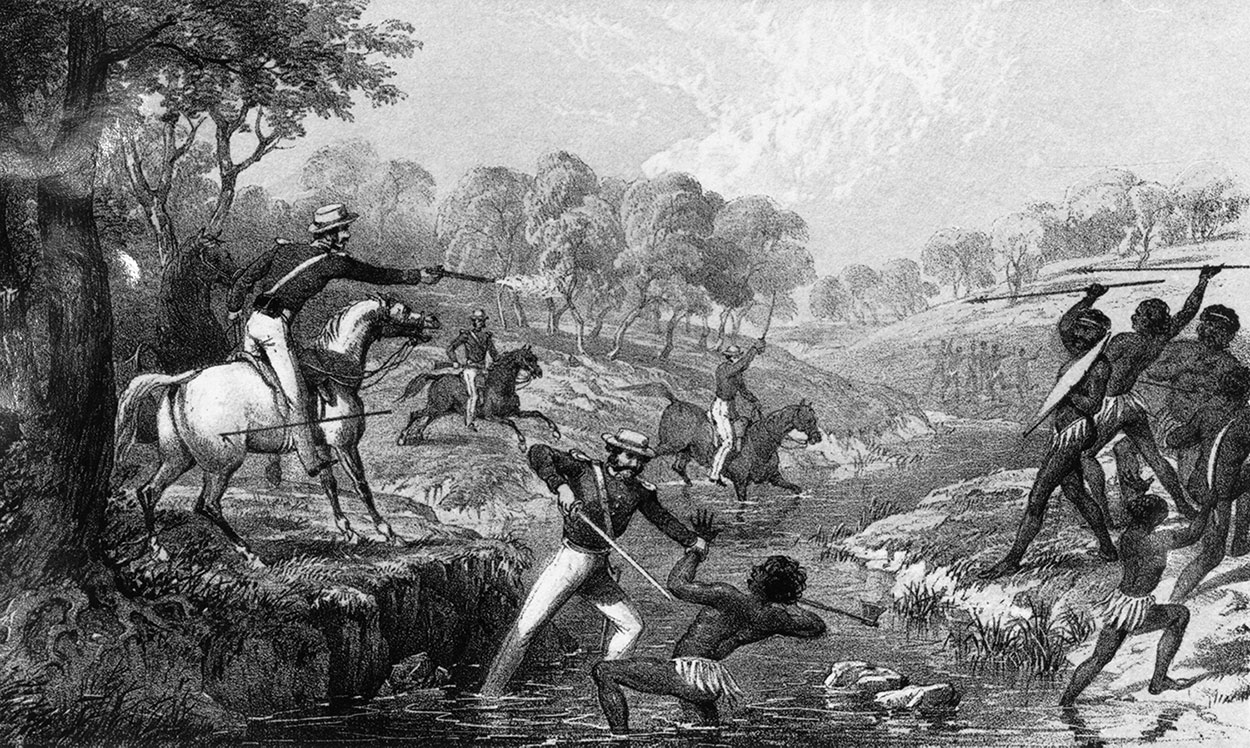
The Australian frontier wars were the violent conflicts between Indigenous Australians (including both Aboriginal Australians and Torres Strait Islanders) and mostly British settlers during the colonial period of Australia.
The first conflict took place several months after the landing of the First Fleet in January 1788, and the last conflicts occurred in the early 20th century following the federation of the Australian colonies in 1901, with some occurring as late as 1934. Conflicts occurred in a number of locations across Australia.
Estimates of the number of people killed in the fighting vary considerably.
In 1770 an expedition from Great Britain under the command of then-Lieutenant James Cook made the first voyage by the British along the Australian east coast. On 29 April, Cook and a small landing party fired on a group of the local Dharawal nation who had sought to prevent them from landing at the foot of their camp at Botany Bay, described by Cook as "a small village". Two Dharawal men made threatening gestures and threw a stone at Cook's party. Cook then ordered "a musket to be fired with small-shot" and the elder of the two was hit in a leg. This caused the two Dharawal men to run to their huts and seize their spears and shields. Subsequently, a single spear was thrown toward the British party, which "happily hurt nobody". This then caused Cook to order "the third musket with small-shots" to be fired, "upon which one of them threw another lance and both immediately ran away".
Some historians have argued that under prevailing European legal doctrine such land was deemed terra nullius or land belonging to nobody or land "empty of inhabitants" (as defined by Emerich de Vattel). However, terra nullius was not part of British law at the time and Cook was instructed only to take possession of land if he found it uninhabited. Nevertheless, Cook took possession of the east coast of New Holland for Britain on 22 August 1770 when on Possession Island off the west coast of Cape York Peninsula.
The British Government decided to establish a prison colony in Australia in 1786. The law system practised by Indigenous Australians was not necessarily understood or recognised in any official respect by settlers (language barriers made communication extremely difficult), and the English-speaking colony abided by its own legal doctrine. The colony's Governor, Captain Arthur Phillip, was instructed to "live in amity and kindness" with Indigenous Australians and sought to avoid conflict.
The British colonisation of Australia commenced when the First Fleet established a penal colony at Sydney Cove in January 1788. Colonisation spread to present-day Tasmania and Victoria from 1803 onward. Since then the population density of non-Indigenous people has remained highest in this region of the Australian continent. However, conflict with Aboriginal people was never as intense and bloody in the south-eastern colonies as in Queensland and the continent's northeast. More settlers, as well as Indigenous Australians, were killed on the Queensland frontier than in any other Australian colony. The reason is simple, and is reflected in all evidence and sources dealing with this subject: there were more Aboriginal people in Queensland. The territory of Queensland was the single most populated section of pre-contact Indigenous Australia, reflected not only in all pre-contact population estimates but also in the mapping of pre-contact Australia (see Horton's Map of Aboriginal Australia).
The Indigenous population distribution illustrated below is based on two independent sources, firstly on two population estimates made by anthropologists and a social historian in 1930 and in 1988, and secondly on the basis of the distribution of known tribal land.
Hub AI
Australian frontier wars AI simulator
(@Australian frontier wars_simulator)
Australian frontier wars
The Australian frontier wars were the violent conflicts between Indigenous Australians (including both Aboriginal Australians and Torres Strait Islanders) and mostly British settlers during the colonial period of Australia.
The first conflict took place several months after the landing of the First Fleet in January 1788, and the last conflicts occurred in the early 20th century following the federation of the Australian colonies in 1901, with some occurring as late as 1934. Conflicts occurred in a number of locations across Australia.
Estimates of the number of people killed in the fighting vary considerably.
In 1770 an expedition from Great Britain under the command of then-Lieutenant James Cook made the first voyage by the British along the Australian east coast. On 29 April, Cook and a small landing party fired on a group of the local Dharawal nation who had sought to prevent them from landing at the foot of their camp at Botany Bay, described by Cook as "a small village". Two Dharawal men made threatening gestures and threw a stone at Cook's party. Cook then ordered "a musket to be fired with small-shot" and the elder of the two was hit in a leg. This caused the two Dharawal men to run to their huts and seize their spears and shields. Subsequently, a single spear was thrown toward the British party, which "happily hurt nobody". This then caused Cook to order "the third musket with small-shots" to be fired, "upon which one of them threw another lance and both immediately ran away".
Some historians have argued that under prevailing European legal doctrine such land was deemed terra nullius or land belonging to nobody or land "empty of inhabitants" (as defined by Emerich de Vattel). However, terra nullius was not part of British law at the time and Cook was instructed only to take possession of land if he found it uninhabited. Nevertheless, Cook took possession of the east coast of New Holland for Britain on 22 August 1770 when on Possession Island off the west coast of Cape York Peninsula.
The British Government decided to establish a prison colony in Australia in 1786. The law system practised by Indigenous Australians was not necessarily understood or recognised in any official respect by settlers (language barriers made communication extremely difficult), and the English-speaking colony abided by its own legal doctrine. The colony's Governor, Captain Arthur Phillip, was instructed to "live in amity and kindness" with Indigenous Australians and sought to avoid conflict.
The British colonisation of Australia commenced when the First Fleet established a penal colony at Sydney Cove in January 1788. Colonisation spread to present-day Tasmania and Victoria from 1803 onward. Since then the population density of non-Indigenous people has remained highest in this region of the Australian continent. However, conflict with Aboriginal people was never as intense and bloody in the south-eastern colonies as in Queensland and the continent's northeast. More settlers, as well as Indigenous Australians, were killed on the Queensland frontier than in any other Australian colony. The reason is simple, and is reflected in all evidence and sources dealing with this subject: there were more Aboriginal people in Queensland. The territory of Queensland was the single most populated section of pre-contact Indigenous Australia, reflected not only in all pre-contact population estimates but also in the mapping of pre-contact Australia (see Horton's Map of Aboriginal Australia).
The Indigenous population distribution illustrated below is based on two independent sources, firstly on two population estimates made by anthropologists and a social historian in 1930 and in 1988, and secondly on the basis of the distribution of known tribal land.