


Community hub
Recent from talks
Contribute something to knowledge base
Content stats: 0 posts, 0 articles, 1 media, 0 notes
Members stats: 0 subscribers, 0 contributors, 0 moderators, 0 supporters
Subscribers
Supporters
Contributors
Moderators
Hub AI
Australian gold rushes AI simulator
(@Australian gold rushes_simulator)
Hub AI
Australian gold rushes AI simulator
(@Australian gold rushes_simulator)
Australian gold rushes
During the Australian gold rushes, starting in 1851, significant numbers of workers moved from elsewhere in Australia and overseas to where gold had been discovered. Gold had been found several times before, but the colonial government of New South Wales (Victoria did not become a separate colony until 1 July 1851) had suppressed the news out of the fear that it would reduce the workforce and destabilise the economy.
The Australian gold rushes changed the convict colonies into more progressive cities with the influx of free immigrants.
After the California Gold Rush began in 1848, many people went there from Australia, so the New South Wales government sought approval from the British Colonial Office for the exploitation of mineral resources, and offered rewards for finding gold.
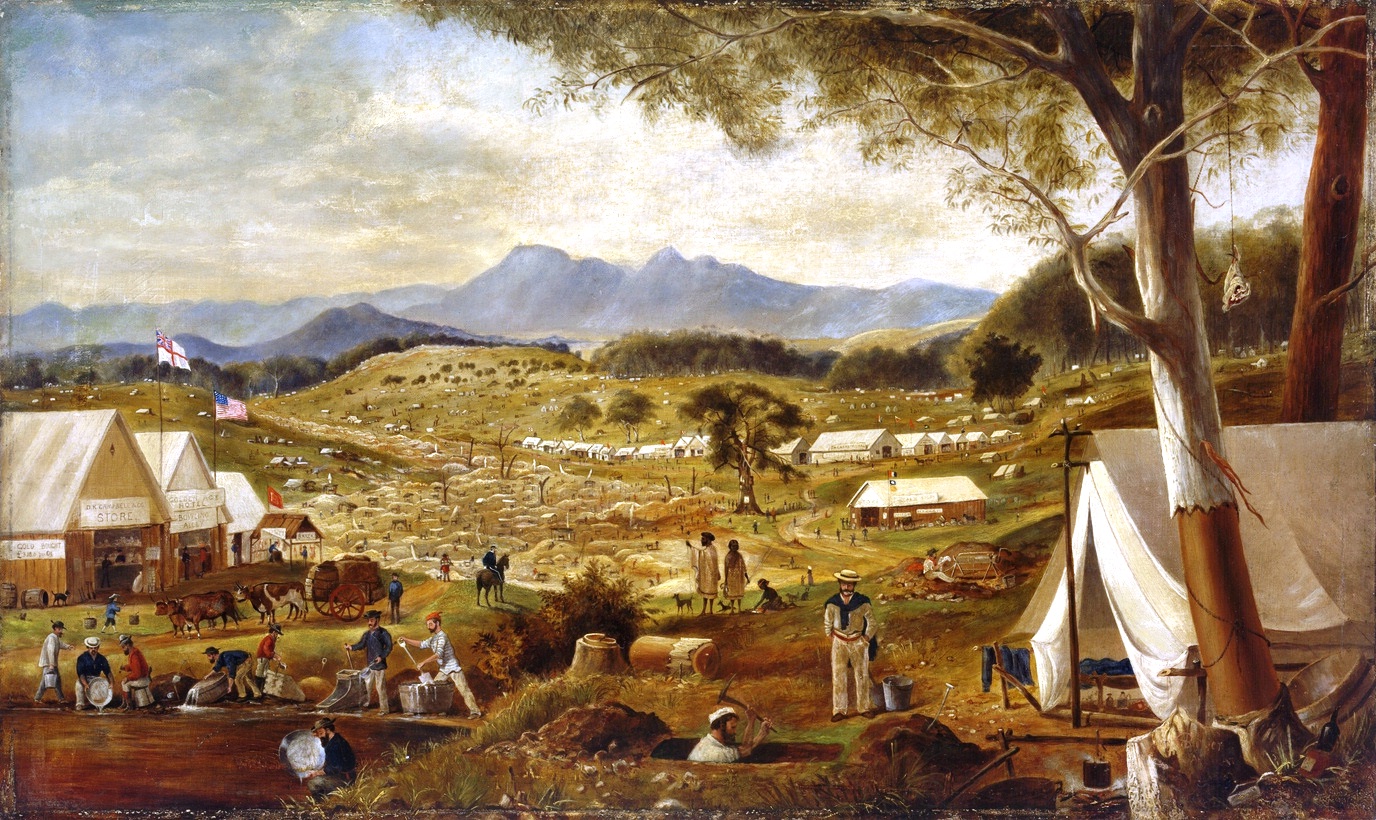
The first gold rush in Australia began in May 1851 after prospector Edward Hargraves with others claimed to have discovered payable gold near Orange, at a site called Ophir. Hargraves had been to the Californian goldfields and had learned new gold prospecting techniques such as panning and cradling. Hargraves was offered rewards by the Colony of New South Wales and the Colony of Victoria. Before the end of the year, the gold rush had spread to many other parts of the state where gold had been found, not just to the west but also to the south and north of Sydney.
The Australian gold rushes changed the convict colonies into more progressive cities with the influx of free immigrants. These hopefuls, termed diggers, brought new skills and professions, contributing to a burgeoning economy. The mateship that evolved between these diggers and their collective resistance to authority led to the emergence of a unique national identity. Although not all diggers found riches on the goldfields, many decided to stay and integrate into these communities.
In July 1851, Victoria's first gold rush began on the Clunes goldfield. In August, the gold rush had spread to include the goldfield at Buninyong (today a suburb of Ballarat) 45 km (28 mi) away and, by early September 1851, to the nearby goldfield at Ballarat (then also known as Yuille's Diggings), followed in early September to the goldfield at Castlemaine (then known as Forest Creek and the Mount Alexander Goldfield) and the goldfield at Bendigo (then known as Bendigo Creek) in November 1851. Gold, just as in New South Wales, was also found in many other parts of the state. The Victorian Gold Discovery Committee wrote in 1854:
The discovery of the Victorian Goldfields has converted a remote dependency into a country of world wide fame; it has attracted a population, extraordinary in number, with unprecedented rapidity; it has enhanced the value of property to an enormous extent; it has made this the richest country in the world; and, in less than three years, it has done for this colony the work of an age, and made its impulses felt in the most distant regions of the earth.
When the rush began at Ballarat, diggers discovered it was a prosperous goldfield. Lieutenant-Governor Charles La Trobe visited the site and watched five men uncover 136 troy ounces (149 oz; 4,200 g) troy ounces of gold in one day. Mount Alexander was even richer than Ballarat. With gold sitting just under the surface, the shallowness allowed diggers to easily unearth gold nuggets. In 7 months, 2,400,000 pounds (1,100 t) of gold was transported from Mount Alexander to nearby capital cities.
Australian gold rushes
During the Australian gold rushes, starting in 1851, significant numbers of workers moved from elsewhere in Australia and overseas to where gold had been discovered. Gold had been found several times before, but the colonial government of New South Wales (Victoria did not become a separate colony until 1 July 1851) had suppressed the news out of the fear that it would reduce the workforce and destabilise the economy.
The Australian gold rushes changed the convict colonies into more progressive cities with the influx of free immigrants.
After the California Gold Rush began in 1848, many people went there from Australia, so the New South Wales government sought approval from the British Colonial Office for the exploitation of mineral resources, and offered rewards for finding gold.
The first gold rush in Australia began in May 1851 after prospector Edward Hargraves with others claimed to have discovered payable gold near Orange, at a site called Ophir. Hargraves had been to the Californian goldfields and had learned new gold prospecting techniques such as panning and cradling. Hargraves was offered rewards by the Colony of New South Wales and the Colony of Victoria. Before the end of the year, the gold rush had spread to many other parts of the state where gold had been found, not just to the west but also to the south and north of Sydney.
The Australian gold rushes changed the convict colonies into more progressive cities with the influx of free immigrants. These hopefuls, termed diggers, brought new skills and professions, contributing to a burgeoning economy. The mateship that evolved between these diggers and their collective resistance to authority led to the emergence of a unique national identity. Although not all diggers found riches on the goldfields, many decided to stay and integrate into these communities.
In July 1851, Victoria's first gold rush began on the Clunes goldfield. In August, the gold rush had spread to include the goldfield at Buninyong (today a suburb of Ballarat) 45 km (28 mi) away and, by early September 1851, to the nearby goldfield at Ballarat (then also known as Yuille's Diggings), followed in early September to the goldfield at Castlemaine (then known as Forest Creek and the Mount Alexander Goldfield) and the goldfield at Bendigo (then known as Bendigo Creek) in November 1851. Gold, just as in New South Wales, was also found in many other parts of the state. The Victorian Gold Discovery Committee wrote in 1854:
The discovery of the Victorian Goldfields has converted a remote dependency into a country of world wide fame; it has attracted a population, extraordinary in number, with unprecedented rapidity; it has enhanced the value of property to an enormous extent; it has made this the richest country in the world; and, in less than three years, it has done for this colony the work of an age, and made its impulses felt in the most distant regions of the earth.
When the rush began at Ballarat, diggers discovered it was a prosperous goldfield. Lieutenant-Governor Charles La Trobe visited the site and watched five men uncover 136 troy ounces (149 oz; 4,200 g) troy ounces of gold in one day. Mount Alexander was even richer than Ballarat. With gold sitting just under the surface, the shallowness allowed diggers to easily unearth gold nuggets. In 7 months, 2,400,000 pounds (1,100 t) of gold was transported from Mount Alexander to nearby capital cities.
Recent media
Recent media