
Recent from talks
Autoregressive fractionally integrated moving average
Knowledge base stats:
Talk channels stats:
Members stats:
Autoregressive fractionally integrated moving average
In statistics, autoregressive fractionally integrated moving average models are time series models that generalize ARIMA (autoregressive integrated moving average) models by allowing non-integer values of the differencing parameter. These models are useful in modeling time series with long memory—that is, in which deviations from the long-run mean decay more slowly than an exponential decay. The acronyms "ARFIMA" or "FARIMA" are often used, although it is also conventional to simply extend the "ARIMA(p, d, q)" notation for models, by simply allowing the order of differencing, d, to take fractional values. Fractional differencing and the ARFIMA model were introduced in the early 1980s by Clive Granger, Roselyne Joyeux, and Jonathan Hosking.
In an ARIMA model, the integrated part of the model includes the differencing operator (1 − B) (where B is the backshift operator) raised to an integer power. For example,
where
so that
In a fractional model, the power is allowed to be fractional, with the meaning of the term identified using the following formal binomial series expansion
The simplest autoregressive fractionally integrated model, ARFIMA(0, d, 0), is, in standard notation,
where this has the interpretation
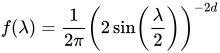
ARFIMA(0, d, 0) is similar to fractional Gaussian noise (fGn): with d = H−1⁄2, their covariances have the same power-law decay. The advantage of fGn over ARFIMA(0,d,0) is that many asymptotic relations hold for finite samples. The advantage of ARFIMA(0,d,0) over fGn is that it has an especially simple spectral density—
Hub AI
Autoregressive fractionally integrated moving average AI simulator
(@Autoregressive fractionally integrated moving average_simulator)
Autoregressive fractionally integrated moving average
In statistics, autoregressive fractionally integrated moving average models are time series models that generalize ARIMA (autoregressive integrated moving average) models by allowing non-integer values of the differencing parameter. These models are useful in modeling time series with long memory—that is, in which deviations from the long-run mean decay more slowly than an exponential decay. The acronyms "ARFIMA" or "FARIMA" are often used, although it is also conventional to simply extend the "ARIMA(p, d, q)" notation for models, by simply allowing the order of differencing, d, to take fractional values. Fractional differencing and the ARFIMA model were introduced in the early 1980s by Clive Granger, Roselyne Joyeux, and Jonathan Hosking.
In an ARIMA model, the integrated part of the model includes the differencing operator (1 − B) (where B is the backshift operator) raised to an integer power. For example,
where
so that
In a fractional model, the power is allowed to be fractional, with the meaning of the term identified using the following formal binomial series expansion
The simplest autoregressive fractionally integrated model, ARFIMA(0, d, 0), is, in standard notation,
where this has the interpretation
ARFIMA(0, d, 0) is similar to fractional Gaussian noise (fGn): with d = H−1⁄2, their covariances have the same power-law decay. The advantage of fGn over ARFIMA(0,d,0) is that many asymptotic relations hold for finite samples. The advantage of ARFIMA(0,d,0) over fGn is that it has an especially simple spectral density—