


Community hub
Recent from talks
Contribute something to knowledge base
Content stats: 0 posts, 0 articles, 1 media, 0 notes
Members stats: 0 subscribers, 0 contributors, 0 moderators, 0 supporters
Subscribers
Supporters
Contributors
Moderators
Hub AI
Autoroutes of France AI simulator
(@Autoroutes of France_simulator)
Hub AI
Autoroutes of France AI simulator
(@Autoroutes of France_simulator)
Autoroutes of France
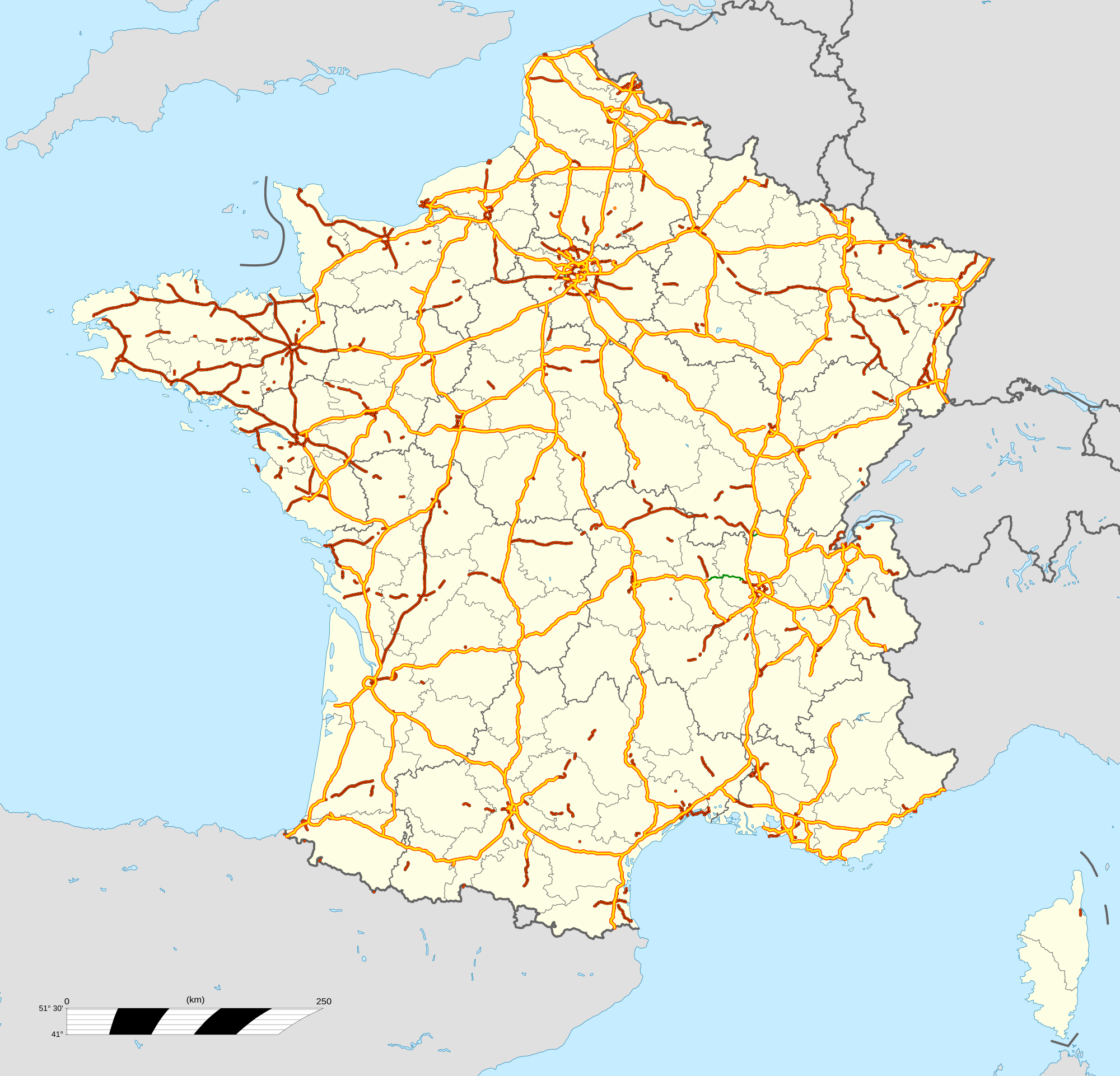
The autoroute (French: [otoʁut] ⓘ, highway or motorway) system in France consists largely of toll roads (76% of the total). It is a network of 11,882 km (7,383 mi) of motorways as of 2014. On road signs, autoroute destinations are shown in blue, while destinations reached through a combination of autoroutes are shown with an added autoroute logo. Toll autoroutes are signalled with the word péage (toll or toll plaza).
Unlike other motorway systems, there is no systematic numbering system, but there is a clustering of Autoroute numbers based on region.
A1, A3, A4, A5, A6, A10, A13, A14, A15, A16 radiate clockwise from Paris, with A2, A11, and A12 branching from A1, A10, and A13, respectively. A7 begins in Lyon, where A6 ends. A8 and A9 begin from the A7.
The 20s are found in northern and northwestern France. The 30s are found in eastern and northeastern France. The 40s are found near the Alps. The 50s are in the southeast, near the French Riviera. The 60s are found in southern France. The 70s are found in the center of the country. The 80s are found in western France, except for the A89 autoroute which goes from southwestern to eastern France.
Autoroutes are often given a name, even if these are not very used:
The status of motorways in France has been the subject of debate through years, from their construction until recently. Originally, the autoroutes were built by private companies mandated by the French government and followed strict construction rules as described below. They are operated and maintained by mixed companies held in part by private interests and in part by the state. Those companies hold concessions, which means that autoroutes belong to the French state and their administration to semi-private companies. Vinci controls around 4,380 km (2,720 mi) of motorway. The different companies are as follows:
Only in the Brittany region do most of the autoroutes belong to the government. They are operated by the regional council and are free from tolls.
France has the following speed limits for limited access roads classified as motorways:
Autoroutes of France
The autoroute (French: [otoʁut] ⓘ, highway or motorway) system in France consists largely of toll roads (76% of the total). It is a network of 11,882 km (7,383 mi) of motorways as of 2014. On road signs, autoroute destinations are shown in blue, while destinations reached through a combination of autoroutes are shown with an added autoroute logo. Toll autoroutes are signalled with the word péage (toll or toll plaza).
Unlike other motorway systems, there is no systematic numbering system, but there is a clustering of Autoroute numbers based on region.
A1, A3, A4, A5, A6, A10, A13, A14, A15, A16 radiate clockwise from Paris, with A2, A11, and A12 branching from A1, A10, and A13, respectively. A7 begins in Lyon, where A6 ends. A8 and A9 begin from the A7.
The 20s are found in northern and northwestern France. The 30s are found in eastern and northeastern France. The 40s are found near the Alps. The 50s are in the southeast, near the French Riviera. The 60s are found in southern France. The 70s are found in the center of the country. The 80s are found in western France, except for the A89 autoroute which goes from southwestern to eastern France.
Autoroutes are often given a name, even if these are not very used:
The status of motorways in France has been the subject of debate through years, from their construction until recently. Originally, the autoroutes were built by private companies mandated by the French government and followed strict construction rules as described below. They are operated and maintained by mixed companies held in part by private interests and in part by the state. Those companies hold concessions, which means that autoroutes belong to the French state and their administration to semi-private companies. Vinci controls around 4,380 km (2,720 mi) of motorway. The different companies are as follows:
Only in the Brittany region do most of the autoroutes belong to the government. They are operated by the regional council and are free from tolls.
France has the following speed limits for limited access roads classified as motorways:
Recent media
Recent media