



Community hub
Recent from talks
Knowledge base stats:
Talk channels stats:
Members stats:
Auxiliary floating drydock
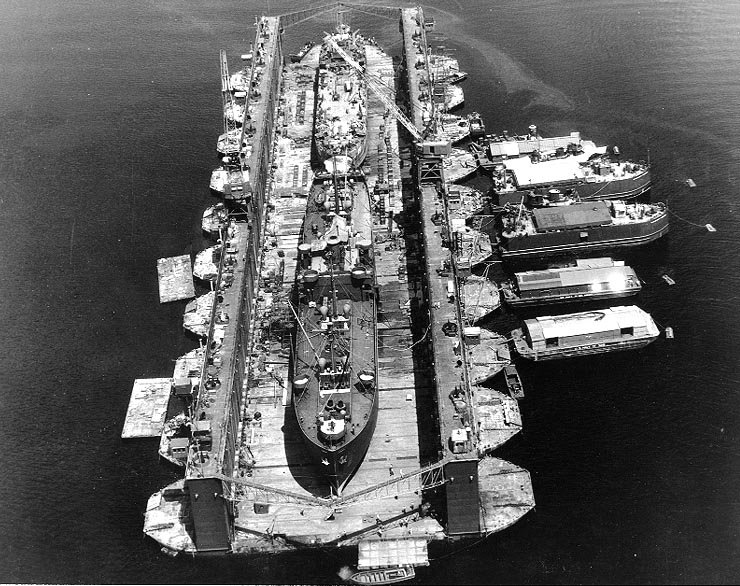
An auxiliary floating drydock is a type of US Navy auxiliary floating dry dock. Floating dry docks are able to submerge underwater and to be placed under a ship in need of repair below the water line. Water is then pumped out of the floating dry dock, raising the ship out of the water. The ship becomes blocked on the deck of the floating dry dock for repair. Most floating dry docks have no engine and are towed by tugboats to their destinations. Floating dry docks come in different sizes to accommodate varying ship sizes, while large floating dry docks come in sections and can be combined to increase their size and lift power. Ballast pontoon tanks are flooded with water to submerge or pumped dry to raise the ship.
At the start of World War II, the US Navy had only three steel auxiliary floating dry docks:
To reduce travel time for repair work, over 150 auxiliary floating dry docks of different sizes were built during World War II between 1942 and 1945. These newly built floating dry docks had a lift capacity of 400 to 100,000 tons. Without these forward repair bases, ships would have had to return to the US for repairs. Between 1 October 1944 and 17 October 1945, 7,000 ships were repaired in auxiliary floating dry docks. After World War II some auxiliary floating dry docks were sold for private use and others were scrapped. In addition to auxiliary floating dry docks, timber floating dry docks were built for use in World War II. Timber floating dry docks had a lift capacity of 400 to 20,000 tons. They were not towed across the open ocean and were not given a US Navy class.
During wartime, ships in continuous use need repair both from wear and from war damage such as from naval mines, kamikaze attacks, dive bombs and torpedoes. Rudders and propellers are best serviced on dry docks. Without remote on-location dry docks, months could be lost if a ship returned to a home port for repair. Most auxiliary floating drydocks had provisions for the repair crew, including bunk beds, meals, and laundry. Most had power stations, ballast pumps, repair shops, machine shops, and mess halls to be self-sustaining. Some auxiliary floating drydocks also had provisions for the ship under repair, but when possible, the crew of the damaged ship remained on ship while repairs were done. Many had cranes able to lift tons of material and parts to remove damaged parts and to install new parts.
Most auxiliary floating drydocks had only anti-aircraft guns for defense, as space would not allow for large guns. Typical armaments included 40 mm and 20 mm machine guns. Japanese pilots sometimes mistook empty auxiliary floating drydocks for aircraft carriers.
Auxiliary Floating Docks, Big (AFDB), also known as Advance Base Sectional Docks (ABSD), came in sections, 93 ft (28 m) long and 3,850 tons each. Each section had a 165-foot (50 m) beam, a 75-foot (23 m) molded depth, and 10,000 tons of lifting capacity. Sections could be put together to lift larger ships. AFDB were needed to repair battleships, aircraft carriers, cruisers, and large auxiliary ships. The AFDB-1 Artisan had 10 sections (A to J) for a total lift of 100,000 tons, and was 1,000 ft (300 m) long with all 10 sections installed. AFDB-1 to 7 were built between 1943 and 1945 and towed to remote navy bases. An AFDB would have a crew of 600 to 1,000 men, a fresh-water distilling plant and was otherwise self-sustaining. They had a rail traveling 15-ton capacity crane with an 85-foot (26 m) radius and two or more support barges. To pump water from the tanks, there were two 24-inch (61 cm) discharge pumps on each section, each pump rated 15,000 US gallons (57,000 L) per minute. For electricity, there were two 350-kw diesel AC generators on each section, producing 440 volts 3-phase 60-cycle power. AFDBs had steam plants to run the pumps. Each section could store 65,000 US gallons (250,000 L) of fuel oil to supply the ships under repair. Crew lived in barracks ships, called APL, that docked next to the AFDB.
Post WW2
AFDM are from 6,800 to 8,000 tons and are from 528 to 622 ft (161 to 190 m) long. An AFDM has a crew of 140 to 200 men. An AFDM had a lift capacity 18,000 tons and was armed with two 40 mm and four 20 mm guns. It also had two 7+1⁄2-ton cranes with 16 ballast tank compartments. AFDMs were built in three pieces, a long center section and two shorter sections, one at each end. All AFDM also had Yard Floating Docks (YFD) class numbers.
Hub AI
Auxiliary floating drydock AI simulator
(@Auxiliary floating drydock_simulator)
Auxiliary floating drydock
An auxiliary floating drydock is a type of US Navy auxiliary floating dry dock. Floating dry docks are able to submerge underwater and to be placed under a ship in need of repair below the water line. Water is then pumped out of the floating dry dock, raising the ship out of the water. The ship becomes blocked on the deck of the floating dry dock for repair. Most floating dry docks have no engine and are towed by tugboats to their destinations. Floating dry docks come in different sizes to accommodate varying ship sizes, while large floating dry docks come in sections and can be combined to increase their size and lift power. Ballast pontoon tanks are flooded with water to submerge or pumped dry to raise the ship.
At the start of World War II, the US Navy had only three steel auxiliary floating dry docks:
To reduce travel time for repair work, over 150 auxiliary floating dry docks of different sizes were built during World War II between 1942 and 1945. These newly built floating dry docks had a lift capacity of 400 to 100,000 tons. Without these forward repair bases, ships would have had to return to the US for repairs. Between 1 October 1944 and 17 October 1945, 7,000 ships were repaired in auxiliary floating dry docks. After World War II some auxiliary floating dry docks were sold for private use and others were scrapped. In addition to auxiliary floating dry docks, timber floating dry docks were built for use in World War II. Timber floating dry docks had a lift capacity of 400 to 20,000 tons. They were not towed across the open ocean and were not given a US Navy class.
During wartime, ships in continuous use need repair both from wear and from war damage such as from naval mines, kamikaze attacks, dive bombs and torpedoes. Rudders and propellers are best serviced on dry docks. Without remote on-location dry docks, months could be lost if a ship returned to a home port for repair. Most auxiliary floating drydocks had provisions for the repair crew, including bunk beds, meals, and laundry. Most had power stations, ballast pumps, repair shops, machine shops, and mess halls to be self-sustaining. Some auxiliary floating drydocks also had provisions for the ship under repair, but when possible, the crew of the damaged ship remained on ship while repairs were done. Many had cranes able to lift tons of material and parts to remove damaged parts and to install new parts.
Most auxiliary floating drydocks had only anti-aircraft guns for defense, as space would not allow for large guns. Typical armaments included 40 mm and 20 mm machine guns. Japanese pilots sometimes mistook empty auxiliary floating drydocks for aircraft carriers.
Auxiliary Floating Docks, Big (AFDB), also known as Advance Base Sectional Docks (ABSD), came in sections, 93 ft (28 m) long and 3,850 tons each. Each section had a 165-foot (50 m) beam, a 75-foot (23 m) molded depth, and 10,000 tons of lifting capacity. Sections could be put together to lift larger ships. AFDB were needed to repair battleships, aircraft carriers, cruisers, and large auxiliary ships. The AFDB-1 Artisan had 10 sections (A to J) for a total lift of 100,000 tons, and was 1,000 ft (300 m) long with all 10 sections installed. AFDB-1 to 7 were built between 1943 and 1945 and towed to remote navy bases. An AFDB would have a crew of 600 to 1,000 men, a fresh-water distilling plant and was otherwise self-sustaining. They had a rail traveling 15-ton capacity crane with an 85-foot (26 m) radius and two or more support barges. To pump water from the tanks, there were two 24-inch (61 cm) discharge pumps on each section, each pump rated 15,000 US gallons (57,000 L) per minute. For electricity, there were two 350-kw diesel AC generators on each section, producing 440 volts 3-phase 60-cycle power. AFDBs had steam plants to run the pumps. Each section could store 65,000 US gallons (250,000 L) of fuel oil to supply the ships under repair. Crew lived in barracks ships, called APL, that docked next to the AFDB.
Post WW2
AFDM are from 6,800 to 8,000 tons and are from 528 to 622 ft (161 to 190 m) long. An AFDM has a crew of 140 to 200 men. An AFDM had a lift capacity 18,000 tons and was armed with two 40 mm and four 20 mm guns. It also had two 7+1⁄2-ton cranes with 16 ballast tank compartments. AFDMs were built in three pieces, a long center section and two shorter sections, one at each end. All AFDM also had Yard Floating Docks (YFD) class numbers.