


Community hub
Recent from talks
Contribute something to knowledge base
Content stats: 0 posts, 0 articles, 1 media, 0 notes
Members stats: 0 subscribers, 0 contributors, 0 moderators, 0 supporters
Subscribers
Supporters
Contributors
Moderators
Hub AI
Avro Lincoln AI simulator
(@Avro Lincoln_simulator)
Hub AI
Avro Lincoln AI simulator
(@Avro Lincoln_simulator)
Avro Lincoln
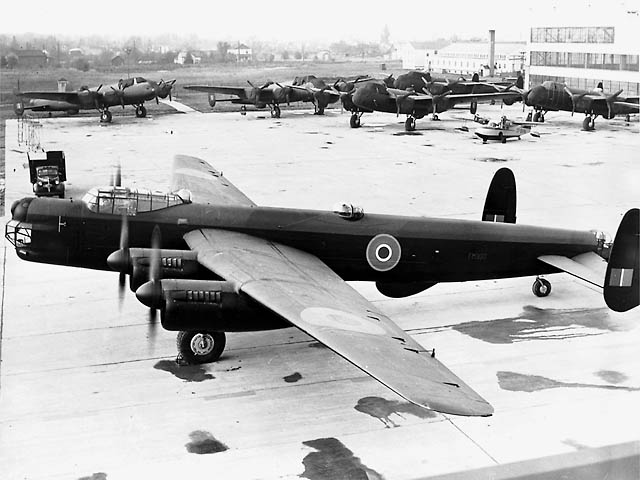
The Avro Type 694 Lincoln is a British four-engined heavy bomber, which first flew on 9 June 1944. Developed from the Avro Lancaster, the first Lincoln variants were initially known as the Lancaster IV and V; these were renamed Lincoln I and II. It was the last piston-engined bomber operated by the Royal Air Force (RAF); the later Avro Shackleton, though piston-engined, served in maritime patrol rather than bomber roles.
The Lincoln attained operational status in August 1945. It had been initially assigned to units of the Tiger Force, a Commonwealth heavy bomber force which had been intended to play a role in the Japan campaign in the closing stages of the Second World War, but the war ended before the Lincoln could participate. Production of the type proceeded and the type was adopted in quantity, complementing and progressively replacing the Lancaster in RAF service during the late 1940s.
The Lincoln was deployed on operations during the 1950s. RAF squadrons equipped with the type fought against guerrilla fighters during the Mau Mau Uprising in Kenya; the RAF and the Royal Australian Air Force (RAAF) also operated the Lincoln during the Malayan Emergency. The type also saw significant peacetime service with the RAF, RAAF and the Argentine Air Force. Lincolns were also operated in civil aviation, including use as aerial test beds for aero-engine research.
In RAF service, the Lincoln was replaced by a new generation of bombers using jet propulsion. In 1967 the last Lincoln bombers in service, in Argentina, were retired.
The Avro Lincoln originated from a design produced by Roy Chadwick as a development of the earlier Lancaster bomber which had been produced with the purpose of conforming with the requirements of the Specification B.14/43. Known initially as the Lancaster IV and Lancaster V, the envisioned aircraft, while considerably similar to the Lancaster, had numerous improvements such as the adoption of stronger, longer span, higher aspect ratio (10.30 compared with 8.02) wings, and two-stage supercharged Rolls-Royce Merlin 85 engines fitted within Universal Power Plant (UPP) installations. The new bomber also had an enlarged fuselage that accommodated increased fuel and bomb loads and allowed up to 11 tons of various armaments and equipment fittings, including the Grand Slam bomb, to be carried. It had a higher operational ceiling and longer range than the Lancaster, with a maximum altitude of 35,000 ft (6.6 mi; 11 km) and a maximum range of 4,450 miles (7,160 km).
The prototype Lancaster IV, later renamed the Lincoln I, was assembled by Avro's experimental flight department at Manchester's Ringway Airport. According to aviation author Kev Delve, development of the Lincoln had proceeded relatively smoothly. On 9 June 1944, the prototype conducted its maiden flight from Ringway Airport. Testing of the prototype quickly proved it to have favourable flight characteristics. In February 1945 the first production Lincoln was completed.
The type was mainly produced at Avro's Woodford, Cheshire and Chadderton Lancashire factories; additional aircraft were also constructed by Armstrong Whitworth at their Coventry facilities. Separate production lines were also established in Canada and Australia, although, as a consequence of the end of the war, production in Canada was halted after only a single aircraft had been constructed. Lincolns were manufactured in Australia and operated by the Royal Australian Air Force (RAAF).
From early 1945 the British Government set about restoring the country to a peacetime stance, with drastic reductions to the armed forces including the disbanding of many squadrons of the Royal Air Force (RAF). A new emphasis was soon placed on 'quality over quantity' during the rationalisation process, seeking to employ fewer but more capable aircraft to perform their envisioned roles; while there was no longer any urgency in bringing new types of aircraft into service, limited procurement of equipment that fell within this ethos did proceed. In accordance with this aim, the British Air Ministry proceeded to formulate and release Specification B.14/43, which sought an improved piston-engined heavy bomber to replace the wartime four-engine bombers, the Short Stirling, the Handley Page Halifax, and the Avro Lancaster.
Avro Lincoln
The Avro Type 694 Lincoln is a British four-engined heavy bomber, which first flew on 9 June 1944. Developed from the Avro Lancaster, the first Lincoln variants were initially known as the Lancaster IV and V; these were renamed Lincoln I and II. It was the last piston-engined bomber operated by the Royal Air Force (RAF); the later Avro Shackleton, though piston-engined, served in maritime patrol rather than bomber roles.
The Lincoln attained operational status in August 1945. It had been initially assigned to units of the Tiger Force, a Commonwealth heavy bomber force which had been intended to play a role in the Japan campaign in the closing stages of the Second World War, but the war ended before the Lincoln could participate. Production of the type proceeded and the type was adopted in quantity, complementing and progressively replacing the Lancaster in RAF service during the late 1940s.
The Lincoln was deployed on operations during the 1950s. RAF squadrons equipped with the type fought against guerrilla fighters during the Mau Mau Uprising in Kenya; the RAF and the Royal Australian Air Force (RAAF) also operated the Lincoln during the Malayan Emergency. The type also saw significant peacetime service with the RAF, RAAF and the Argentine Air Force. Lincolns were also operated in civil aviation, including use as aerial test beds for aero-engine research.
In RAF service, the Lincoln was replaced by a new generation of bombers using jet propulsion. In 1967 the last Lincoln bombers in service, in Argentina, were retired.
The Avro Lincoln originated from a design produced by Roy Chadwick as a development of the earlier Lancaster bomber which had been produced with the purpose of conforming with the requirements of the Specification B.14/43. Known initially as the Lancaster IV and Lancaster V, the envisioned aircraft, while considerably similar to the Lancaster, had numerous improvements such as the adoption of stronger, longer span, higher aspect ratio (10.30 compared with 8.02) wings, and two-stage supercharged Rolls-Royce Merlin 85 engines fitted within Universal Power Plant (UPP) installations. The new bomber also had an enlarged fuselage that accommodated increased fuel and bomb loads and allowed up to 11 tons of various armaments and equipment fittings, including the Grand Slam bomb, to be carried. It had a higher operational ceiling and longer range than the Lancaster, with a maximum altitude of 35,000 ft (6.6 mi; 11 km) and a maximum range of 4,450 miles (7,160 km).
The prototype Lancaster IV, later renamed the Lincoln I, was assembled by Avro's experimental flight department at Manchester's Ringway Airport. According to aviation author Kev Delve, development of the Lincoln had proceeded relatively smoothly. On 9 June 1944, the prototype conducted its maiden flight from Ringway Airport. Testing of the prototype quickly proved it to have favourable flight characteristics. In February 1945 the first production Lincoln was completed.
The type was mainly produced at Avro's Woodford, Cheshire and Chadderton Lancashire factories; additional aircraft were also constructed by Armstrong Whitworth at their Coventry facilities. Separate production lines were also established in Canada and Australia, although, as a consequence of the end of the war, production in Canada was halted after only a single aircraft had been constructed. Lincolns were manufactured in Australia and operated by the Royal Australian Air Force (RAAF).
From early 1945 the British Government set about restoring the country to a peacetime stance, with drastic reductions to the armed forces including the disbanding of many squadrons of the Royal Air Force (RAF). A new emphasis was soon placed on 'quality over quantity' during the rationalisation process, seeking to employ fewer but more capable aircraft to perform their envisioned roles; while there was no longer any urgency in bringing new types of aircraft into service, limited procurement of equipment that fell within this ethos did proceed. In accordance with this aim, the British Air Ministry proceeded to formulate and release Specification B.14/43, which sought an improved piston-engined heavy bomber to replace the wartime four-engine bombers, the Short Stirling, the Handley Page Halifax, and the Avro Lancaster.
Recent media
Recent media