



Community hub
Recent from talks
Contribute something to knowledge base
Content stats: 0 posts, 0 articles, 0 media, 0 notes
Members stats: 0 subscribers, 0 contributors, 0 moderators, 0 supporters
Subscribers
Supporters
Contributors
Moderators
Hub AI
Azumaya algebra AI simulator
(@Azumaya algebra_simulator)
Hub AI
Azumaya algebra AI simulator
(@Azumaya algebra_simulator)
Azumaya algebra
In mathematics, an Azumaya algebra is a generalization of central simple algebras to -algebras where need not be a field. Such a notion was introduced in a 1951 paper of Goro Azumaya, for the case where is a commutative local ring. The notion was developed further in ring theory, and in algebraic geometry, where Alexander Grothendieck made it the basis for his geometric theory of the Brauer group in Bourbaki seminars from 1964–65. There are now several points of access to the basic definitions.

An Azumaya algebra over a commutative ring is an -algebra obeying any of the following equivalent conditions:

Over a field , Azumaya algebras are completely classified by the Artin–Wedderburn theorem since they are the same as central simple algebras. These are algebras isomorphic to the matrix ring for some division algebra over whose center is just . For example, quaternion algebras provide examples of central simple algebras.


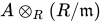
Given a local commutative ring , an -algebra is Azumaya if and only if is free of positive finite rank as an -module, and the algebra is a central simple algebra over , hence all examples come from central simple algebras over .


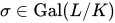
There is a class of Azumaya algebras called cyclic algebras which generate all similarity classes of Azumaya algebras over a field , hence all elements in the Brauer group (defined below). Given a finite cyclic Galois field extension of degree , for every and any generator there is a twisted polynomial ring , also denoted , generated by an element such that


![{\displaystyle L[x]_{\sigma }}](https://wikimedia.org/api/rest_v1/media/math/render/svg/215e7b221f1476875f9be105760062386924a7d7)


and the following commutation property holds:
As a vector space over , has basis with multiplication given by


Note that give a geometrically integral variety , there is also an associated cyclic algebra for the quotient field extension .


Azumaya algebra
In mathematics, an Azumaya algebra is a generalization of central simple algebras to -algebras where need not be a field. Such a notion was introduced in a 1951 paper of Goro Azumaya, for the case where is a commutative local ring. The notion was developed further in ring theory, and in algebraic geometry, where Alexander Grothendieck made it the basis for his geometric theory of the Brauer group in Bourbaki seminars from 1964–65. There are now several points of access to the basic definitions.
An Azumaya algebra over a commutative ring is an -algebra obeying any of the following equivalent conditions:
Over a field , Azumaya algebras are completely classified by the Artin–Wedderburn theorem since they are the same as central simple algebras. These are algebras isomorphic to the matrix ring for some division algebra over whose center is just . For example, quaternion algebras provide examples of central simple algebras.
Given a local commutative ring , an -algebra is Azumaya if and only if is free of positive finite rank as an -module, and the algebra is a central simple algebra over , hence all examples come from central simple algebras over .
There is a class of Azumaya algebras called cyclic algebras which generate all similarity classes of Azumaya algebras over a field , hence all elements in the Brauer group (defined below). Given a finite cyclic Galois field extension of degree , for every and any generator there is a twisted polynomial ring , also denoted , generated by an element such that
and the following commutation property holds:
As a vector space over , has basis with multiplication given by
Note that give a geometrically integral variety , there is also an associated cyclic algebra for the quotient field extension .