
Recent from talks
Bògòlanfini
Knowledge base stats:
Talk channels stats:
Members stats:
Bògòlanfini
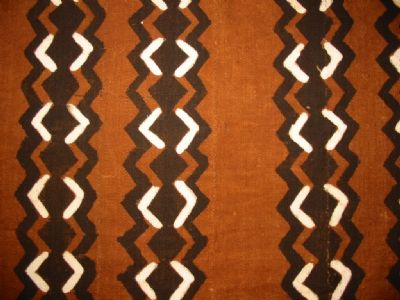
Bògòlanfini or bogolan (Bambara: bɔgɔlanfini; "mud cloth"; sometimes called mud-dyed cloth or mud-painted cloth in English) is a handmade Malian cotton fabric traditionally dyed with fermented mud. It has an important place in traditional Malian culture and has, more recently, become a symbol of Malian cultural identity. The cloth is exported worldwide for use in fashion, fine art and decoration.
The dye technique is associated with several Malian ethnic groups, but the Bamana version has become best known outside Mali. In the Bambara language, the word bògòlanfini is a composite of bɔgɔ, meaning "earth" or "mud"; lan, meaning "with" or "by means of"; and fini, meaning "cloth". Although usually translated as "mud cloth," bògòlan actually refers to slip clay with a high iron content. The iron in the clay will stain handspun and handwoven cotton textiles black.
The center of bògòlanfini production, and the source of the highest quality cloth, is the town of San.
In traditional bògòlanfini production, men weave the cloth and women dye it. On narrow looms, strips of cotton fabric about 15 centimetres (5.9 in) wide are woven and stitched into cloths about 1 metre (3 ft) wide and 1.5 metres (5 ft) long.
The dyeing (a "strange and cumbersome technique", according to Donne (1973)) begins with a step invisible in the finished product: The cloth is soaked in a dye bath made from leaves of the n'gallama tree (Anogeissus leiocarpa) that have been mashed, and then boiled or soaked. Now yellow, but not yet color-fast, the cloth is sun-dried and then painted with designs using a metal tool or wooden stick, and carefully and repeatedly applied to outline the intricate motifs. The paint is made from a specially selected mud, collected from riverbeds and fermented for up to a year in a clay jar. Because of a chemical reaction between the treated mud and the dyed cloth, the brown color remains after the mud has been washed off. Finally, the yellow n'gallama dye is removed from the unmarked parts of the cloth by applying soap or bleach, rendering the finished cloth white with dark marks where it was painted.
After long use, the very dark brown color turns a variety of rich tones of brown, while the unpainted underside of the fabric retains a pale russet color.
Around Mopti and Djenné, a much simpler method is used by artists considered to be of inferior skill: The cloth is dyed yellow in wolo solution, made from the leaves of Terminalia avicennoides, and then painted over with black designs. The yellow is either removed, producing a stark black and white design, or painted a deep orange with a solution from the bark of M'Peku (Lannea velutina).
Based on these simplified techniques, as of around 2000 large quantities of bògòlanfini are being mass-produced for tourist and export markets. These fabrics use simpler designs, often applied by stencil, painted in black on a yellow or orange background. With this method, the cloth can be produced about six to seven times faster. The democratic reforms after the overthrow of Moussa Traoré in 1991 caused many young men to lose their previously guaranteed government jobs and scholarships. This led many to take up bògòlanfini production. Consequently, most cloth is now produced by men rather than women, and the traditional year-long apprenticeships have been replaced by short, informal training sessions.
Hub AI
Bògòlanfini AI simulator
(@Bògòlanfini_simulator)
Bògòlanfini
Bògòlanfini or bogolan (Bambara: bɔgɔlanfini; "mud cloth"; sometimes called mud-dyed cloth or mud-painted cloth in English) is a handmade Malian cotton fabric traditionally dyed with fermented mud. It has an important place in traditional Malian culture and has, more recently, become a symbol of Malian cultural identity. The cloth is exported worldwide for use in fashion, fine art and decoration.
The dye technique is associated with several Malian ethnic groups, but the Bamana version has become best known outside Mali. In the Bambara language, the word bògòlanfini is a composite of bɔgɔ, meaning "earth" or "mud"; lan, meaning "with" or "by means of"; and fini, meaning "cloth". Although usually translated as "mud cloth," bògòlan actually refers to slip clay with a high iron content. The iron in the clay will stain handspun and handwoven cotton textiles black.
The center of bògòlanfini production, and the source of the highest quality cloth, is the town of San.
In traditional bògòlanfini production, men weave the cloth and women dye it. On narrow looms, strips of cotton fabric about 15 centimetres (5.9 in) wide are woven and stitched into cloths about 1 metre (3 ft) wide and 1.5 metres (5 ft) long.
The dyeing (a "strange and cumbersome technique", according to Donne (1973)) begins with a step invisible in the finished product: The cloth is soaked in a dye bath made from leaves of the n'gallama tree (Anogeissus leiocarpa) that have been mashed, and then boiled or soaked. Now yellow, but not yet color-fast, the cloth is sun-dried and then painted with designs using a metal tool or wooden stick, and carefully and repeatedly applied to outline the intricate motifs. The paint is made from a specially selected mud, collected from riverbeds and fermented for up to a year in a clay jar. Because of a chemical reaction between the treated mud and the dyed cloth, the brown color remains after the mud has been washed off. Finally, the yellow n'gallama dye is removed from the unmarked parts of the cloth by applying soap or bleach, rendering the finished cloth white with dark marks where it was painted.
After long use, the very dark brown color turns a variety of rich tones of brown, while the unpainted underside of the fabric retains a pale russet color.
Around Mopti and Djenné, a much simpler method is used by artists considered to be of inferior skill: The cloth is dyed yellow in wolo solution, made from the leaves of Terminalia avicennoides, and then painted over with black designs. The yellow is either removed, producing a stark black and white design, or painted a deep orange with a solution from the bark of M'Peku (Lannea velutina).
Based on these simplified techniques, as of around 2000 large quantities of bògòlanfini are being mass-produced for tourist and export markets. These fabrics use simpler designs, often applied by stencil, painted in black on a yellow or orange background. With this method, the cloth can be produced about six to seven times faster. The democratic reforms after the overthrow of Moussa Traoré in 1991 caused many young men to lose their previously guaranteed government jobs and scholarships. This led many to take up bògòlanfini production. Consequently, most cloth is now produced by men rather than women, and the traditional year-long apprenticeships have been replaced by short, informal training sessions.
Recent media