



Community hub
Recent from talks
Contribute something to knowledge base
Content stats: 0 posts, 0 articles, 0 media, 0 notes
Members stats: 0 subscribers, 0 contributors, 0 moderators, 0 supporters
Subscribers
Supporters
Contributors
Moderators
BET theory
Brunauer–Emmett–Teller (BET) theory aims to explain the physical adsorption of gas molecules on a solid surface and serves as the basis for an important analysis technique for the measurement of the specific surface area of materials. The observations are very often referred to as physical adsorption or physisorption. In 1938, Stephen Brunauer, Paul Hugh Emmett, and Edward Teller presented their theory in the Journal of the American Chemical Society. BET theory applies to systems of multilayer adsorption that usually utilizes a probing gas (called the adsorbate) that does not react chemically with the adsorptive (the material upon which the gas attaches to) to quantify specific surface area. Nitrogen is the most commonly employed gaseous adsorbate for probing surface(s). For this reason, standard BET analysis is most often conducted at the boiling temperature of N2 (77 K). Other probing adsorbates are also utilized, albeit less often, allowing the measurement of surface area at different temperatures and measurement scales. These include argon, carbon dioxide, and water. Specific surface area is a scale-dependent property, with no single true value of specific surface area definable, and thus quantities of specific surface area determined through BET theory may depend on the adsorbate molecule utilized and its adsorption cross section.
The concept of the theory is an extension of the Langmuir theory, which is a theory for monolayer molecular adsorption, to multilayer adsorption with the following hypotheses:
The resulting BET equation is
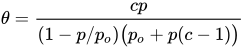
where c is referred to as the BET C-constant, is the vapor pressure of the adsorptive bulk liquid phase which would be at the temperature of the adsorbate and θ is the surface coverage, defined as:

.

Here is the amount of adsorbate and is called the monolayer equivalent. The is the entire amount that would be present as a monolayer (which is theoretically impossible for physical adsorption[citation needed]) that would cover the surface with exactly one layer of adsorbate. The above equation is usually rearranged to yield the following equation for the ease of analysis:


where and are the equilibrium and the saturation pressure of adsorbates at the temperature of adsorption, respectively; is the adsorbed gas quantity (for example, in volume units) while is the monolayer adsorbed gas quantity. is the BET constant,


BET theory
Brunauer–Emmett–Teller (BET) theory aims to explain the physical adsorption of gas molecules on a solid surface and serves as the basis for an important analysis technique for the measurement of the specific surface area of materials. The observations are very often referred to as physical adsorption or physisorption. In 1938, Stephen Brunauer, Paul Hugh Emmett, and Edward Teller presented their theory in the Journal of the American Chemical Society. BET theory applies to systems of multilayer adsorption that usually utilizes a probing gas (called the adsorbate) that does not react chemically with the adsorptive (the material upon which the gas attaches to) to quantify specific surface area. Nitrogen is the most commonly employed gaseous adsorbate for probing surface(s). For this reason, standard BET analysis is most often conducted at the boiling temperature of N2 (77 K). Other probing adsorbates are also utilized, albeit less often, allowing the measurement of surface area at different temperatures and measurement scales. These include argon, carbon dioxide, and water. Specific surface area is a scale-dependent property, with no single true value of specific surface area definable, and thus quantities of specific surface area determined through BET theory may depend on the adsorbate molecule utilized and its adsorption cross section.
The concept of the theory is an extension of the Langmuir theory, which is a theory for monolayer molecular adsorption, to multilayer adsorption with the following hypotheses:
The resulting BET equation is
where c is referred to as the BET C-constant, is the vapor pressure of the adsorptive bulk liquid phase which would be at the temperature of the adsorbate and θ is the surface coverage, defined as:
.
Here is the amount of adsorbate and is called the monolayer equivalent. The is the entire amount that would be present as a monolayer (which is theoretically impossible for physical adsorption[citation needed]) that would cover the surface with exactly one layer of adsorbate. The above equation is usually rearranged to yield the following equation for the ease of analysis:
where and are the equilibrium and the saturation pressure of adsorbates at the temperature of adsorption, respectively; is the adsorbed gas quantity (for example, in volume units) while is the monolayer adsorbed gas quantity. is the BET constant,