




Community hub
Recent from talks
Contribute something to knowledge base
Content stats: 0 posts, 0 articles, 1 media, 0 notes
Members stats: 0 subscribers, 0 contributors, 0 moderators, 0 supporters
Subscribers
Supporters
Contributors
Moderators
BMW E9
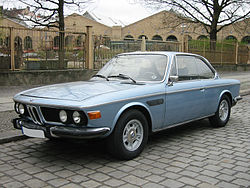
The BMW E9 is a range of coupés produced by German automaker BMW from 1968 to 1975. Initially released as the 2800 CS model, the E9 was based on the BMW 2000 C / 2000 CS four-cylinder coupés, which were enlarged to fit the BMW M30 six-cylinder engine. The E9’s bodywork was built by Karmann.
As a racing car, the E9 was very successful in the European Touring Car Championship and the Deutsche Rennsport Meisterschaft, especially the 3.0 CSL homologation model.
The E9 range was replaced by the E24 6 Series.
The E9's predecessors are the 2000 C and 2000 CS models, which were produced from 1965 to 1969 as part of the BMW New Class range.
The first of the E9 coupés, the 2800 CS, replaced the 2000 C and 2000 CS in 1968. The lead designer was Wilhelm Hofmeister. The wheelbase and length were increased to allow the engine bay to be long enough to accommodate the new straight-six engine code-named M30, and the front of the car was restyled to resemble the E3 sedan. The rear axle, however, remained the same as that used in the lesser "Neue Klasse" models and the rear brakes were initially drums - meaning that the 2800 saloon was a better performing car, as it was also lighter. The CS' advantages were thus strictly visual to begin with. The 2800 CS used the 2,788 cc (170.1 cu in) version of the engine used in the E3 sedans. The engine produced 125 kW (168 hp) at 6000 rpm.
Not only was the 2800 CS lighter than the preceding 2000 CS, it also had a smaller frontal area, further increasing the performance advantage. The curb weight of the 2800 CS is 1,420 kg (3,131 lb).[citation needed]
At the 1969 Geneva Motor Show, BMW unveiled the "2800 Bertone Spicup" concept car. This model, which has a similar appearance to the 1967 Alfa Romeo Montreal, did not reach production.
The 2800CS was replaced by the 3.0 CS and 3.0 CSi in 1971, which was bored out to give a displacement of 2,986 cc (182.2 cu in). The 3.0 CS has a 9.0:1 compression ratio, twin carburetors and produces 134 kW (180 hp) at 6000 rpm. The 3.0 CSi has a 9.5:1 compression ratio, Bosch D-Jetronic electronic fuel injection, and produces 149 kW (200 hp) at 5500 rpm. Transmission options were a 4-speed manual or a 3-speed automatic.
BMW E9
The BMW E9 is a range of coupés produced by German automaker BMW from 1968 to 1975. Initially released as the 2800 CS model, the E9 was based on the BMW 2000 C / 2000 CS four-cylinder coupés, which were enlarged to fit the BMW M30 six-cylinder engine. The E9’s bodywork was built by Karmann.
As a racing car, the E9 was very successful in the European Touring Car Championship and the Deutsche Rennsport Meisterschaft, especially the 3.0 CSL homologation model.
The E9 range was replaced by the E24 6 Series.
The E9's predecessors are the 2000 C and 2000 CS models, which were produced from 1965 to 1969 as part of the BMW New Class range.
The first of the E9 coupés, the 2800 CS, replaced the 2000 C and 2000 CS in 1968. The lead designer was Wilhelm Hofmeister. The wheelbase and length were increased to allow the engine bay to be long enough to accommodate the new straight-six engine code-named M30, and the front of the car was restyled to resemble the E3 sedan. The rear axle, however, remained the same as that used in the lesser "Neue Klasse" models and the rear brakes were initially drums - meaning that the 2800 saloon was a better performing car, as it was also lighter. The CS' advantages were thus strictly visual to begin with. The 2800 CS used the 2,788 cc (170.1 cu in) version of the engine used in the E3 sedans. The engine produced 125 kW (168 hp) at 6000 rpm.
Not only was the 2800 CS lighter than the preceding 2000 CS, it also had a smaller frontal area, further increasing the performance advantage. The curb weight of the 2800 CS is 1,420 kg (3,131 lb).[citation needed]
At the 1969 Geneva Motor Show, BMW unveiled the "2800 Bertone Spicup" concept car. This model, which has a similar appearance to the 1967 Alfa Romeo Montreal, did not reach production.
The 2800CS was replaced by the 3.0 CS and 3.0 CSi in 1971, which was bored out to give a displacement of 2,986 cc (182.2 cu in). The 3.0 CS has a 9.0:1 compression ratio, twin carburetors and produces 134 kW (180 hp) at 6000 rpm. The 3.0 CSi has a 9.5:1 compression ratio, Bosch D-Jetronic electronic fuel injection, and produces 149 kW (200 hp) at 5500 rpm. Transmission options were a 4-speed manual or a 3-speed automatic.
Recent media
Recent media