



Community hub
Recent from talks
Contribute something to knowledge base
Content stats: 0 posts, 0 articles, 1 media, 0 notes
Members stats: 0 subscribers, 0 contributors, 0 moderators, 0 supporters
Subscribers
Supporters
Contributors
Moderators
Hub AI
BRM Type 15 AI simulator
(@BRM Type 15_simulator)
Hub AI
BRM Type 15 AI simulator
(@BRM Type 15_simulator)
BRM Type 15
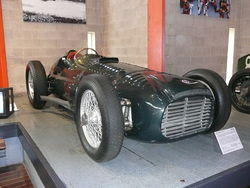
The BRM Type 15 was a Formula One racing car of the early 1950s, and the first car produced by British Racing Motors. The car was fitted with a revolutionary and highly complex supercharged 1.5-litre British Racing Motors V16 which produced considerably more power than any of its contemporaries.
The distinctive noise of the car made it a favourite with crowds wherever it appeared, but the initial unreliability of the car, its inability to live up to the hype that the project's leading figures had created around it, and the change to Formula Two regulations in 1952 meant the project never achieved the hoped-for level of success on the Grand Prix stage; the car's complexities meant it had a longer development time than its competitors and was not properly competitive until 1953 (3 years after it first raced), where it saw success at non-championship events.
After the end of the Second World War motor racing slowly returned, based on whatever machinery could be found, largely consisting of the pre-war Voiturette cars conforming to a formula of supercharged 1.5-litre engines. One of the more successful voiturette constructors of the late 1930s had been English Racing Automobiles, founded by Raymond Mays and others. Mays was a very patriotic British driver with an enviable reputation, but despite considerable success in lesser races he had been given little opportunity to race in Grands Prix, since there were very few significant British attempts to build suitable cars to challenge the dominant Italian and later German cars. In early 1939, ERA's wealthy backer Humphrey Cook withdrew his funding, and Mays along with talented and imaginative ERA engineer Peter Berthon founded Automobile Developments Ltd, a project to build a fully-fledged British Grand Prix car along the lines of Mercedes-Benz and Auto Union. Throughout the war, the idea gestated in the two men's minds, with Berthon latching on to the idea of a supercharged 135° V16 engine as had been proposed to power the British Union Grand Prix car. With the end of the war in sight, Mays began to look for backers within British industry for his project.
Designers Berthon and Eric Richter were expecting 500 bhp and at least 12,000rpm from their new British Racing Motors V16 engine, which was a 1.5-litre 135° V16 designed to meet the 1947 "Formula A" or "Formula 1" regulations that would go on to become the formula for the Drivers' World Championship in 1950. A V8 configuration had also been considered but it has been suggested that the V16 was chosen in part to bolster the car's image when approaching potential sponsors.
After Germany fell, Mays had access to several of the Mercedes and Auto Union designs, as well as other relevant German wartime technology. This showed in the design of the chassis, with Auto Union derived trailing arm suspension at the front and Mercedes inspired de Dion radius arms at the rear. This arrangement did little for the car's road-holding, although few cars of the period handled particularly well. However the car used Lockheed oleo-pneumatic struts in place of the conventional coil spring and damper units, it being thought at the time that this aviation-derived system would become a common road car arrangement.
Another significant departure from previous designs was the use of twin centrifugal rather than Roots-type superchargers, developed by Rolls-Royce based on the units used on later versions of the Merlin aero engine. This was to prove one of the car's main shortcomings. While it allowed for tremendous power at high revs, the engine produced significantly less power lower down the rev range. This meant drivers were constantly struggling to keep the revs within a very small power band.
The chassis itself was not particularly advanced, essentially a ladder chassis with pairs of tubes running down either flank of the car each linked with welded sheet metal, with cross members running across the car between the two. Much attention was paid to keeping the centre of gravity low, and the Type 15 has a significantly lower profile compared with other Formula One cars of the time. Steering was by recirculating ball and nut, and continued to be so despite calls from Stirling Moss in particular to switch to a rack and pinion system to increase responsiveness. Initially the car had drum brakes developed by Girling with three shoes per corner, but in late 1951 the team began to fit disc brakes, a first for a Formula One car.
Mays set about persuading British engineering businesses of the merits of being associated with the project. His main thrust was that it was a matter of British prestige for the country to finally build a World-beating Grand Prix car. With the country still awash with post-war patriotism more than three hundred companies including Lucas, Girling, Rolls-Royce, Vandervell, Rubery Owen, David Brown and Standard Motors enthusiastically backed the project either with cash or help in kind in the form of parts, staff secondments, access to testing equipment and technical information. On 25 April 1947 the British Motor Racing Research Trust was formed with the engine already under development.
BRM Type 15
The BRM Type 15 was a Formula One racing car of the early 1950s, and the first car produced by British Racing Motors. The car was fitted with a revolutionary and highly complex supercharged 1.5-litre British Racing Motors V16 which produced considerably more power than any of its contemporaries.
The distinctive noise of the car made it a favourite with crowds wherever it appeared, but the initial unreliability of the car, its inability to live up to the hype that the project's leading figures had created around it, and the change to Formula Two regulations in 1952 meant the project never achieved the hoped-for level of success on the Grand Prix stage; the car's complexities meant it had a longer development time than its competitors and was not properly competitive until 1953 (3 years after it first raced), where it saw success at non-championship events.
After the end of the Second World War motor racing slowly returned, based on whatever machinery could be found, largely consisting of the pre-war Voiturette cars conforming to a formula of supercharged 1.5-litre engines. One of the more successful voiturette constructors of the late 1930s had been English Racing Automobiles, founded by Raymond Mays and others. Mays was a very patriotic British driver with an enviable reputation, but despite considerable success in lesser races he had been given little opportunity to race in Grands Prix, since there were very few significant British attempts to build suitable cars to challenge the dominant Italian and later German cars. In early 1939, ERA's wealthy backer Humphrey Cook withdrew his funding, and Mays along with talented and imaginative ERA engineer Peter Berthon founded Automobile Developments Ltd, a project to build a fully-fledged British Grand Prix car along the lines of Mercedes-Benz and Auto Union. Throughout the war, the idea gestated in the two men's minds, with Berthon latching on to the idea of a supercharged 135° V16 engine as had been proposed to power the British Union Grand Prix car. With the end of the war in sight, Mays began to look for backers within British industry for his project.
Designers Berthon and Eric Richter were expecting 500 bhp and at least 12,000rpm from their new British Racing Motors V16 engine, which was a 1.5-litre 135° V16 designed to meet the 1947 "Formula A" or "Formula 1" regulations that would go on to become the formula for the Drivers' World Championship in 1950. A V8 configuration had also been considered but it has been suggested that the V16 was chosen in part to bolster the car's image when approaching potential sponsors.
After Germany fell, Mays had access to several of the Mercedes and Auto Union designs, as well as other relevant German wartime technology. This showed in the design of the chassis, with Auto Union derived trailing arm suspension at the front and Mercedes inspired de Dion radius arms at the rear. This arrangement did little for the car's road-holding, although few cars of the period handled particularly well. However the car used Lockheed oleo-pneumatic struts in place of the conventional coil spring and damper units, it being thought at the time that this aviation-derived system would become a common road car arrangement.
Another significant departure from previous designs was the use of twin centrifugal rather than Roots-type superchargers, developed by Rolls-Royce based on the units used on later versions of the Merlin aero engine. This was to prove one of the car's main shortcomings. While it allowed for tremendous power at high revs, the engine produced significantly less power lower down the rev range. This meant drivers were constantly struggling to keep the revs within a very small power band.
The chassis itself was not particularly advanced, essentially a ladder chassis with pairs of tubes running down either flank of the car each linked with welded sheet metal, with cross members running across the car between the two. Much attention was paid to keeping the centre of gravity low, and the Type 15 has a significantly lower profile compared with other Formula One cars of the time. Steering was by recirculating ball and nut, and continued to be so despite calls from Stirling Moss in particular to switch to a rack and pinion system to increase responsiveness. Initially the car had drum brakes developed by Girling with three shoes per corner, but in late 1951 the team began to fit disc brakes, a first for a Formula One car.
Mays set about persuading British engineering businesses of the merits of being associated with the project. His main thrust was that it was a matter of British prestige for the country to finally build a World-beating Grand Prix car. With the country still awash with post-war patriotism more than three hundred companies including Lucas, Girling, Rolls-Royce, Vandervell, Rubery Owen, David Brown and Standard Motors enthusiastically backed the project either with cash or help in kind in the form of parts, staff secondments, access to testing equipment and technical information. On 25 April 1947 the British Motor Racing Research Trust was formed with the engine already under development.
Recent media
Recent media